

Industrial Cobots vs. Automated Guided Vehicles (AGVs): Better for Assembly Logistics?
- Published
- Source
- jaka.com
In the evolving landscape of modern manufacturing, JAKA is advocating for the adoption of industrial collaborative robots (cobots) over traditional Automated Guided Vehicles (AGVs) for assembly logistics. This shift is driven by the need for greater flexibility and efficiency in material handling, particularly as production demands change.
While AGVs have long been utilized for point-to-point transport along fixed paths, they struggle to adapt to the dynamic requirements of assembly lines, which often necessitate rapid reconfiguration for different product variants. In contrast, a stationary cobot can easily manage hand-offs between multiple workstations and human operators, allowing for quicker reprogramming and less disruption during production adjustments.
Moreover, cobots offer added value by performing tasks such as quality inspections or light assembly during the transport process, transforming logistics nodes into productive checkpoints. This capability not only reduces handling time but also shortens overall cycle times, a benefit that standalone AGVs cannot match.
Additionally, the integration of cobots simplifies factory layouts by eliminating the need for dedicated navigation lanes and charging stations required by AGVs. Operating within existing workspaces, cobots streamline operations and reduce the complexity of managing multiple systems.
Ultimately, while AGVs remain effective for long-distance transport of standardized loads, JAKA's cobots present a compelling alternative for intricate, variable tasks within compact assembly environments, enhancing both logistical efficiency and production value.
Original report
Industrial Cobots vs. Automated Guided Vehicles (AGVs): Better for Assembly Logistics?
jaka.com · JAKAThis briefing is an independently written summary based on publicly available reporting and is provided for industry information and news discovery. The original report and source publication are credited and linked where applicable. RobotToday does not claim ownership of third-party source material.
Rights concerns? Contact [email protected] with the relevant URL and details. We will review the matter and take appropriate action where warranted.
More related news
- 1
- 2
-
3
RobotToday Weekly October 12 – 16, 2026 RobotToday · 1 day ago
- 4
- 5
- 6
- 7
- 8
- 9
- 10
-
11
Global Industrie 2027 – Lyon, Mar 15–18, 2027 RobotToday · 4 days ago
-
12
RoboDEX 2027 – Tokyo, Feb 17–19, 2027 RobotToday · 4 days ago
Related Suppliers

Janome Industrial Equipment Europe GmbH
Germany
German sales subsidiary of Janome Industrial Equipment (Japan), distributing servo presses and desktop/Cartesian robots in Europe since 1984.

Industrial Technology Research Institute (ITRI) 工業技術研究院
Taiwan
Hsinchu County, Taiwan applied-technology research institute founded 1973; over 6,500 staff developing autonomous mobile robots and AI perception systems.
ROS-Industrial
United States
Open-source consortium managed by SwRI extending ROS to industrial manufacturing automation, with global hubs in Americas, Europe, and Asia-Pacific.
Collaborative Robotics
United States
Maker of Proxie, a swerve-drive autonomous mobile manipulator that moves materials alongside people without facility changes.

Massachusetts Technology Collaborative
United States
Massachusetts state agency fostering technology and robotics innovation through funding, partnerships, and the MassRobotics Accelerator.

Azalea Robotics
United States
Berkeley-based YC-backed startup building fully-mobile collaborative robots for autonomous airport baggage handling on ramps and in terminals.
E-COBOT
France
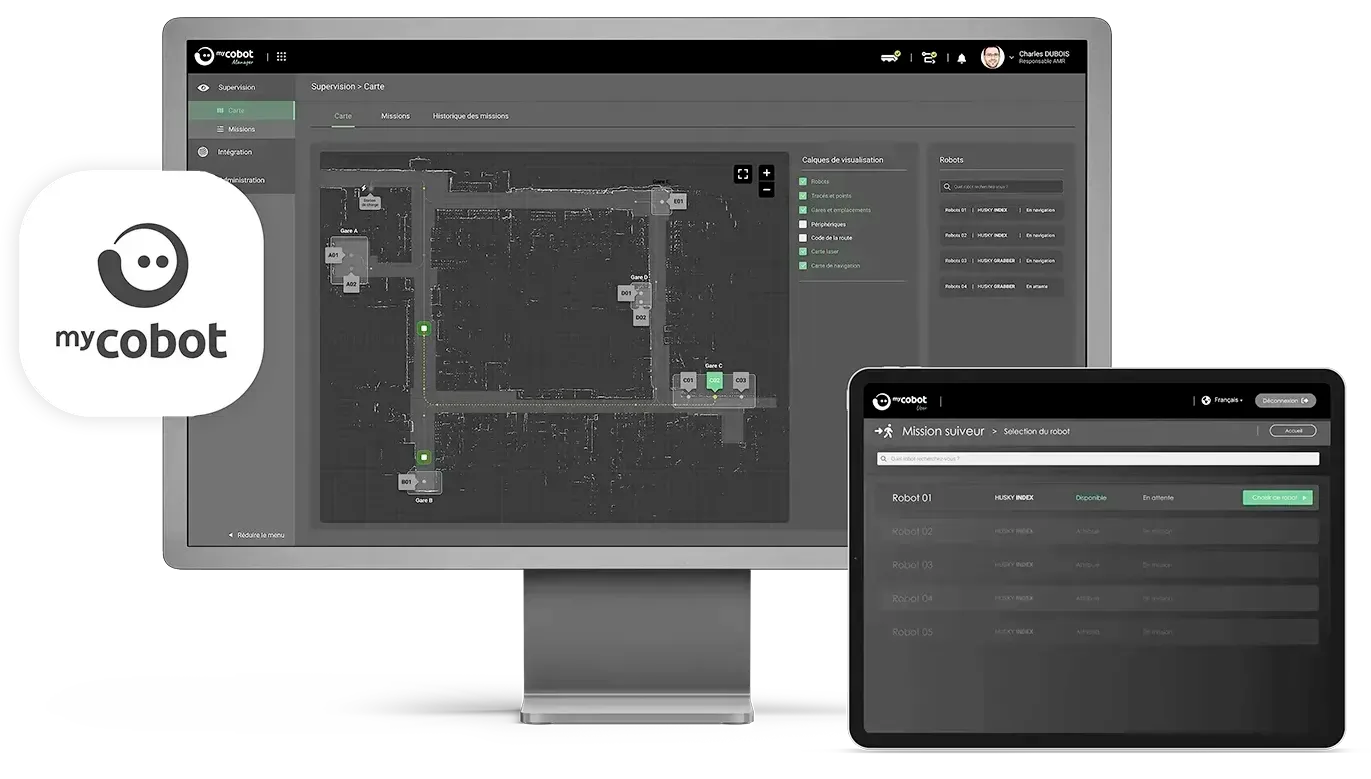
French AMR manufacturer and system integrator offering the HUSKY robot range and MyCobot fleet management software.
EasyMile
France
Toulouse, France autonomous-vehicle software company founded 2014; EZTow and EZDolly systems automate industrial tow tractors and cargo movers at airports.

Filics
Germany
Munich-based robotics startup making ultra-flat omnidirectional AMRs that drive under Euro pallets for space-efficient intralogistics.
The Mobile Robot Company
Denmark
Danish startup founded by ex-MiR and Geekplus veterans, won a 2026 IFOY AWARD for its J1600 self-driving pallet jack.

AMR Integration
United States
Kaysville, Utah AMR systems integrator and arm of In-Position Technologies (operating since 1997); deploys MiR, AGILOX and Gausium mobile robots.

EA Mobile Robotics
Sweden
Mobile-robot unit of Swedish integrator Elektroautomatik; TC-series AGVs from 1,000 to 6,000 kg, built in Skovde and running since 1986
Robotics needs a service framework.
RSF defines a common language for robot service capability, lifecycle operations, certification pathways, and service-provider networks.
Join the RobotToday community on LinkedIn
Daily robotics news, in-depth analysis, conference highlights, and discussions with professionals worldwide.


