


A Pittsburgh startup built on years of Carnegie Mellon and DARPA research is developing a wearable headset that stimulates the brain to ease chronic pain. RobotToday spoke with co-founder and CEO Vishal Jain about the technology, early patient results, FDA plans and a second use he revealed near the end of our talk.
RobotToday | Interview during StartUP PGH 2026, Pittsburgh (Sept 14–18, 2026) | Interviewee: Vishal Jain, PhD, Co-founder and CEO, Synapse Symphony Inc.
Key takeaways
Synapse Symphony was incorporated in 2024. Its technology comes from eight to ten years of research, much of it funded by DARPA at Carnegie Mellon.
The headset targets central sensitization, where the brain keeps sending pain signals after the body has healed.
A patented algorithm checks each patient’s muscle response before every session and adjusts the stimulation, so the device can be used at home.
The company has raised about $500,000 in grants and awards, is opening its first investment round and is preparing to approach the FDA.
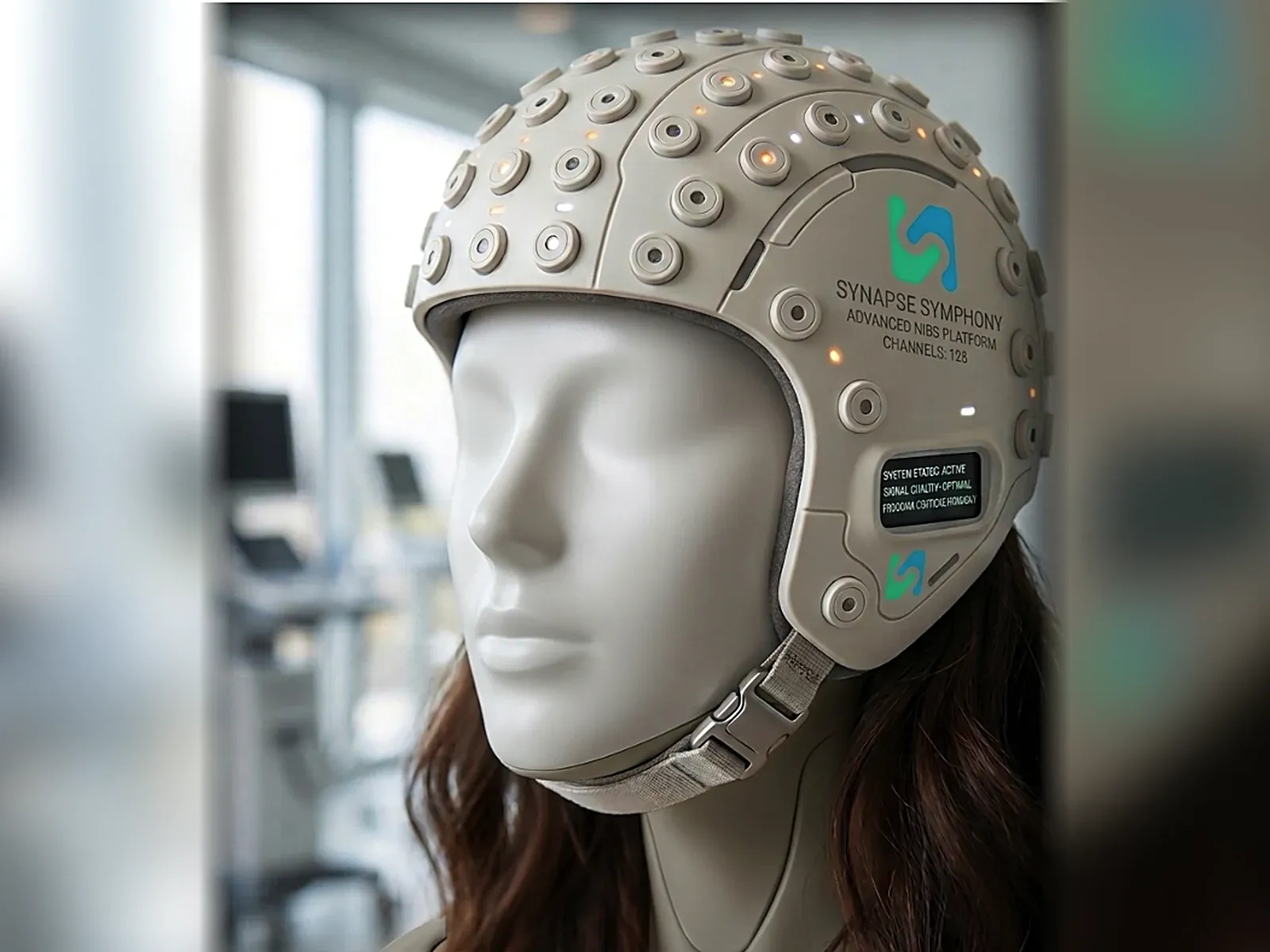
Synapse Symphony at a glance
About one in four U.S. adults lives with chronic pain, according to CDC figures for 2023, and 8.5% have pain that often limits work or daily life. Most are treated with drugs and physical therapy, and some end up in surgery. Jain describes a familiar pattern: doses creep up, opioids become a risk, and the operating room becomes the last option.
Synapse Symphony wants to offer something in between. The Pittsburgh company is building a noninvasive brain-stimulation system that patients use at home. Jain, who is also research scientist at CMU, runs the company. CMU Professor Pulkit Grover is chief science officer, and UPMC pain specialist Dr. Benedict Alter is the clinical advisor and runs the patient studies with the team. The first target is fibromyalgia..
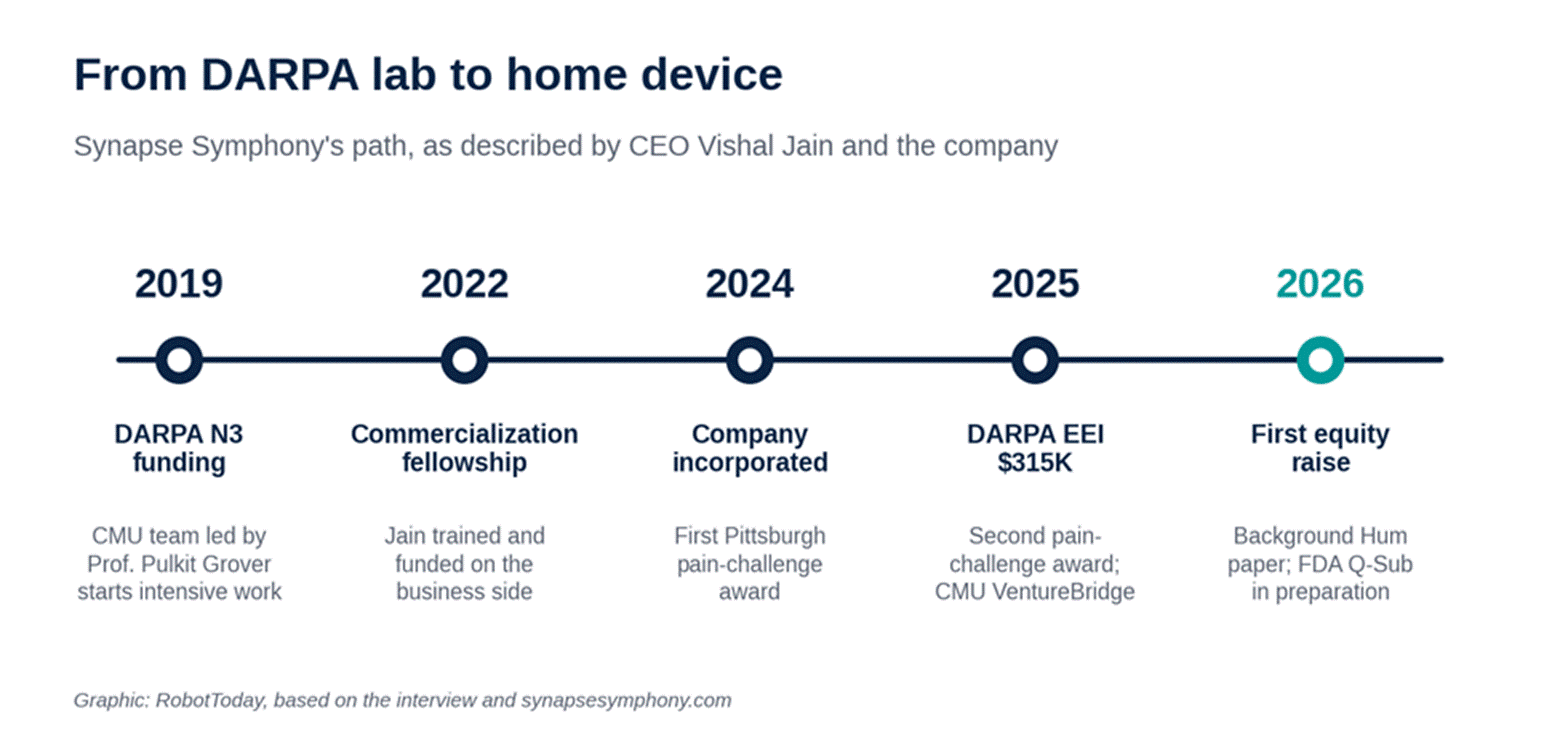
Synapse Symphony’s path from DARPA-funded research to a startup preparing for FDA review.
The interview
1. From a DARPA lab to a startup
Grover had been working on precise, noninvasive brain stimulation for years when DARPA’s N3 program (Next-Generation Nonsurgical Neurotechnology) funded his CMU team in 2019. The award was about $19.5 million for a team that also included the University of Pittsburgh and Battelle. The program ran for five to six years.
Once the technology had been validated, the team looked for a civilian use and settled on chronic pain. Jain took an Innovation Commercialization Fellowship in 2022 to learn the business side, and the company was incorporated in 2024. DARPA backed the move, nominating the team for its Embedded Entrepreneurship Initiative, which provided $315,000 in 2025.
“We are scientists. We are not businesspeople. When we start a startup, we begin becoming businesspeople and developing that mindset.”
— Vishal Jain, PhD, Co-founder and CEO, Synapse Symphony
2. Why target the brain?
Existing noninvasive methods such as tDCS and tACS spread current across a wide area. Jain says they “can prime the brain” but may not produce the direct brain response the team is after. Synapse Symphony uses high-density, pulsed stimulation aimed at specific regions. Magnetic stimulation (TMS) is another option, but it needs bulky equipment and a clinic visit.
The medical basis is central sensitization. During a long recovery from injury, the brain strengthens the connections that carry pain. In some patients those connections stay active after the body has healed, leaving a dull, constant pain. The headset stimulates the brain’s pain centers to calm that activity.
“The brain works through firing and wiring. Even while we are talking now, the brain is creating memories and new connections.”
— Vishal Jain, PhD, Co-founder and CEO, Synapse Symphony
3. The device and a session at home
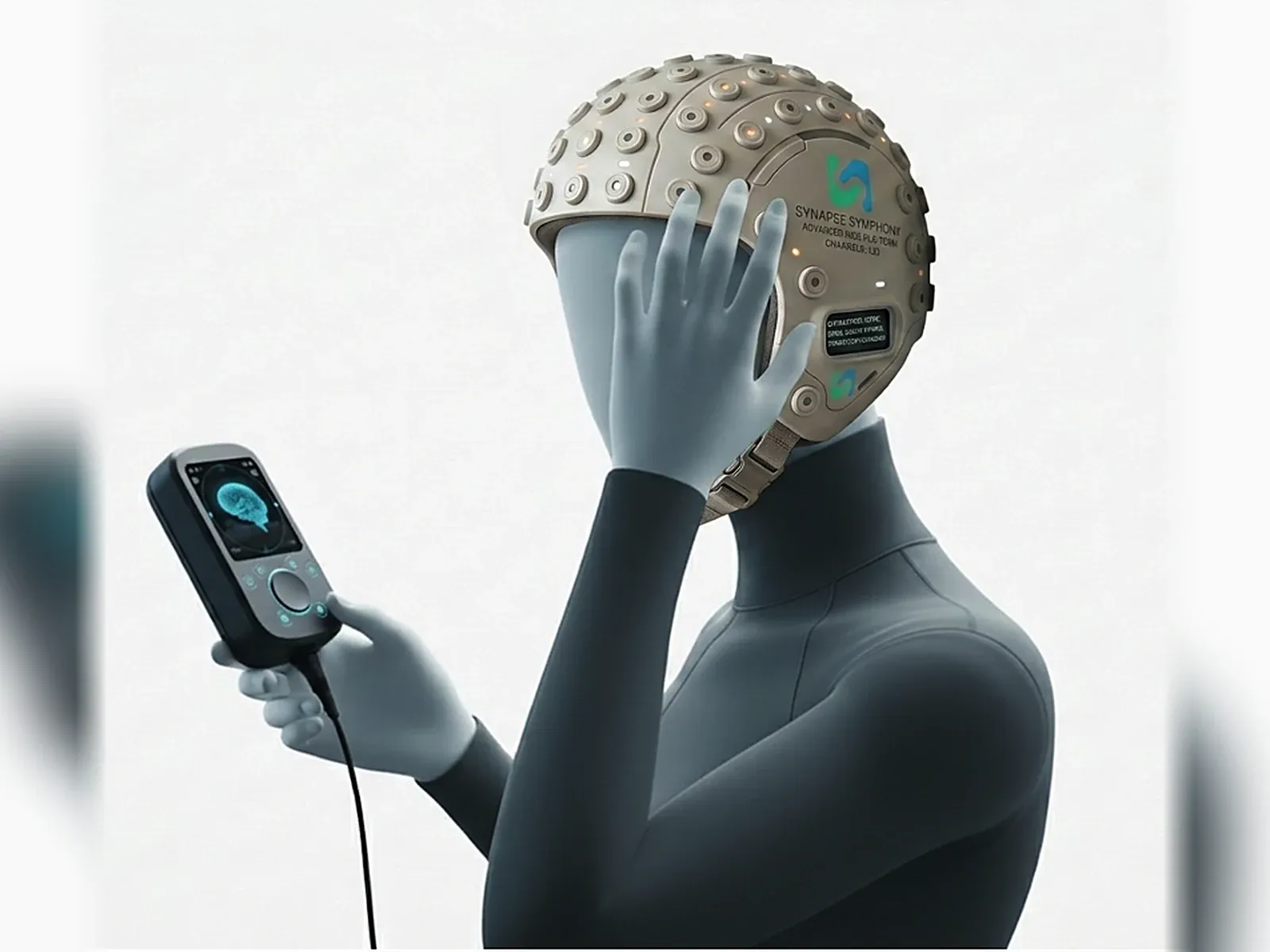
The company builds its own hardware and software. The system has three parts: a cap with high-density electrodes, a stimulator, and software that runs the algorithm. Lab stimulators are stacks of large modules. The current version fits in a box about 8 × 8 inches, and the long-term goal is a phone-controlled cap with a built-in battery.
Many stimulation devices use the same preset settings for everyone. Synapse Symphony adjusts timing, frequency and power for each person, based on the patient’s EMG (muscle) response. Settings also need to change over time, because the brain changes.
“Think about tuning a radio. If you want to hear something better, you might simply turn up the volume. But we are not just increasing the stimulation power for different patients.”
— Vishal Jain, PhD, Co-founder and CEO, Synapse Symphony
A patient visits a clinic once for setup. At home, the system sends a short test pulse before each session and checks the response. If the response has drifted, the algorithm finds new settings, then runs a session of about 30 minutes. The patient only puts on the cap and enters a pain score from 0 to 10. The clinician sees the data remotely, so weekly calibration visits are not needed. Jain’s goal is 24 to 48 hours of relief from each session.
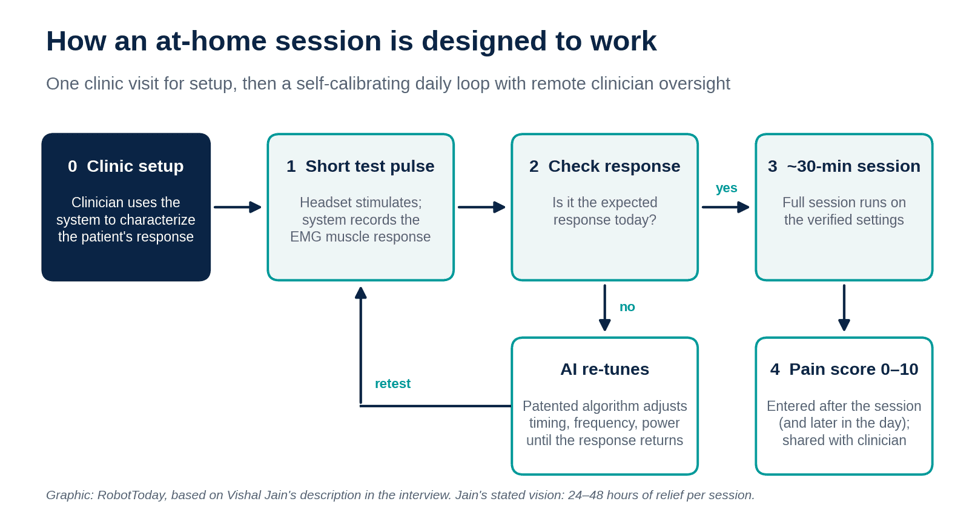
The self-calibrating session loop Jain described.
4. Making stimulation tolerable
Current passing through the scalp can hurt, and that discomfort often stops clinicians from raising the dose, even when a higher level would be safe. The team’s fix is a technique it calls Background Hum: a mild secondary stimulation, delivered with a specific electrode layout, that reduces what the patient feels at the scalp.
The method is described in a paper by Mats Forssell and colleagues, first posted as a preprint in April 2025. In seven healthy volunteers, it cut scalp pain by about 2 points on a 10-point scale. Two fibromyalgia patients stayed below 3/10 over more than 1,000 pulses.
The hardware has also become easier to wear. Early study participants had to shave their heads so a flat electrode patch could touch the scalp. Jain says they agreed without hesitation: “Yes, I can do anything. Just take away my pain.” The current cap uses dry, spike-style electrodes that reach the scalp through hair, with no gel or preparation.
5. Early results
After studies in mice, monkeys and healthy volunteers, the device is now being tested with fibromyalgia patients, and osteoarthritis studies are under way with Dr. Alter at UPMC. Jain calls the early results “very encouraging.” His first patient used to spend half an hour in bed each morning rubbing her legs before she could stand. After several sessions, she got up right away and walked downstairs without pain. Jain recalled her words:
“This is the first time I have walked like a normal person, without pain, and gotten out of bed immediately.”
— First study participant, as recounted by Vishal Jain
The team does not promise participants a cure, to avoid biasing the results. “We tell them honestly: it may work, or it may not,” Jain said. These are individual reports from studies that are still running.
6. Funding, FDA and hospitals
All of the roughly $500,000 raised so far is non-dilutive. Amounts not given in the interview come from the company’s website.
Source | Amount |
|---|---|
DARPA Embedded Entrepreneurship Initiative (2025) | $315,000 |
2024 Magee-Womens Pain Challenge (fibromyalgia) | $75,000 |
2025 Virginia Kaufman Pain Challenge (knee osteoarthritis) | $50,000 |
CMU Swartz Center VentureBridge | $50,000 |
Now the company is opening its first investment round. The money will turn the current MVP into a full prototype for hospitals and pay for regulatory work. Synapse Symphony plans an FDA Q-Submission to learn how the device will be classified. It is aiming for the 510(k) pathway and will use De Novo if required. Allegheny Health Network in Pittsburgh is ready to sign a letter of intent, and Jain is traveling to San Francisco to seek more.
7. A second market: motor health
Near the end of the interview, Jain described another use. After a stroke, clinicians usually judge recovery by watching a patient grip or lift something. Synapse Symphony’s system can instead stimulate the brain’s motor region and measure the muscle response, showing whether the brain-to-muscle pathway is healthy, slow or improving. The same test could help athletes track fatigue. Jain said Samsung has shown interest, and part of the team is already working on it.
“To be honest, we are more confident in the motor-health-monitoring results than in pain treatment, because the pain studies are still ongoing.”
— Vishal Jain, PhD, Co-founder and CEO, Synapse Symphony
8. The team
The core team has about five people: Jain (CEO), Grover (chief science officer), Dr. Alter (clinical advisor) and lead engineer Mats Forssell, who has worked on the hardware from the start, plus business advisers.
RobotToday analysis
Synapse Symphony’s main advantage is the feedback loop. The system measures the body’s response, adjusts, and only then treats. That is what makes unsupervised home use possible, and it gives doctors a measurable signal alongside patients’ own pain scores. Robotics readers will recognize the approach: sensing, feedback and control, applied to the nervous system.
The company is also early, and Jain said so himself. The pain results are still individual reports, the published Background Hum study is small, and FDA review, controlled trials and insurance coverage all lie ahead. The motor-health idea could reach clinics sooner, because a measurement tool may face a lighter regulatory path than a treatment.









Leave a comment