


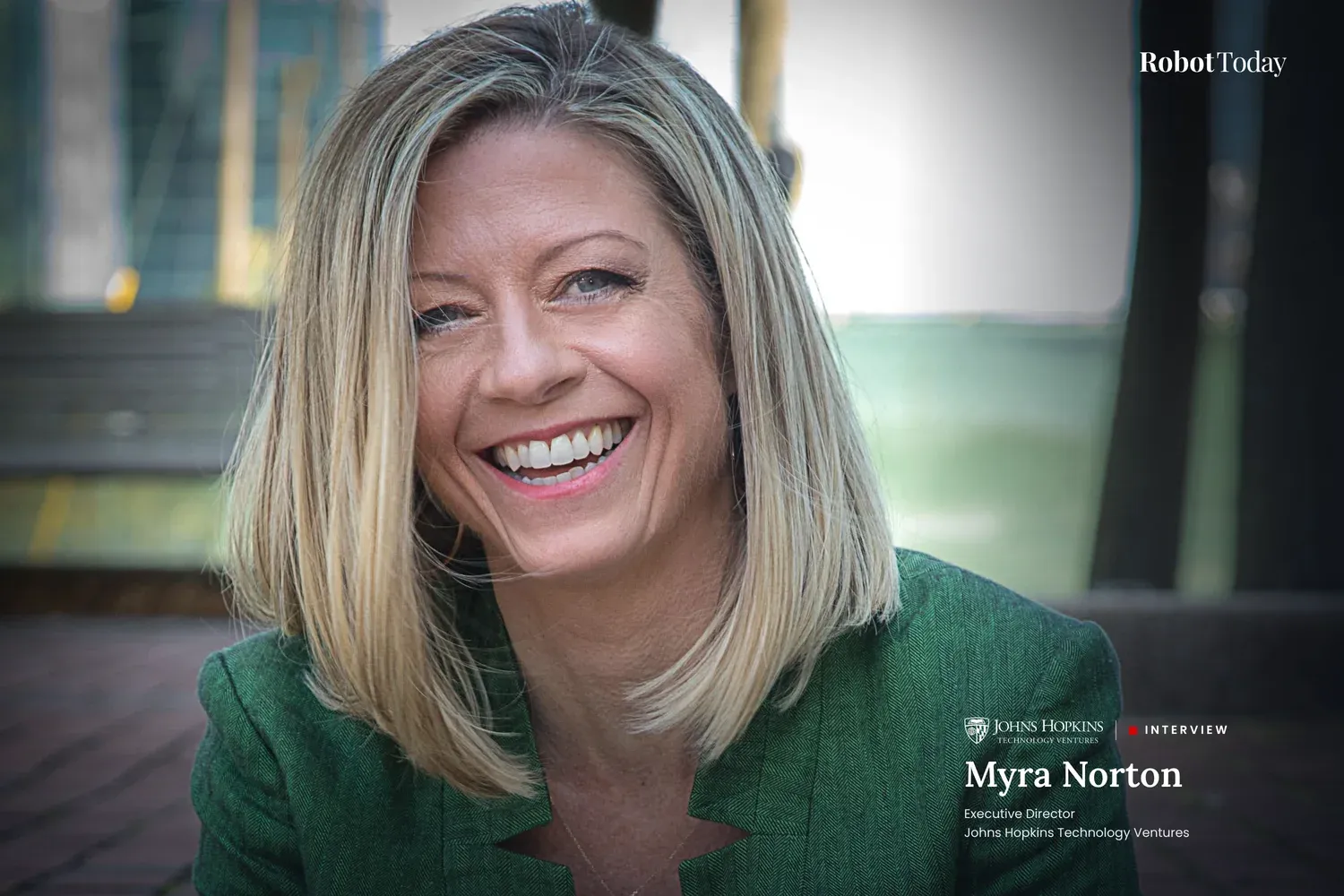
The former CEO, now at Johns Hopkins Technology Ventures, explains how the university picks which inventions to back, where academia and industry still talk past each other, and why investors are starting to look at Baltimore.
Ask Myra Norton what Johns Hopkins Technology Ventures does and she skips the org chart. "We wake up every day thinking about how we get the amazing science and research happening across Johns Hopkins out into the world," she said, "to impact patients and human beings and end users."
JHTV is the university's commercialization office. It takes in invention reports, files patents, licenses technology to existing companies, runs the FastForward incubator and helps faculty and students start companies. In fiscal year 2026 it logged 462 invention reports, 111 new U.S. patents and 17 new startups. Its companies raised $151 million in venture capital that year, and 77% of it stayed in Baltimore.
Norton came to the job from the founder side. She taught math and statistics at Temple, Towson and the U.S. Naval Academy, then spent about twenty years building companies, most recently as president and CEO of Arena Analytics. At JHTV she is executive director. RobotToday spoke with her on Oct. 6.
RobotToday: How would you describe JHTV in your own words?
Norton: We focus on translation and commercialization across the whole university. We serve all ten schools: students, faculty, alumni and community changemakers. We even run a Social Innovation Lab that you don't need a Hopkins affiliation to join, for people launching social impact businesses in Baltimore and beyond.
A big part of our focus is Baltimore. We talk about being anchored here with an eye toward the world. We get technologies out by spinning out startups, supporting entrepreneurs, licensing to existing companies and partnering with industry. And we're always working with partners across the state to build the Baltimore innovation ecosystem.
RobotToday: At what point does JHTV get involved with an idea, and how far do you go with it?
Norton: We start very early, from the moment a faculty member reports an invention and says, "I think I may have discovered something." We sit down with them and ask what the potential is and how it could turn into real-world impact.
Phase one is choosing the translational path. Does this need a startup? Should we partner with an existing company? Is it a public good, something to do with a foundation? Then we have teams to support each of those routes. If it's a license, one team looks for the right companies. If it's a startup, we help with company formation, and we have partners for legal and accounting. We help with investor connections, the right capital stack, and team building.
Often we have brilliant scientists who don't want to run a company day to day. They need a business lead or a CEO, a partner to build the company with. We help make those matches, and we stay with them through the seed round, the Series A and on.
RobotToday: How do you tell an invention with a commercial future from research that's good science but not a business?
Norton: It's a team effort. First, how novel is the science? We talk with key opinion leaders in the field to find out. More important, we go to industry. We ask investors and potential partners, the eventual customers of the technology, what their appetite is. Would an investor put money in if it were developed in a certain direction? Is a company actually trying to solve this problem?
We also run the Commercialization Academy. PhD students work as analysts and do landscape analysis: where does this idea sit, what competes with it. Once we have that outside validation, we know we have something investable and which direction to push.
For the many ideas that are too early, or where there's no commercial appetite, we give the inventor clear feedback straight from industry. Often what they hear is, "What you've done isn't that interesting to us, but if you could do X, that would be." So a lot of our work is helping people pivot, and doing it fast. We want to shorten the time between doing the work and realizing you need to change direction.
RobotToday: What's the real gap between academia and business?
Norton: Three things. The first is language. The two sides speak differently, so we help scientists look at their work the way investors and industry do. That comes from exposure: customer discovery, learning how an investor values a technology.
The second is capital. Academic ideas are very early and need a lot of de-risking before they're a company. We run translational funds that give researchers non-dilutive money to build the data package an investor needs to see. That gap is an ecosystem problem, not only ours.
The third is talent. We have world-class scientists, and we try to match them with business people of the same caliber, people who have built a company in that field. Academics tend to think about this later than they should. In biotech that person is asking about the regulatory path and who will pay for the product. In medical devices it's the manufacturing strategy. The scientist wakes up thinking about the next scientific milestone. At some point you need someone who wakes up thinking about the business.
RobotToday: At IROS in Pittsburgh I met tenured professors with mature technology and their own labs who said they simply don't know whom to call in industry. Do you see that at Hopkins?
Norton: That's very true. One of our teams, corporate partnerships, works on exactly that: connecting research coming out of academia with large companies that care about it. There's a translation layer. You have to know who the right people are, and that's part of what I mean by talent. Business talent comes with a network, the people you call to build a commercial relationship between what a lab is doing and what a company is willing to fund or license.
RobotToday: Does Baltimore, and Maryland more broadly, have the ecosystem to support that?
Norton: We're building it. What we have that many places don't is location. We have strong anchor institutions, Hopkins and the University of Maryland among them. We have federal labs and agencies right here, the regulators for many industries and the government as a customer. And we have sectors where we're reaching real critical mass: life sciences and biotech, quantum and AI, cybersecurity.
But let's be honest. Like Pittsburgh, we're an emerging ecosystem. When I started my first company there was no real entrepreneurial support or customer access here. Today it's much stronger. The Greater Baltimore Committee and other groups are working to bring in large companies that could be customers for startups. Techstars runs its AI Health accelerator here, with companies coming from all over the world and the major health systems and payers around them. There's Blackbird Labs too. We've been putting these pieces in place over the last decade, and you can see the momentum building.
RobotToday: What about hardware? Can a startup prototype and then find a supply chain locally?
Norton: That's also emerging. We have a handful of companies that do initial prototyping and design, and we're building critical mass in advanced manufacturing for scale-up. Baltimore's history is in manufacturing, the old-school kind, and we see a chance to build on that through biomanufacturing and advanced manufacturing.
RobotToday: Venture capital tends to favor the coasts. How do investors see Baltimore?
Norton: We're having success. One of our startups, which we supported from a very early idea through several pivots, launched in the past year and raised its seed round led by General Catalyst, with Bison Ventures following. Both are investing in a company that's building here in Baltimore. We also host innovation days where we bring curated groups of investors in to see what's coming out of Hopkins. So we're making progress.
RobotToday: You started in academia, spent two decades as a founder and CEO, and now work inside a university again. What brought you here?
Norton: I thought academia would be my whole career. Then I was at Temple University when 9/11 happened, and the next week I woke up and knew I needed to do something different. That started twenty years of starting and building companies.
When Hopkins asked me to come to JHTV, I wasn't sure I could go back into an academic setting after so long in startup land. Then I met the students, faculty, alumni and entrepreneurs here. I'm here because of them. I want more innovation getting out into the world, and I want to support the people trying to make that happen.
What I know from being an entrepreneur is that it's lonely. It's lonely and it's hard, harder than anyone will admit.
These are brave people choosing to do something no one has done before, and they need a community around them. I want every entrepreneur and innovator in Baltimore and Maryland to know they have a support system here, a home that will help them realize their vision for a better world.
RobotToday: What will JHTV focus on over the next year or two?
Norton: We're seeing a real increase in inventions related to AI and with quantitative underpinnings. Hopkins has historically been anchored in biotech, and we'll stay strong there. But AI and quantitative work is rising fast. The university launched its Data Science and AI Institute a couple of years ago and is hiring more than 100 faculty, with probably 700 or more graduate students to follow. I expect we'll spend a lot of time with innovators building in that space. It moves quickly, so it will keep us on our toes.
This interview has been edited for length and clarity.
Baltimore's medtech story
Since 2014, startups from Johns Hopkins Technology Ventures have raised $4.8 billion in venture capital. Four companies show what that looks like on the medical-device side.
LIV Medical Technologies builds OCT-guided tools for eye microsurgery. It pairs optical coherence tomography imaging with a precision microinjector, so surgeons can see transparent retinal tissue in real time and control injection depth to the micron. The target is delicate work such as subretinal injections for retinal disease and gene therapy. JHTV patented the technology and helped form the company through FastForward.
IMERSE Surgical Robotics is a JHTV startup co-founded by Axel Krieger, a robotics professor at the Johns Hopkins Whiting School of Engineering. It builds robotic systems for minimally invasive surgery, combining robotic instruments with visualization and navigation to give surgeons more precision and control in complex procedures.
Somnair is developing a fully non-invasive neurostimulation therapy for obstructive sleep apnea. It is still in pre-clinical development, but it has won the ASU Innovation Open, placed second at the Rice Business Plan Competition and was a finalist at SXSW Pitch 2025.
Kubanda Cryotherapy was founded in 2016 by Hopkins engineering undergraduates Bailey Surtees and Clarisse Hu. Its system destroys tumors in pets with extreme cold. A veterinarian inserts a thin cryoprobe into the tumor, and rapid freezing forms ice crystals inside the cells that kill them. The current CryoDuo system handles both topical and intratumoral treatment with interchangeable probes, so some masses can be treated in a regular vet visit instead of surgery.








Leave a comment