



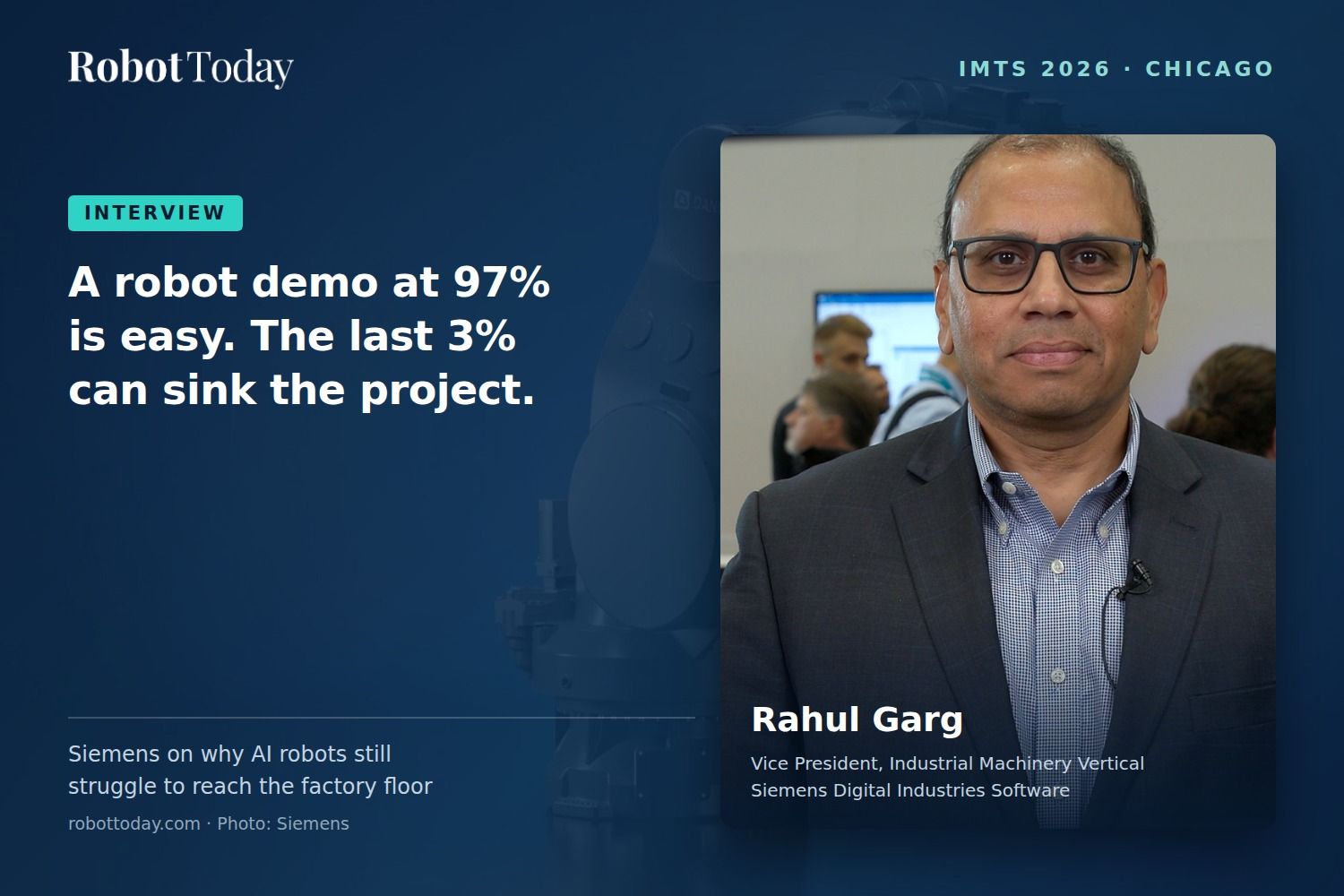
On the IMTS 2026 show floor in Chicago, RobotToday sat down with Rahul Garg, VP Industrial Machinery Vertical at Siemens, to discuss how AI is changing what robots can do, why advanced robots still struggle to enter real factories, and why the company believes its PLM data and business context give it an edge in agentic AI. Siemens’ four IMTS launches point the same way. In the company’s view, getting a robot through a demo is the easy part; the time goes into making it work inside a real factory.
Interview at IMTS 2026, McCormick Place, Chicago (Sept 14–19, 2026) | Interviewee: Rahul Garg: Vice President of Industrial Machinery at Siemens Digital Industries Software
Key takeaways
|
Siemens at IMTS 2026
IMTS, the International Manufacturing Technology Show, is the world’s second-largest machine tool show and, according to Siemens, the single largest marketing event for its Machine Tool Systems business, with more than 90,000 industry professionals and roughly 1,750 exhibitors represented over six days at McCormick Place in Chicago.
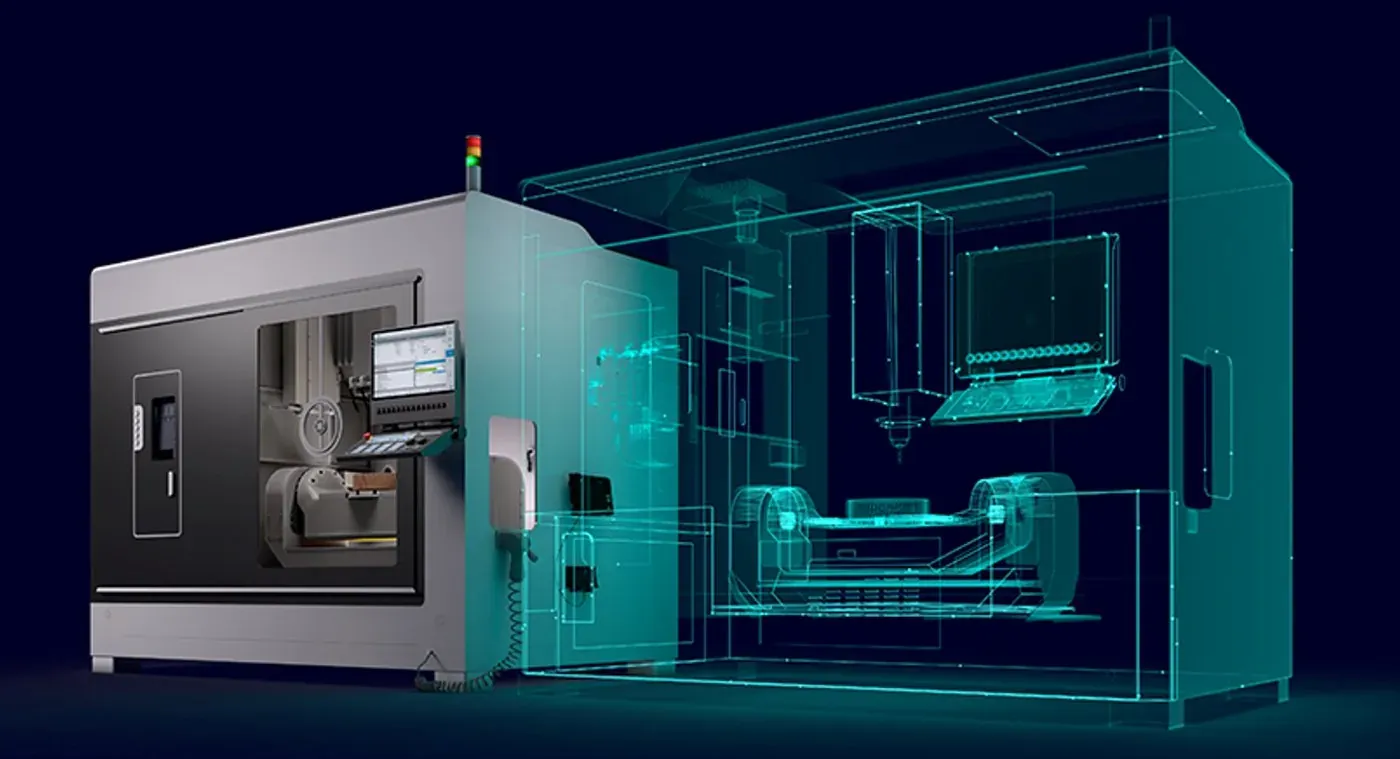
Under the theme “Shape the future of your shopfloor. Now.”, Siemens organized its presence around a single aerospace part: a jet engine scavenge pump component traced from product definition in NX and collaboration in Teamcenter X, through process planning, digital validation, additive manufacturing and subtractive CNC machining, to shopfloor optimization with Industrial AI. Each exhibit was tied to one of four lifecycle stages (Design, Validate, Produce, Improve), which together make up what Siemens calls the digital thread.
Most of the points Rahul Garg raised in our interview, from integration to data context to the “last 3%,” line up with something Siemens was showing on the floor.
The interview
1. How is AI changing the robotics industry?
Robotics has long been an important business for Siemens. The company has worked in the field for decades, originally helping customers program robots to perform specific, relatively simple tasks. Those capabilities are now being combined with a new generation of AI.
Where industrial robots once executed static, fixed programs, they are increasingly able to observe their surroundings, understand what is happening and act on real-time conditions. That widens the range of tasks robots can take on and is driving a new generation of advanced robots.
But Siemens described much of what advanced-robotics companies show today as the tip of the iceberg. Some newer companies have paired AI and robotics with specific industry use cases in impressive ways. Getting those robots into factories at scale takes a much larger body of work that stays out of sight, which Siemens calls industrialization.
“Getting a robot demo to 97% may not be that hard. But the last 3% often consumes most of the project’s time.” — Rahul Garg |
2. Why does industrial robot deployment take so long?
Siemens said this matches what it hears from customers. In real production, a company cannot simply drop a new robot into the factory and let it start working. The robot has to become part of the production flow. It takes parts or information from upstream, does its share of the job and passes the result on. Before deployment, integrators need answers to questions like these:
What input does the robot receive from the previous process?
Which part of the task does it need to understand and complete?
How does it hand off the workpiece or information to the next step?
Can it fit the customer’s existing equipment, software and production environment?
Industrial customers are very interested in advanced and AI-enabled robots, but many are waiting for more mature capabilities and more proven use cases. Before committing, they must be confident that a robot meets their requirements for safety, cybersecurity and data security, reliability and return on investment.
3. How does Siemens bring AI into industrial products and customer processes?
Siemens sees the breadth of its industrial hardware and software portfolio as a core advantage. For AI to be useful, it said, data from a single department is not enough.
Take a buyer in procurement. Purchasing data matters, but if the system can also see supply chain, production capacity, inventory and component quality, that buyer can make faster and better decisions. Because Siemens systems span many parts of the enterprise, AI can both raise individual productivity and pull together cross-functional data so each role works with fuller business context. That takes two things: enough data, and the business context behind it.
“Industrial AI doesn’t just need to know what information exists. It has to understand what each piece means and how it relates to the business process.” — Rahul Garg |
4. Where does the data to train and run industrial AI come from?
Siemens has provided product lifecycle management (PLM) technology for many years, and customers have long used its systems to store and manage product information. As a result, large volumes of industrial data already reside in Siemens PLM environments, and that data is structured. Siemens is now working to unlock it so AI agents can access it more easily and support agentic workflows. The data includes:
Product and engineering information
Dates, versions and configuration variants
Release and approval records
User activity: who did what, and when
When information was released and how it was subsequently used
5. Is agentic AI still far from mature?
Siemens’ view is that the main question today may not be whether agentic AI is capable, but whether enterprises are ready to adopt it. Using it well takes three things together: the AI technology, the data, and the business context behind the data. When those are in place, AI delivers real value in industrial settings, and Siemens says it already sees some customers combining all three and gaining clear benefits.
6. What does agentic AI look like on the ground?
Rahul Garg used customer inquiries and RFP/RFQ responses as an example. When a request arrives, an AI agent needs to know how the company has answered similar customers before, what production capabilities it has now, the schedules and utilization of each line, and the delivery date the customer wants.
Illustrative scenario: an RFQ with a 7-day deadline The agent flags that the original plan won’t work and proposes one that will. Information that used to take manual queries across several departments comes together in a single decision.
|
7. Is there clear ROI yet?
Siemens said it does not yet see a large body of ROI data expressed in dollars, but it is seeing very significant time savings. Some work that used to take 8 hours now takes about 30 minutes; certain machining or programming tasks that took 6 hours may now take only 5 minutes. Siemens expects those gains to turn into economic value, with financial returns becoming easier to see as AI use grows.
8. On the floor: from customer request to finished part
After the interview, the Siemens team invited RobotToday to walk an end-to-end demonstration showing how a company receives a customer request, uses AI to analyze it, develops a machining plan and produces the part. Engineering, machining and production ran as one continuous flow.
What Siemens launched at IMTS 2026
Siemens issued four U.S. press releases at IMTS 2026. Each covers part of the integration work the interview focused on.
Interview theme | What Siemens showed at IMTS 2026 | Company-reported figures |
|---|---|---|
Closing the last 3% in robotics | SINUMERIK Machine Tool Robot (MTR), launched in North America. An intelligent control concept gives 6-axis robots machine-tool characteristics; controlled by SINUMERIK ONE, so robots are programmed in the same CNC environment machinists already know. Digital twin in VR at the Siemens booth; live robotic machining at Danobat (Booth 236717). | 200–300% better path accuracy (up to 4×); 20–40% productivity gain |
Fitting into existing workflows | SINUMERIK Run MyRobot /Direct Connect and /Handling integrate robots with CNC machining (live with KUKA, Booth 236807). Meet at the Machine with founding partner TRAK Machine Tools lets manufacturers program, simulate and validate while the machine is still being built. | Meet at the Machine: ramp-up time reduced by up to 50% |
Validate before anything moves | SINUMERIK 828D with Run MyVirtual Machine: digital twin programming for compact and mid-range machines in the U.S. for the first time; new 12.1" and 15.6" panels and energy-consumption analysis. | Setup time on the machine cut by up to 20% |
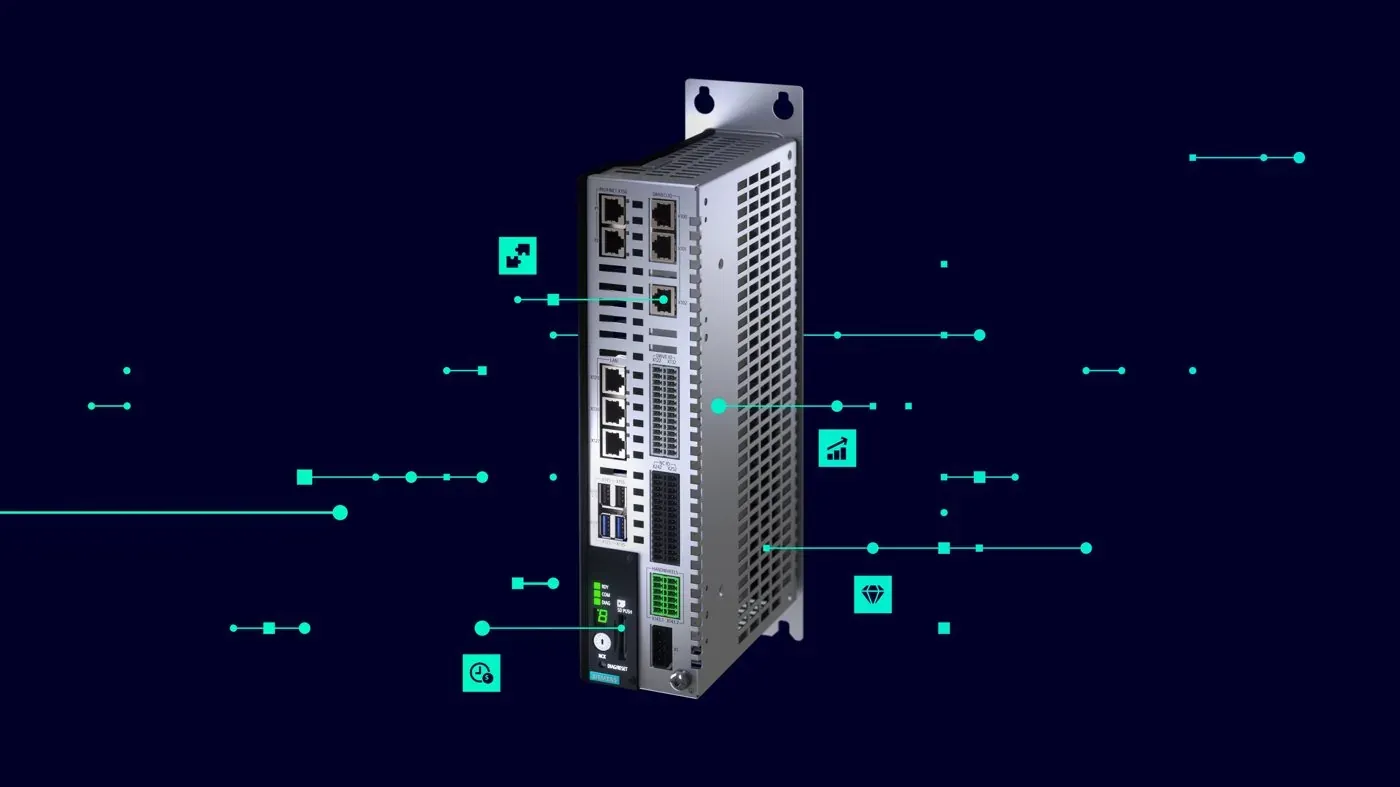
Safety, security and AI readiness | SINUMERIK ONE Generation 2: new NCU 1740.2 / 1750.2 / 1760.2 processors, new PLC ASIC, 64-bit architecture as the foundation for AI; security archive, user management, certificate storage and secure patching aligned with requirements such as the EU Cyber Resilience Act. | — |
Data plus context | NX + Teamcenter X carrying the jet engine pump from design to production; Brownfield Connector bringing existing machines into the data flow; Adaptive Control and Monitoring adjusting parameters to cutting conditions. | — |
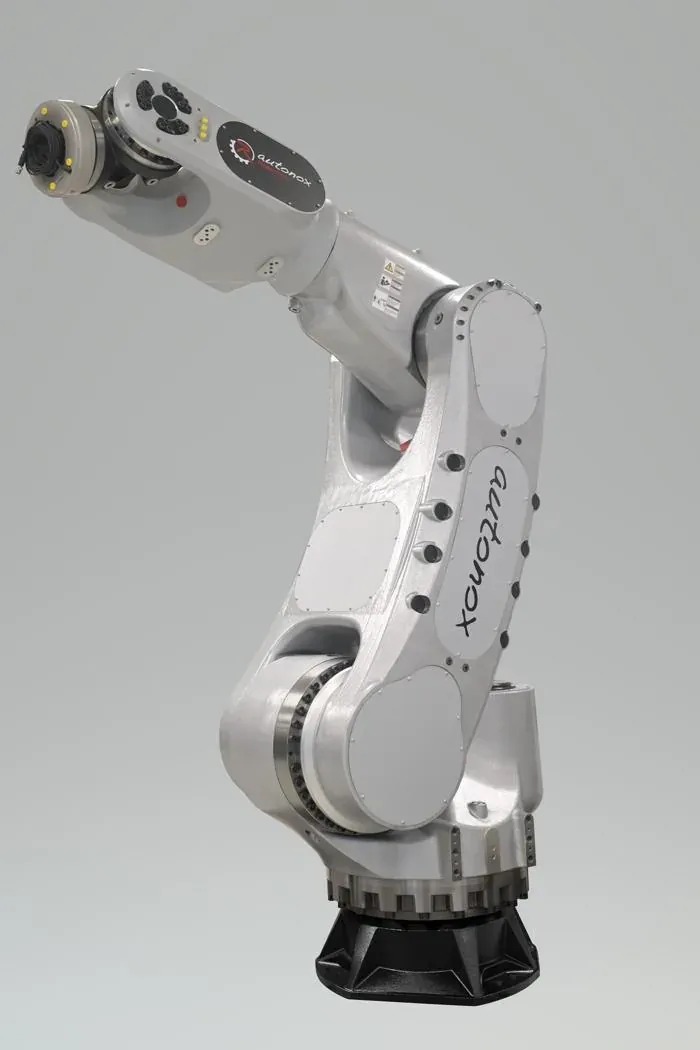
“Manufacturers have always had to choose between the reach of a robot and the accuracy of a machine tool, and the Machine Tool Robot for the U.S. market removes that choice for a large class of parts.” — Zachary Gray, Head of Machine Tool Systems Americas, Siemens (press release) |
“Manufacturing truth has always ultimately been at the machine.” — Mark Hindsbo, Head of Operations Software, Siemens (Meet at the Machine launch, Sept 15) |
RobotToday analysis
An argument that suits an incumbent
Siemens’ case, that the value lies in industrialization rather than the demo, plays to the strengths of a company with a large installed base of controllers and PLM software. The MTR is a good example. AI alone does not turn a robot into a machine tool; an intelligent control concept that counters the arm’s built-in give, higher dynamic rigidity and a programming environment machinists already use do most of that work.
Why Siemens is betting on data context
On agentic AI, Siemens suggests the advantage lies less in the model than in access to structured enterprise data with version histories: release records, configurations and logs of who changed what. Manufacturers already on Teamcenter start with that data in place. Shops running software from several vendors will want to know how open that data layer is.
ROI is still counted in hours
The time savings Siemens cites are large, but they come from the company, apply to specific tasks and have not yet been put in dollar terms, which Siemens acknowledges. Buyers should ask what the baseline was, which tasks were measured and how the saved hours show up in throughput or cost.
What it means for robotics startups
|
Questions we will keep asking
When an AI agent proposes adding a shift, who approves it, and how are permissions, audit trails and accountability handled?
How open is Siemens’ PLM data layer to agents and systems from other vendors?
When will time savings show up as published, dollar-denominated customer ROI?
How does MTR accuracy hold up across materials, payloads and long production runs in customer plants?

Leave a comment