


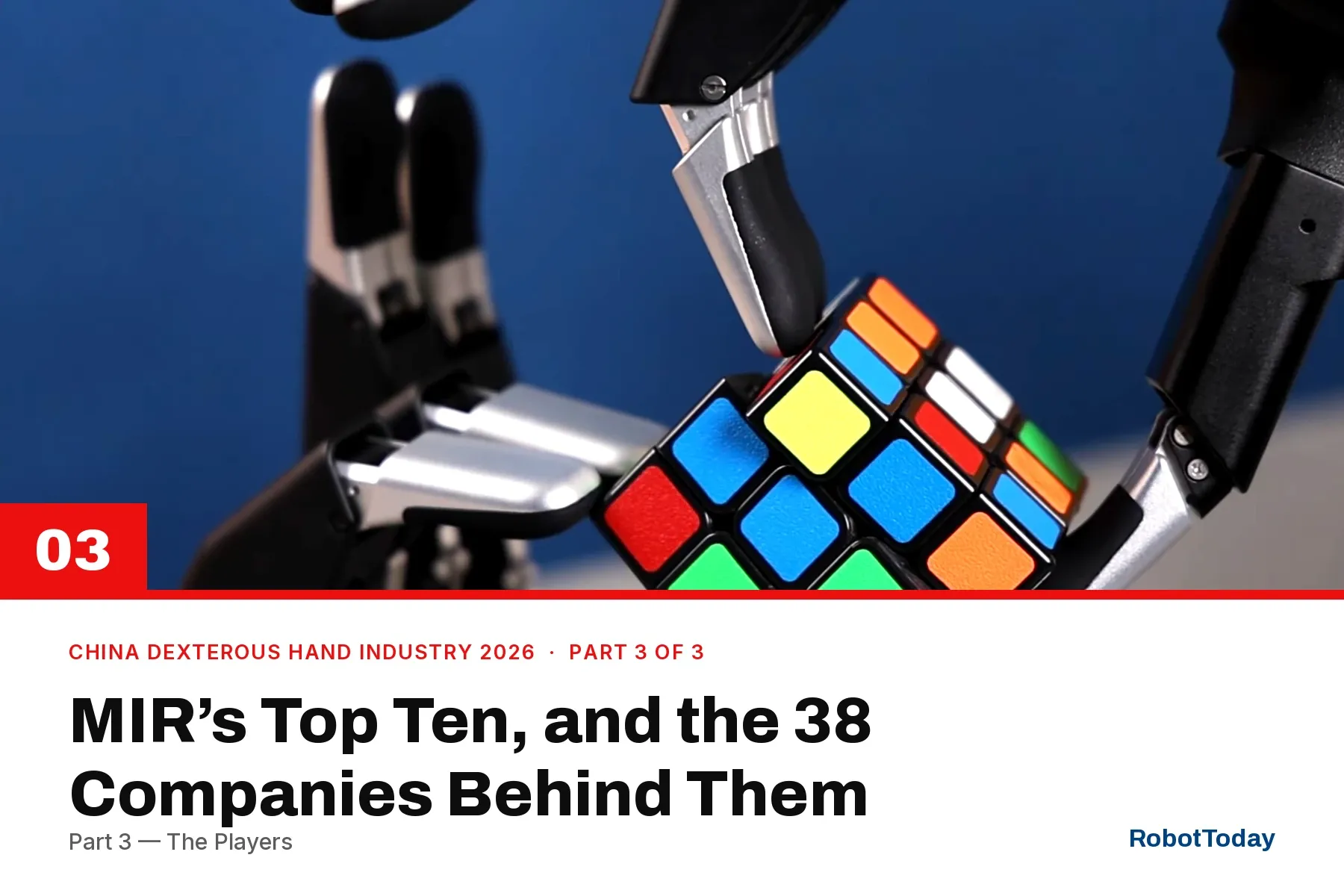
The five kinds of company building dexterous hands in China, MIR’s composite top ten, eight vendor profiles, six field deployments, and every organisation named in the white paper linked to the RobotToday Supplier Directory.
Briefing details |
|
|---|---|
Source document | 2026 China Dexterous Hand Industry White Paper, MIR Industry Research (MIR Databank), 40 pp. |
Series | Part 1 — The Demand Picture · Part 2 — The Technology · Part 3 — The Players |
In this part | Five vendor archetypes · MIR composite vendor ranking · eight vendor profiles · six deployment case files · 38-company index with live supplier-directory links |
Prepared for | RobotToday global readership — OEM strategy, component sourcing, investment and editorial teams |
Note on figures | All quantitative forecasts are MIR Databank estimates as published; RobotToday has not independently verified them. |
1. Vendor Landscape
MIR segments the Chinese supply base by origin story rather than by product, which is the more useful cut: where a company came from predicts its cost structure, its natural customer and its likely weakness.
Archetype | Characteristics | Named vendors |
|---|---|---|
New entrants — hand-native | Dexterous hands are the core business. Strong product generality and standardised supply across industries; driving the shift from research instrument to industrial production unit; fast iteration and broad scene fit. | LinkerBot, Xynova, WUJI, Sharpa, CasiaHand, DexRobot |
Gripper extension | Years of industrial end-effector experience with mature production-line delivery. Strong on rigid grasping and payload control; product fits industrial settings. | DH Robotics, Jodell Robotics, Zhixing Robotics |
Medical rehabilitation derived | Deep experience in biomimetic human end devices, with accumulated capability in fine pressure sensing and lightweight biomimetic structural design. | BrainCo, OYMotion |
Humanoid OEM in-house | Rapid accumulation of embodied interaction data from their own platforms, forming a hardware–data–algorithm loop. Product is tuned first to their own humanoid, so external commercialisation is comparatively limited. | Agibot, Unitree, UBTECH, Robotera, Tesla |
Component extension | In-house development and production of core components gives a clear supply-chain cost advantage and strong low-level hardware iteration, but system integration and advanced intelligent algorithm reserves are comparatively thin. | INSPIRE ROBOTS, Leadshine, ZHAOWEI |
Source: MIR Databank, Table 2.
MIR composite vendor ranking
MIR’s composite list assesses integrated hardware–software delivery capability, breadth of technology-route coverage and progress in field deployment. MIR states explicitly that the list is not ranked in order of merit.
No. — not a ranking | Company | Archetype | Transmission routes present | HQ | MIR Ch. 7 profile |
|---|---|---|---|---|---|
1 | Component extension | Linkage | Beijing | Yes | |
2 | Rehabilitation derived | Linkage + direct drive | Hangzhou | Yes | |
3 | New entrant | Linkage + tendon + direct drive | Beijing | Yes | |
4 | New entrant | Direct drive | Singapore / Shanghai | Yes | |
5 | CasiaHand | New entrant | All four routes | Nanjing | Yes |
6 | New entrant | Tendon | Zhejiang | No | |
7 | WUJI | New entrant | Direct drive | Shanghai | Yes |
8 | New entrant | Tendon + hybrid | Hangzhou | Yes | |
9 | Humanoid OEM spin-off (Agibot) | Linkage + direct drive + hybrid | Shanghai | Yes | |
10 | Gripper extension | Linkage + direct drive | Shenzhen | No |
Source: MIR Databank, Figure 6, with archetype and route attributes from Tables 2 and 4 and profile coverage from Chapter 7. MIR states explicitly that the list is not ranked in order of merit — the numbering is the order of publication only. A route marked present appears somewhere in the vendor’s range; MIR does not identify a primary architecture. DexRobot and DH Robotics are on the composite list but get no Chapter 7 profile, which is why they have no vendor profile below. Company names link to the RobotToday Supplier Directory where a profile exists.
Vendor profiles
INSPIRE ROBOTS
Founded 2016, Beijing. Anthropomorphic dexterous hands and the micro servo electric cylinders that drive them, with servo drive units and hand mechanics developed and produced in-house. Hardware is committed to linkage transmission. Product ladder: RH56BFX and RH56DFX (12 DOF / 6 DOA) for speed, precision, grip force and low mass; RH56E2 adding tactile sensing and power-off self-locking; RH56F1 with multi-axis tactile sensing in a full-metal monocoque body; RH5DG2 at 18 DOF (13 DOA) with multi-axis tactile sensing; RH56H1 (11 DOF / 6 DOA) as the compact option. Downstream concentration is humanoid supply and research/education. An early entrant with mature iteration and volume delivery, already shipping in quantity to Agibot, Unitree and Galbot.
BrainCo
Founded 2015, Hangzhou. Originated in non-invasive brain–computer interfaces and multi-axis neural sensing, then extended into bionic rehabilitation limbs and humanoid dexterous hands. Revo 1 (10 DOF / 6 DOA) leads on grip force with high-speed precise control, in base and tactile versions; Revo 2 (11 DOF / 6 DOA) reduces volume and mass across base, Pro and tactile versions; the Revo 3 flagship moves to 21 DOF fully active direct drive, with the high-end variant integrating combined vision and tactile sensing. Customers include Unitree and Leju Robotics, alongside broad supply into university laboratories, robotics competitions and research institutes.
LinkerBot
Beijing; the white paper is internally inconsistent on the founding year, giving 2023 in Chapter 4 and 2018 in Chapter 7, so none is stated here. Operates a standardised multi-model product matrix across all three mainstream architectures with mature volume production and delivery. Linkage is the core line: O6 (11 DOF / 6 DOA) as the value option, L6 Industrial (11 DOF / 6 DOA), L20 Lite (20 DOF / 10 DOA), L20 (21 DOF / 16 DOA) and L25 (22 DOF / 17 DOA). Direct drive is represented by O30 at 20 active DOF; the tendon flagship L30 reaches 25 DOF (7 DOA) with high biomimetic fidelity. Paired with a full embodied-AI software stack — Dex-Serl real-machine reinforcement learning, sub-millimetre fine manipulation from vision and force fusion. Downstream: research and education, humanoid supply, and industrial flexible manufacturing, with industrial variants deployed in 3C, automotive and lithium-battery precision assembly.
Sharpa
Founded 2024. Global headquarters in Singapore, manufacturing and R&D centre in Shanghai, co-founded by core founders of Hesai. SharpaWave is the single product line: 22 active DOF on a fully direct-drive architecture with proprietary Dynamic Tactile Array vision-tactile sensing — a micro camera and over a thousand tactile pixels per fingertip. Downstream is high-end humanoid supply and leading global research institutions; humanoid customers include Galbot and Unitree. Selected by NVIDIA in 2026 as the standard hand for the NVIDIA Isaac GR00T reference humanoid.
CasiaHand
Founded 2024, Nanjing, with a core team from the Chinese Academy of Sciences Institute of Automation. Tendon-led with direct-drive fusion for payload and precision, core hardware self-controlled, paired with in-house embodied-AI algorithms. The graded Casia Hand matrix spans 11 to 25 DOF and 5 kg to 30 kg payload: Casia Hand-M11 (11 DOF / 11 DOA, hybrid, 5 kg active payload, rigid–flexible hybrid control, active cooling); Casia Hand-M6 (11 DOF / 6 DOA, linkage, ultra-compact, multimodal sensing); Casia Hand-X12 (12 DOF / 12 DOA, direct drive, true self-locking, 30 kg active payload, industrial grade); Casia Hand-X25 (25 DOF / 21 DOA, tendon, high biomimetic fidelity). Industrial flexible manufacturing is the growth vertical; research and education is the stable base.
AGILINK
Founded 2026, Shanghai, spun out of Agibot’s internal dexterous-hand division, with in-house micro drive units and multi-DOF hand structures. The OmniHand 3 series spans three routes: Lite (11 DOF / 6 DOA, linkage) as the compact, drop-resistant, cost-effective humanoid fit; Ultra-T (22+3 DOF, hybrid) with a proprietary tendon-tensioning structure for payload and grasp stability; Ultra-M (20 DOF / 20 DOA, direct drive) with full-surface 3D tactile sensing and fast force-control response. Humanoid robotics is the core application, with OmniHand serving as the principal end effector on Agibot humanoids for data collection and general grasping interaction.
WUJI
Founded 2019, Shanghai. Anthropomorphic hands and micro precision actuation, with a team drawn from micro servo and robot force-control work, committed to a fully direct-drive route. Wuji Hand and Wuji Hand 2 both run 20 active DOF: the first generation prioritises payload, low mass and impact resistance; the second improves high-frequency force-control performance, with the high-end variant carrying a full-surface flexible tactile array. Both ship with a complete hardware and software development ecosystem. Downstream is high-end research laboratories and humanoid OEM supply, with open SDKs and simulation models supplied to lower the research development barrier.
Xynova
Founded 2024, Hangzhou, led by CAE academician Xia Changliang. High-DOF anthropomorphic hands, integrated joint modules and micro electric cylinders, with motion-control algorithms and multimodal force sensing developed alongside. Xynova Flex 1 (25 DOF / 20 DOA, pure tendon, 380 g complete hand) balances payload against compliant grasping; Flex 2 (23 DOF / 19 DOA, tendon-plus-direct-drive hybrid) uses an integrated arm–hand design that relocates the main actuators to the forearm — bringing palm mass below 400 g, a figure not comparable with Flex 1’s complete-hand 380 g — while palm-mounted direct-drive joints hold positioning accuracy, with four-in-one vision, tactile, force and proximity sensing. Supplied as a standardised end effector to humanoid OEMs and, through open hardware and software interfaces, to universities and research institutes.
2. Deployment Evidence
MIR documents six field cases. They are the closest thing the report offers to evidence of commercial readiness, and they are worth reading for what they concede as much as for what they claim — Case 2 is described in the source as a PoC pilot. One caution before the table: these are vendor accounts reproduced by MIR, not third-party audited results. No throughput, yield, uptime or cost figure appears in any of them, and none should be cited as evidence of production capacity or quality performance. Read them as existence proofs that a deployment happened, not as performance data.
Case | Vendor | Setting and outcome |
|---|---|---|
Logistics sorting | Irregular items, soft packaging, cartons, bagged goods and fragile items defeat rigid grippers. A compliant dexterous hand with multi-DOF grasping, force sensing and intelligent recognition handles mixed sorting, cutting damage rates and manual intervention. Transferable to parcel, e-commerce warehousing, order picking and returns processing. | |
Optical module insertion test | Optical modules are small with fragile pins and are contact-force sensitive; manual handling risks damage at high repetition. The hand paired with the Psi-R2 manipulation foundation model plans insertion paths autonomously with precise localisation and force control. Run as a PoC pilot at a YOFC (Yangtze Optical Fibre) plant; transferable to 3C precision insertion assembly. | |
3C line flexible handling | CasiaHand | A flexible production line where manual unloading runs three shifts of high-intensity repetitive work with recruitment and consistency problems; one robot must serve multiple grinders, requiring cross-station autonomous movement and multi-task scheduling. A general-manipulation-plus-specific-configuration approach avoids modifying existing machines or plant layout. Deployed on a Dingtai Hi-Tech production line in Shenzhen, with a stable closed operating loop across multiple machines. |
Research and education | Two-finger grippers with low DOF and no force feedback cannot support advanced coursework in embodied AI, fine manipulation, teleoperated surgery or sim-to-real transfer. Research-grade force control and DOF configuration with a fully open research ecosystem. Shipped in volume alongside Unitree humanoids into teaching, research, algorithm iteration and real-machine dataset capture. | |
Stage and gala performance | Commercial galas and technology showcases require anthropomorphic fine hand motion. High-DOF hands with multi-finger coordination and compliant force control reproduce complex human hand poses at performance tempo — for example, playing a keyboard instrument. Transferable to gala performance, science museums and trade exhibitions. | |
Aerial materials transport | Special-materials transport imposes simultaneous lightweighting and payload demands on the flight platform. The hand’s low mass allows direct use as a UAV end effector, validating the feasibility of aerial physical interaction and extending the technical envelope for high-altitude special operations. |
Source: MIR Databank, Cases 1–6. RobotToday translation. Every claim above is as stated by the vendor in the source document; neither MIR nor RobotToday has verified any of them, and no case carries quantified performance data.
3. Company Index with RobotToday Supplier Links
Every organisation named in the white paper is listed below with its role in the report. Where a profile exists in the RobotToday Supplier Directory, the company name is a live link to it. Entries marked “Not listed” had no matching profile at the time of compilation and are candidates for addition.
3.1 Dexterous hand vendors — MIR composite list
Company | Role in the report | Directory |
|---|---|---|
Composite list #1; component-extension archetype; linkage route; research and education case study | Listed | |
Composite list #2; rehabilitation-derived archetype; UAV materials-transport case study | Listed | |
Composite list #3; all three architectures; Linker Genesis foundation model; stage performance case study | Listed | |
Composite list #4; hardware technology case; NVIDIA Isaac GR00T reference hand | Listed | |
CasiaHand | Composite list #5; software technology case; DL framework advocate; 3C line case study | Not listed |
Composite list #6; new-entrant archetype; tendon route | Listed | |
WUJI | Composite list #7; new-entrant archetype; full direct-drive route | Not listed |
Composite list #8; hardware technology case; hybrid transmission early mover | Listed | |
Composite list #9; Agibot spin-off; OmniHand 3 series; hybrid transmission early mover | Listed | |
Composite list #10; gripper-extension archetype | Listed |
3.2 Other hand and end-effector suppliers
Company | Role in the report | Directory |
|---|---|---|
Gripper-extension archetype; linkage route | Listed | |
Zhixing Robotics | Gripper-extension archetype | Not listed |
Rehabilitation-derived archetype; linkage route | Listed | |
Component-extension archetype; linkage and direct-drive routes | Listed | |
Component-extension archetype; direct-drive route | Listed |
3.3 Humanoid robot platforms
Company | Role in the report | Directory |
|---|---|---|
Humanoid OEM archetype; parent of AGILINK; wheeled and full-size biped player; INSPIRE ROBOTS customer | Listed | |
Humanoid OEM archetype; tendon and hybrid routes; customer of INSPIRE ROBOTS, BrainCo and Sharpa | Listed | |
Humanoid OEM archetype; full-size biped player | Listed | |
Humanoid OEM archetype; direct-drive route; logistics sorting case study | Listed | |
Humanoid OEM archetype; historical five-finger development; Gen2 cited as full-size biped reference | Listed | |
Wheeled humanoid player; customer of INSPIRE ROBOTS and Sharpa | Listed | |
Wheeled humanoid player | Listed | |
Small/mid biped humanoid player | Listed | |
Full-size biped humanoid player; BrainCo customer | Listed | |
Optical module insertion case study; Psi-R2 manipulation foundation model | Listed |
3.4 Industrial embodied-AI robot players
Company | Role in the report | Directory |
|---|---|---|
Mobile industrial embodied-AI robot player; JAKA Lumi cited as reference platform | Listed | |
Mobile industrial embodied-AI robot player | Listed | |
Weiyi Intelligent Manufacturing | Fixed industrial embodied-AI robot player; grinding robot cited as reference platform | Not listed |
Fixed industrial embodied-AI robot player | Listed |
3.5 Embodied-AI software and end customers
Company | Role in the report | Directory |
|---|---|---|
Software technology case; GENE-26.5 foundation model; Eno body and Genesis Hand | Listed | |
Selected SharpaWave as the standard hand for the Isaac GR00T reference humanoid | Listed | |
Founder background of Sharpa’s core team | Listed | |
YOFC (Yangtze Optical Fibre) | End customer — PsiBot optical module insertion PoC site | Not listed |
Dingtai Hi-Tech | End customer — CasiaHand 3C line deployment site, Shenzhen | Not listed |
3.6 International and historical reference organisations
Organisation | Country | Role in the report | Directory |
|---|---|---|---|
United Kingdom | Cited in the 2000–2024 phase as an overseas five-finger developer | Listed | |
Germany | Cited in the 2000–2024 phase as an overseas five-finger developer | Listed | |
Germany | Cited as a 1970–2000 pioneer; joint prototype with Harbin Institute of Technology | Listed | |
Germany | Institutional home of the DLR hand programme | Listed | |
United States | Cited as a 1970–2000 pioneer in space-oriented hand prototypes | Listed |
Academic institutions cited in the historical section — Japan’s Electrotechnical Laboratory, MIT, Stanford University, Gifu University, Beihang University (BH-3, BH-4), Harbin Institute of Technology and Shanghai Jiao Tong University — are not carried in the supplier directory as commercial entities and are omitted from the index above.
4. What This Means
The judgements in this section are RobotToday’s reading of the white paper, not MIR conclusions. Figures remain MIR’s and are attributed where used.
For robot OEMs
Buying rather than building remains the rational default through at least 2027. The specialist supply base now offers a genuine architecture ladder — linkage for cost-sensitive volume, direct drive for precision and force fidelity, tendon for compliance and mass, hybrid for platforms that need all four properties — and the leading suppliers carry more than one route. The differentiating question to put to a supplier is no longer degrees of freedom; it is what their manipulation model can do without re-teaching, and what real-machine interaction data it was trained on.
For investors
The report’s own logic points away from hardware specifications as a screening criterion. If low-level control is commoditising and hardware parameters are converging, the durable asset is the data–model–scene loop: proprietary real-machine interaction data, a manipulation model tuned to isomorphic hardware, and deployed installations generating more of both. On that test, the interesting subset of the field is small. The three companies MIR selects as its software technology cases — Genesis AI, LinkerBot and CasiaHand — are the ones that describe a closed loop of their own, with Sharpa and Xynova strong on the hardware and sensing side of it. MIR presents these as illustrative cases and neither ranks them nor states that any company has the loop running; treating them as the leading set is RobotToday’s inference.
Prepared by RobotToday. Source: MIR Industry Research / MIR Databank, 2026 China Dexterous Hand Industry White Paper. Translation, condensation, structuring and supplier-directory mapping are RobotToday’s. Forecast figures are MIR estimates as published and have not been independently verified. Company names link to profiles in the RobotToday Supplier Directory at robottoday.com/suppliers-discovery.
China’s Dexterous Hand Industry, 2026 Part 1 — The Demand Picture
China’s Dexterous Hand Industry, 2026 Part 2 — The Technology
China’s Dexterous Hand Industry, 2026 Part 3 — The Players





Leave a comment