


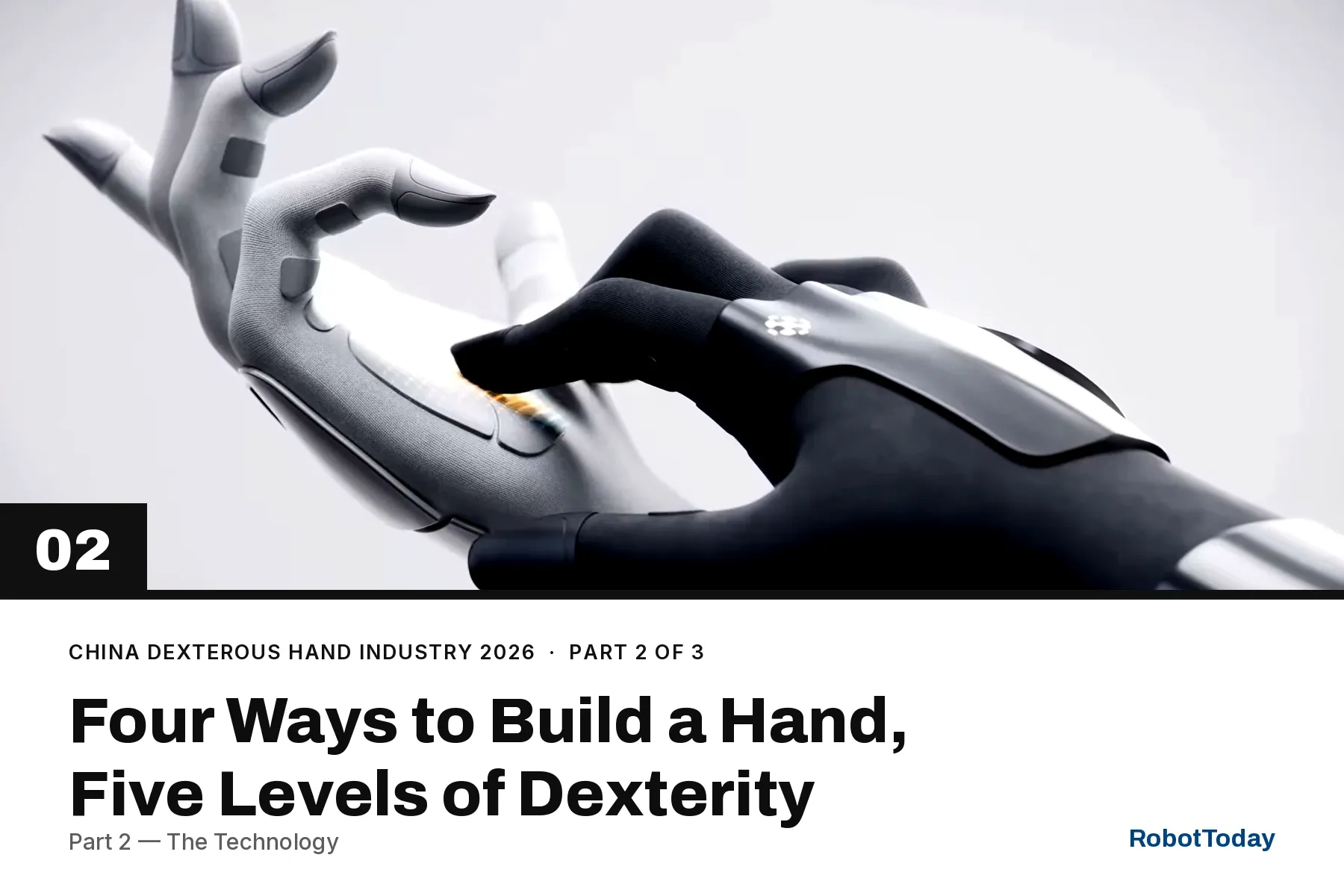
What separates a gripper from a hand, the four transmission architectures competing to build one, and why the industry’s centre of gravity is moving from mechanism to model.
Briefing details |
|
|---|---|
Source document | 2026 China Dexterous Hand Industry White Paper, MIR Industry Research (MIR Databank), 40 pp. |
Series | Part 1 — The Demand Picture · Part 2 — The Technology · Part 3 — The Players |
In this part | Definition and GB/T 12643-2025 threshold · value chain and development history · four transmission architectures and the shift to hybrid · two-tier software stack and the DL1–DL5 dexterity scale · five vendor technology cases |
Prepared for | RobotToday global readership — OEM strategy, component sourcing, investment and editorial teams |
Note on figures | All quantitative forecasts are MIR Databank estimates as published; RobotToday has not independently verified them. |
1. What Counts as a Dexterous Hand
MIR anchors its taxonomy in GB/T 12643-2025 (Robotics — Vocabulary), clause 3.4.27, which defines an end effector as the device or device assembly mounted on the robot’s terminal mechanical flange that interacts directly with the work object. End effectors divide into three families: gripping devices (mechanical grippers, vacuum cups, magnetic grippers and dexterous hands), process tools (welding torches, tightening tools, spray guns) and sensing modules (machine-vision heads and similar).
Within the gripping family, MIR sets a quantitative admission threshold for the dexterous hand category: at least three fingers and at least six active degrees of freedom. Below that line the device is a gripper. Above it, the device is expected to perform in-hand manipulation, precision assembly, deformable-object handling, tool use and multi-object interaction.
Dimension | Gripper | Dexterous hand |
|---|---|---|
Degrees of freedom | 1–3 active DOF; basic open/close only | ≥ 6 active DOF; 11–22 typical in commercial product |
Grasp adaptability | Fixed-geometry rigid parts; low fault tolerance | Irregular, fragile and unknown parts; compliant grasping and in-hand reorientation |
Typical environment | Highly structured industrial cells — fixed load/unload, standard part sorting | Complex scenes requiring enveloping grasps and coordinated finger motion |
Price band | Low — four-figure RMB | High — five-figure RMB; MIR gives the band only, not a median |
Industrialisation stage | Mature, at scale | Pilot penetration |
Source: MIR Databank, Table 1. RobotToday translation and condensation.
Value chain
MIR divides the chain into three tiers. Upstream sets the ceiling on precision, payload and sensing: micro-motors, micro-reducers, encoders, sensors, drivers, and the transmission elements themselves — linkages, lead screws and tendon cables — alongside lightweight biomimetic materials and the precision machining equipment needed to make them. Midstream is the integration layer, covering biomimetic structural design, electronic control, control-algorithm development, assembly and calibration; it comprises both independent hand specialists and the in-house hand divisions of robot OEMs. Downstream splits into host platforms (humanoids, industrial embodied-AI robots, and wearable devices including prosthetics) and end applications across manufacturing, commercial services, domestic care, medical rehabilitation and special operations.
How the industry arrived here
MIR reads the global history in three phases. From 1970 to 2000, development was led by overseas universities and space agencies — Japan’s Electrotechnical Laboratory, MIT, Stanford, DLR and NASA — producing three- to four-finger research prototypes with no path to volume; China was effectively absent until Beihang University released the BH-3 three-finger hand in 1998. From 2000 to 2024, overseas routes diversified through Gifu University, The Shadow Robot Company, Festo and Tesla, but output stayed at research-sample scale, while China moved from single-university projects to an industry–academia system (Beihang BH-4, a Harbin Institute of Technology–DLR joint prototype, Shanghai Jiao Tong University five-finger work) and, after 2020, to commercial suppliers such as INSPIRE ROBOTS shipping production five-finger hands. From 2025 onward, humanoid volume production became the demand engine, and MIR argues China’s advantage shifted decisively to localisation velocity in micro-motors, precision reducers and tactile sensors rather than to novel research architectures.
2. Hardware: Four Architectures, Converging on Hybrid
Transmission architecture determines weight, compliance, payload and control precision, and it is the cleanest way to segment the supply base. MIR identifies four routes.
Architecture | Principle | Strengths | Weaknesses |
|---|---|---|---|
Linkage | Rigid multi-segment linkages joined at pivots form a hybrid serial–parallel mechanism; the motor drives phalanges through fixed geometric relationships | Rigid transmission, strong payload; simple structure, low manufacturing cost; mature control, high production yield | Limited dexterity and joint range; heavy hand mass; limited fine-manipulation capability |
Tendon | Biomimetic tendon–bone analogue; motors sit in the forearm base and pull tungsten or nylon tendons through ball screws and pulleys to drive distal joints | Actuators can be remote-mounted, so the hand is light; good passive compliance for irregular objects; high biomimetic fidelity and joint count | Tendon wear shortens service life and raises maintenance cost; complex control, limited transmission accuracy; thermal management of remote motors |
Direct drive | Micro-motors integrated inside each finger joint with micro-reducers or gear trains; torque acts directly on the phalanx | Precise and fast-responding; rigid transmission with good force feedback and impact resistance; compact, independent per-joint control | Actuators inside the fingers make the hand bulky; gear meshing noise; complex internals and difficult maintenance |
Hybrid | Two or more architectures in one hand, zoned to the differing needs of thumb, fingers, and proximal versus distal joints; “tendon + direct drive” is the prevailing combination | Balances high payload with high dexterity; zoned optimisation keeps precision where it is needed and mass down elsewhere | High system complexity across design, control and manufacture; materially higher hardware cost |
Source: MIR Databank, Section 3(1) and Table 3. RobotToday translation.
Architecture map of the Chinese supply base
MIR’s Table 4 records which transmission routes each vendor has in its range — a tick means the route is present in the product line, not that it is the vendor’s main one. A single-tick vendor is committed to one route; a multi-tick vendor spans several and the table does not say which carries its volume.
Category | Vendor | Linkage | Tendon | Direct drive | Hybrid |
|---|---|---|---|---|---|
New entrants | ✓ | ✓ | ✓ |
| |
|
|
| ✓ |
| |
|
| ✓ |
|
| |
| WUJI |
|
| ✓ |
|
| CasiaHand | ✓ | ✓ | ✓ | ✓ |
|
| ✓ |
| ✓ | |
Gripper extension | ✓ |
| ✓ |
| |
| ✓ |
|
|
| |
Rehab derived | ✓ |
| ✓ |
| |
| ✓ |
|
|
| |
Humanoid OEM | ✓ |
| ✓ | ✓ | |
|
| ✓ |
| ✓ | |
|
|
| ✓ |
| |
Component extension | ✓ |
| ✓ |
| |
| ✓ |
|
|
| |
|
|
| ✓ |
|
Source: MIR Databank, Table 4. A tick marks a route present in the vendor’s range, not a primary architecture. Company names given in English throughout.
Where the hardware is going
Hybrid transmission becomes the mainstream. No single route satisfies precision, payload, low mass and compliance simultaneously. Tendon-plus-direct-drive zoning resolves the thermal problem of pure direct drive and the accuracy problem of pure tendon. Xynova, AGILINK and CasiaHand are named as early movers.
Continued mass reduction. Micro-motors, micro-reducers and micro-lead-screws keep shrinking without torque loss, driven by the hard end-effector mass budget humanoid platforms impose.
Tactile hardware becomes integral, not accessory. Flexible sensing skins and micro-array tactile sensors are becoming standard across fingertips, finger pads and palm, with structural space and flexible routing designed in from the start rather than retrofitted.
The persistent constraint is upstream. Micro-motors, micro-reducers and precision lead screws demand machining tolerances that are difficult to hold at volume, which is the primary reason unit cost remains high and lightweighting slow. Each of those parts must also be co-tuned with the transmission structure and the low-level control algorithm, which raises the engineering barrier for new entrants well beyond the component bill of materials. This is the single most consequential paragraph in MIR’s hardware chapter, and it should be read against the value-versus-volume gap in Part 1: the same micro-component supply that keeps today’s unit cost high is what has to localise for MIR’s +62% unit growth against +48% value growth to be achievable. Whoever holds those parts holds both the cost curve and the entry barrier — which is why the component-extension vendors in MIR’s taxonomy are treated as a distinct archetype rather than as latecomers.
Hardware technology case: Sharpa
Founded 2024, headquartered in Singapore with a manufacturing and R&D centre in Shanghai, co-founded by core founders of Hesai. In 2026 SharpaWave was selected by NVIDIA as the standard dexterous hand for its NVIDIA Isaac GR00T reference humanoid — the clearest external validation any Chinese-founded hand vendor has received. The product uses a fully direct-drive architecture at 1:1 human hand proportions with 22 active degrees of freedom, covering flexion, adduction, opposition and rotation with high gesture fidelity. Its Dynamic Tactile Array (DTA) places more than 1,000 tactile sensing units in each fingertip at 0.02 N pressure sensitivity, resolving gram-level forces and capturing deformation, texture and pressure distribution in real time. The positioning is unambiguously research and high-end humanoid, not cost-driven industrial supply.
Hardware technology case: Xynova
Founded late 2024 in Hangzhou and led by CAE academician Xia Changliang, Xynova is one of the few Chinese hand suppliers with in-house design and production across motors, motor control, reducers, lead screws and algorithms. It positions itself as a full-stack general dexterous-manipulation solution provider — hand as hardware carrier, arm–hand coordination as execution architecture, cerebellar motion-control algorithms as the intelligence hub. The May 2026 Flex 2 uses tendon-plus-direct-drive hybrid transmission in an integrated arm–hand design: 23 DOF (19 active, 4 passive), palm mass below 400 g, repeatability of ±0.1 mm or better, and force-control accuracy of 0.05 N. It integrates four sensing modalities — vision (wrist binocular camera), 3D fingertip tactile, force, and palm proximity sensing to cover the last few centimetres before contact — with an embedded cerebellum-analogue controller providing contact reflex, anti-slip reflex and compliant grasp behaviours in a millisecond-scale closed loop. The first-generation Flex 1 was pure tendon: 25 DOF (20 active) at 380 g. The two mass figures are not directly comparable — MIR gives 380 g as Flex 1’s complete-hand mass and the sub-400 g figure as Flex 2’s palm mass only, with Flex 2’s main actuators relocated to the forearm.
3. Software: The Real Competitive Frontier
MIR’s central analytical claim is that hardware sets the ceiling on motion and form, but software determines whether the hand can perform adaptive grasping, fine manipulation, object adaptation, disturbance rejection and autonomous work in unstructured environments. It splits the stack into two tiers.
Lower tier — motion control and execution
Joint servo control, hybrid force–position regulation, transmission error compensation, slip suppression and compliant contact control. MIR treats this as a general baseline competence held by all hand vendors, with difficulty varying by architecture: linkage and direct-drive structures are stiff with small backlash and are comparatively easy to control, while tendon structures introduce elastic deformation, tension variation and hysteresis that demand far more of the real-time closed loop. The report’s explicit judgement is that this tier is already mature and unlikely to sustain long-term differentiation.
Upper tier — intelligent perception and manipulation models
Integration of vision, language and force–tactile inputs into environment understanding, task reasoning, motion planning, skill generalisation and complex task decomposition. Unlike a two-finger gripper’s binary open/close logic, a high-DOF five-finger hand cannot be driven by fixed programs or simple models. This tier, trained on large-scale physical interaction data, is what supports general grasping, in-hand fine manipulation, tool use, deformable-object handling and multi-step continuous work — and it is where MIR locates the industry’s durable competitive barrier.
The DL scale: a common language for manipulation capability
To make software capability comparable across vendors, the industry — with CasiaHand as the named advocate — has put forward a five-level Dexterity Level framework indexed on adaptability to object, scene and task.
Level | Capability | What it means in practice |
|---|---|---|
DL1 | Fixed programming or teleoperation | Repeats taught motions or is remotely driven, with a task-specific end effector. No environmental adaptation. |
DL2 | Vision/force task-specific adaptation | 2D/3D vision localisation plus force-compliant control with a dedicated gripper, handling grasping, sorting and assembly of specific objects. Basic sensing compensation, still inside a fixed program framework. |
DL3 | Autonomous general grasping | Generalised models plus multi-finger hands deliver stable form- and force-closure grasps of diverse objects. MIR calls this the watershed between the robotic-automation era and the human-like manipulation era. |
DL4 | Functional manipulation | Understands the use semantics of tools and objects and operates tools and fixtures autonomously. |
DL5 | Human-level general manipulation | Matches or exceeds human dexterity across multiple tasks and scenes in unstructured open environments. |
Source: MIR Databank, Section 4(1)2. Framework attributed to CasiaHand and industry peers.
The commercially significant sentence in the report is the placement: most shipping product sits at DL1–DL2. Mid- and high-end hands can compensate for small deviations and contact disturbances, but complex-material adaptive grasping, in-hand fine manipulation, tool reuse and long-horizon multi-step work — DL3 and above — remain in validation and pilot, with few mature commercial packages available.
Two bottlenecks
Model capability. Fixed-parameter control algorithms execute preset tasks and cannot generalise or decide autonomously. General-purpose large models trained across whole-body tasks dilute weight allocation and struggle to meet the millimetre-scale precision, compliant contact and stability requirements specific to five-finger manipulation.
Data scarcity. Public datasets are overwhelmingly two-finger-gripper recordings with simple action dimensions. Hardware fragmentation across architectures and sensor configurations means there is no shared standard for collection, labelling or reuse, so real-machine interaction data is scarce, costly and poorly transferable. Training therefore leans on simulation, and the sim-to-real gap shows up as precision and stability decay on deployment.
The data–model–scene flywheel
MIR’s framing of the industry’s forward path is a self-reinforcing loop: multimodal interaction data (vision, tactile, force) trains the manipulation model; the improved model is deployed to real machines across industrial, commercial and special-operation scenes; field operation generates new physical interaction data that flows back into training. Building the complete closed loop — not any individual component of it — is identified as the core long-term differentiator. On architecture, the consensus forming is a layered split: a general foundation model for language parsing, environment understanding and task decomposition, paired with vertical scene-specific manipulation models and high-precision real-time low-level control. On data, the prevailing method becomes simulation pre-training plus real-machine fine-tuning, with unified vision/force/tactile data standards.
The three software technology cases
MIR profiles three companies in its software chapter. One of them, Genesis AI, is not a Chinese company — MIR presents it as an overseas comparator rather than as part of the domestic supply base, and it should not be counted into any tally of Chinese vendors, including MIR’s own composite list, which excludes it. The other two, LinkerBot and CasiaHand, appear in that list.
Genesis AI — overseas
An overseas embodied-AI startup founded in late 2024 pursuing full-stack co-development on the argument that dexterous manipulation is a systems-engineering problem that no single AI model can solve against a fixed hardware envelope. Genesis AI develops its own hands, simulation environment and GENE foundation-model series in parallel. Its human-centric data engine captures high-fidelity hand motion and tactile signals through a proprietary data glove, teleoperation and egocentric video, with a high-precision motion-mapping strategy that aligns human hand, capture device and robot hand to reduce demonstration loss. The Genesis World high-fidelity simulator expands the dataset in parallel. The GENE-26.5 model targets contact-rich physical interaction, fusing vision, tactile, proprioception and language for end-to-end trajectory generation, with explicit temporal-dependency modelling for long-horizon multi-step work — demonstrated on Rubik’s cube solving, fine cooking, precision pipetting and multi-object coordinated manipulation. Proprietary low-latency middleware pushes commands to the Eno body and Genesis Hand, compressing control-chain latency from roughly 80 ms to as little as 3 ms.
LinkerBot
LinkerBot builds a closed loop across hand hardware, data infrastructure and manipulation models. Its proprietary Linker Genesis manipulation foundation model targets contact-rich fine physical interaction and supports natural-language task decomposition and composition of atomic skills, covering deformable-object handling and long-horizon multi-step tasks. The data base is LinkerSkillNet, a multimodal manipulation dataset spanning industrial, research and service scenes, supported by the proprietary Open TeleDex teleoperation system, UMI-Dex isomorphic demonstration hardware and the Dex-Serl real-machine reinforcement-learning framework. The 1:1 isomorphic demonstration hardware reduces human-to-robot motion transfer loss, and force feedback improves training precision and generalisation. Linker Genesis is tuned to the full Linker Hand range across linkage, tendon and direct-drive architectures.
CasiaHand
Founded 2024 in Nanjing and incubated out of the Chinese Academy of Sciences Institute of Automation, CasiaHand combines volume hand manufacturing with full-stack embodied-AI algorithm development. Its CasiaHand Brain-Si 0.5 human-like manipulation foundation model uses a three-tier decoupled architecture. The top tier fuses scene imagery, force–tactile sensing, proprioception, human intent and action history into long-horizon task decomposition, converting natural language and visual input into step-by-step execution flows with bidirectional interaction to the lower tier. The middle tier — the company’s core — comprises six skill foundation models: pre-grasp and auxiliary manipulation, general grasping, functional manipulation, responsive human–robot handover, bimanual coordination, and human–robot fused manipulation, with VLA/VLM integration and continual learning. The bottom tier is a physically interpretable motion-control layer integrating motion control, force control, closed-loop control and safety constraints, with per-architecture control strategies dispatched on a real-time kernel. On hardware, CasiaHand runs a tendon-plus-direct-drive rigid–flexible coupled architecture.
4. What This Means
The judgements in this section are RobotToday’s reading of the white paper, not MIR conclusions. Figures remain MIR’s and are attributed where used.
For component suppliers
The upstream bottleneck is explicit and it is where margin currently sits: micro-motors, micro-reducers, precision lead screws and micro-array tactile sensors, all of which must be co-tuned with the transmission and the low-level controller rather than sold as catalogue parts. MIR’s unit-versus-value forecast implies sustained price pressure, so suppliers should expect the cost-down conversation to arrive with volume rather than after it.
For engineering teams evaluating a hand
If low-level motion control is genuinely commoditising, degrees of freedom and fingertip force are no longer discriminating specifications — every serious supplier can quote competitive numbers. The questions that separate vendors are architectural and behavioural: which transmission route is used where in the hand and why; whether tactile sensing is integrated into the structure or bolted onto it; what the hand does without re-teaching when the part changes; and, on the DL scale, what capability level the vendor will demonstrate on the buyer’s own parts rather than on a demonstration set.
Prepared by RobotToday. Source: MIR Industry Research / MIR Databank, 2026 China Dexterous Hand Industry White Paper. Translation, condensation, structuring and supplier-directory mapping are RobotToday’s. Forecast figures are MIR estimates as published and have not been independently verified. Company names link to profiles in the RobotToday Supplier Directory at robottoday.com/suppliers-discovery.
China’s Dexterous Hand Industry, 2026 Part 1 — The Demand Picture
China’s Dexterous Hand Industry, 2026 Part 2 — The Technology




Leave a comment