

Intrinsic’s vision for physical AI: Building the software-defined factory
- Published
For decades, the industrial automation sector has adhered to a consistent model, where production lines have accelerated, robots have gained enhanced capabilities, and software has evolved, yet the fundamental approach has remained unchanged. Automation systems have traditionally been designed for specific tasks, resulting in high costs and lengthy processes for achieving flexibility. However, this conventional model is now facing significant challenges as manufacturers strive to adapt to rapidly changing market demands and consumer preferences. The push for more versatile and efficient automation solutions is prompting a reevaluation of existing practices, signaling a potential shift in the industry towards more adaptable and cost-effective systems. As companies seek to enhance their competitiveness, the evolution of automation technology is becoming increasingly critical in meeting the dynamic needs of the manufacturing landscape.
Original report
Intrinsic’s vision for physical AI: Building the software-defined factory
RoboticsAndAutomationNews.com · Sam FrancisThis briefing is an independently written summary based on publicly available reporting and is provided for industry information and news discovery. The original report and source publication are credited and linked where applicable. RobotToday does not claim ownership of third-party source material.
Rights concerns? Contact [email protected] with the relevant URL and details. We will review the matter and take appropriate action where warranted.
More related news
- 1
- 2
-
3
RobotToday Weekly October 12 – 16, 2026 RobotToday · 16 hours ago
- 4
- 5
- 6
-
7
Global Industrie 2027 – Lyon, Mar 15–18, 2027 RobotToday · 3 days ago
-
8
RoboDEX 2027 – Tokyo, Feb 17–19, 2027 RobotToday · 3 days ago
-
9
automatica 2027 – Munich, Jun 22–25, 2027 RobotToday · 3 days ago
- 10
- 11
- 12
Related Suppliers

Janome Industrial Equipment Europe GmbH
Germany
German sales subsidiary of Janome Industrial Equipment (Japan), distributing servo presses and desktop/Cartesian robots in Europe since 1984.

Industrial Technology Research Institute (ITRI) 工業技術研究院
Taiwan
Hsinchu County, Taiwan applied-technology research institute founded 1973; over 6,500 staff developing autonomous mobile robots and AI perception systems.
ROS-Industrial
United States
Open-source consortium managed by SwRI extending ROS to industrial manufacturing automation, with global hubs in Americas, Europe, and Asia-Pacific.
Ortelio Ltd
United Kingdom
Ortelio Ltd is a UK cloud robotics research company founded in 2011 that develops AI platforms giving robots intelligence for service and healthcare tasks.

Parata Systems
United States
Durham, North Carolina pharmacy automation maker acquired by BD in 2022; builds robotic vial-filling and packaging systems.

Pensa Systems
United States
Austin-based AI retail shelf platform using autonomous drones and CV to detect stockouts; customers include J&J, AB InBev, and Circle K.

ADEK Industrial Computers
United States
US-based industrial PC manufacturer building custom rugged rack-mount, panel, and embedded computers for robotics, SCADA, and HMI applications since 1993.

Aichi Robot Industrial Promotion Council
Japan
Japanese industry council promoting robotics development and diffusion in Aichi Prefecture, one of Japan's largest robot manufacturing hubs.

Arctek Robótica Industrial
Brazil
Brazilian industrial robotics system integrator in Curitiba, Parana, specializing in robotic welding, automated handling, palletizing, and custom automation.
E-COBOT
France
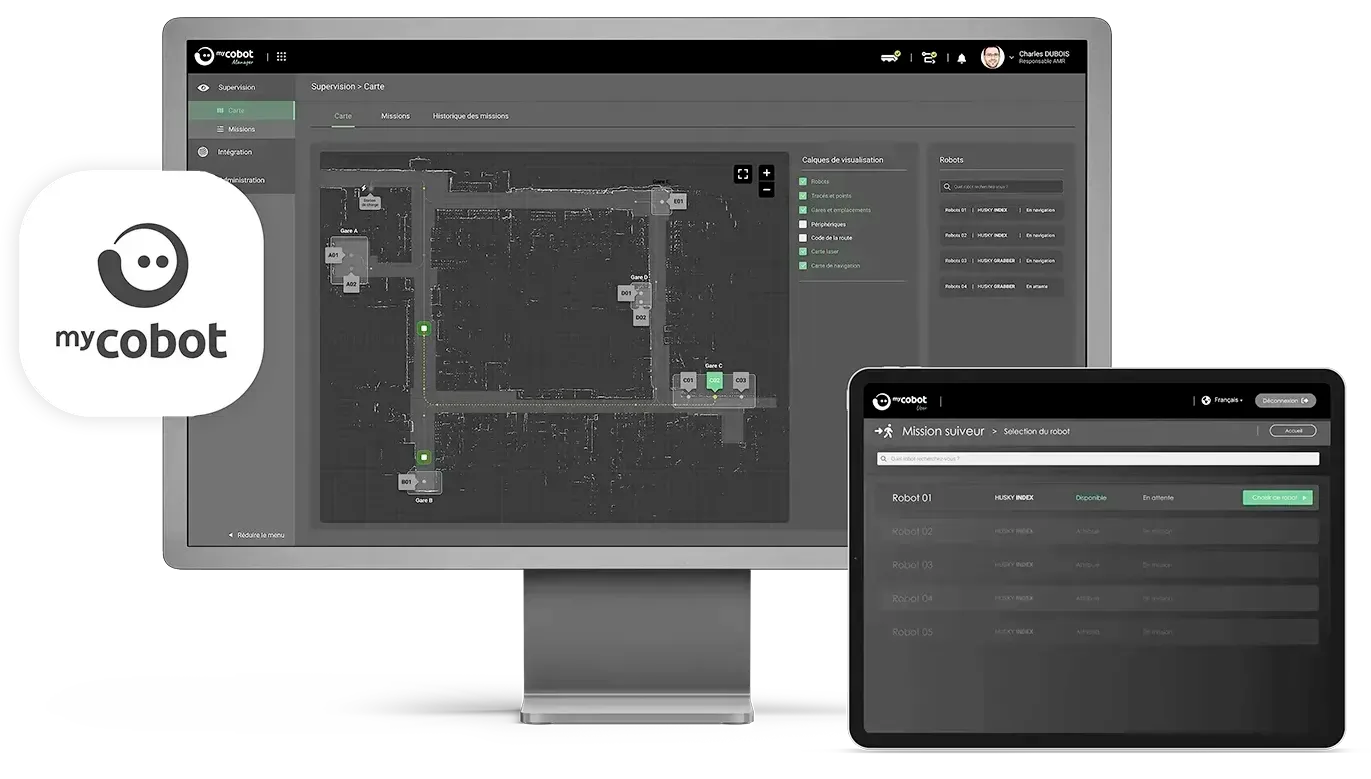
French AMR manufacturer and system integrator offering the HUSKY robot range and MyCobot fleet management software.
EasyMile
France
Toulouse, France autonomous-vehicle software company founded 2014; EZTow and EZDolly systems automate industrial tow tractors and cargo movers at airports.

Filics
Germany
Munich-based robotics startup making ultra-flat omnidirectional AMRs that drive under Euro pallets for space-efficient intralogistics.
Robotics needs a service framework.
RSF defines a common language for robot service capability, lifecycle operations, certification pathways, and service-provider networks.
Join the RobotToday community on LinkedIn
Daily robotics news, in-depth analysis, conference highlights, and discussions with professionals worldwide.


