

Northrop Grumman Advances Peg-in-Hole Technology for Satellite Servicing
- Published
- Source
- ri.cmu.edu
Northrop Grumman is enhancing its peg-in-the-hole capability for its Mission Robotic Vehicle (MRV), designed to service satellites in geosynchronous orbit. Collaborating with Carnegie Mellon University's Robotics Institute, led by professor Howie Choset, the initiative aims to extend the operational lifespan of satellites by enabling refueling and maintenance in space.
This development is significant as thousands of satellites are currently non-functional due to depleted fuel, reflecting a shift from the traditional aerospace paradigm of 'launch once, use once.' Choset emphasizes the potential for satellites to remain operational indefinitely, which could revolutionize satellite management and reduce space debris.
Looking ahead, Northrop Grumman's MRV, which launched in July from Cape Canaveral, Florida, is set to perform multiple successful docking operations using a new technique that allows for safe connections with target satellites. No further timeline was disclosed at the time of publication.
Original report
Peg-in-Hole Isn’t Kid Stuff
ri.cmu.edu · Mallory LindahlThis briefing is an independently written summary based on publicly available reporting and is provided for industry information and news discovery. The original report and source publication are credited and linked where applicable. RobotToday does not claim ownership of third-party source material.
Rights concerns? Contact [email protected] with the relevant URL and details. We will review the matter and take appropriate action where warranted.
More related news
- 1
- 2
- 3
- 4
- 5
- 6
- 7
- 8
- 9
- 10
- 11
-
12
Glacian: Physics Model Vets AI Data Center Cooling RobotToday · 2 weeks ago
Related Suppliers

Northrop Grumman Space Systems
United States
Falls Church, Virginia-based Northrop Grumman division builds Cygnus spacecraft and OPIR satellites; parent company reported $41.95 billion 2025 revenue.
General Dynamics
United States
US aerospace and defense conglomerate since 1952 whose Land Systems unit builds the TRX and MUTT unmanned ground combat vehicles.

Textron Systems
United States
US defense unit of Textron Inc. building Aerosonde UAS, CUSV and TSUNAMI uncrewed vessels, and Ripsaw robotic ground vehicles for military customers.

Orbit Fab, Inc.
United States
Lafayette, Colorado startup founded 2018; builds in-space refueling infrastructure including RAFTI ports, RAVEN shuttle, and NEST orbital propellant depots.
Aqua Satellite
United States
Mountain View, California underwater-vehicle startup founded 2020 by Alan Eustace; builds AUVs rated to 500 meters with 4K, AI-assisted imaging.
Ocean Infinity
United States
Marine robotics company operating large uncrewed surface vessels and AUVs/ROVs for remote ocean survey and seabed operations.
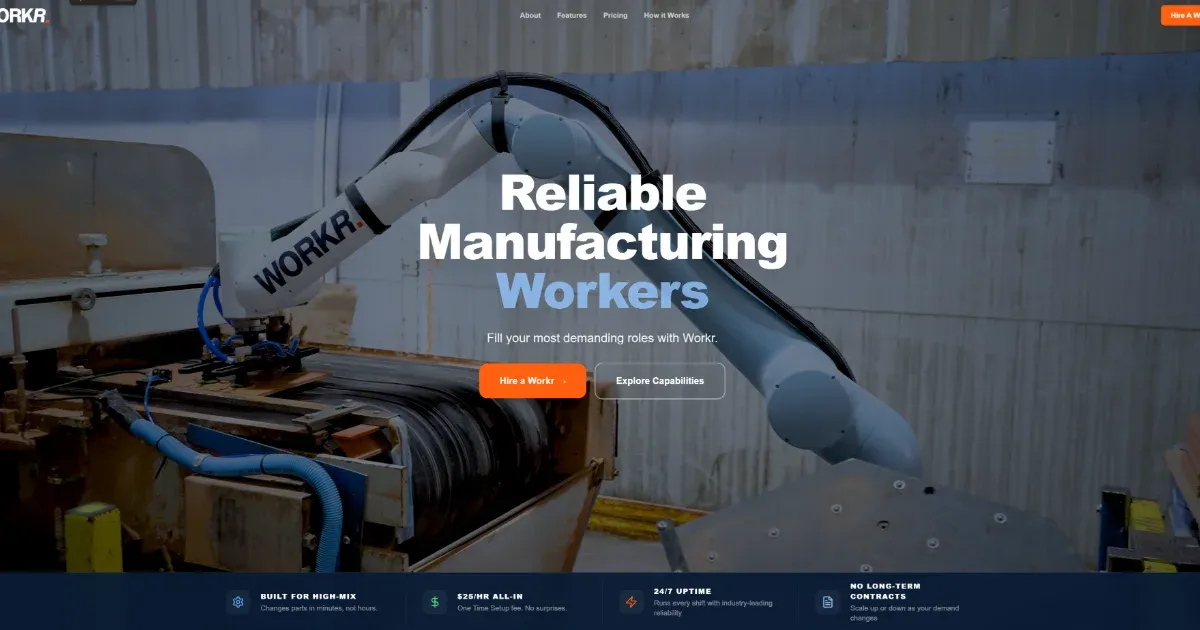
Workr Robotics
Ireland
Irish RaaS startup delivering AI-powered robotic workforce to manufacturers at $25/hour with no capital expenditure required.

GITAI
United States
Space robotics startup developing autonomous robotic arms and lunar rovers for on-orbit servicing, satellite maintenance, and lunar base construction.
Point One Navigation
United States
San Francisco GNSS/RTK startup providing centimeter-accurate positioning via the Polaris correction network and FusionEngine SDK.

Starfish Space
United States
In-orbit satellite servicing company developing autonomous spacecraft for satellite life extension, disposal, and rendezvous missions.

Liquid AI
United States
MIT-spinout building device-native foundation models (LFMs) that run on-device across phones, cars, robots and edge hardware.

Liquid Robotics
United States
Liquid Robotics, a Boeing subsidiary, manufactures the Wave Glider unmanned surface vehicle for long-endurance ocean data collection and maritime surveillance.
Robotics needs a service framework.
RSF defines a common language for robot service capability, lifecycle operations, certification pathways, and service-provider networks.
Join the RobotToday community on LinkedIn
Daily robotics news, in-depth analysis, conference highlights, and discussions with professionals worldwide.


