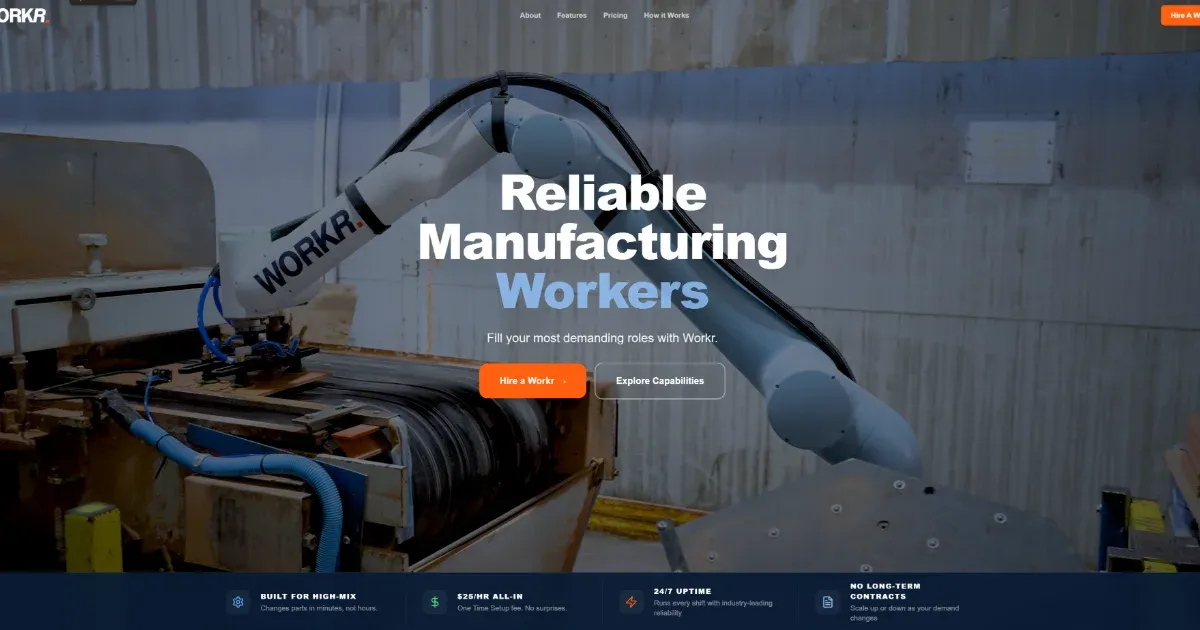
Workr Robotics

Workr Robotics

"No CapEx. No hiring. Just reliable, scalable production."

Irish RaaS startup delivering AI-powered robotic workforce to manufacturers at $25/hour with no capital expenditure required.

Visit Website

Company Overview

Workr Robotics is an Ireland-based Robotics-as-a-Service (RaaS) company that provides manufacturers with an AI-powered robotic workforce on a subscription or hourly pricing model starting at $25 per robot-hour. The core value proposition eliminates the need for capital expenditure on robotic equipment: customers access a fully managed robotic production capability without purchasing hardware, hiring robotics engineers, or maintaining complex automation systems in-house.

The company's model targets manufacturers who need scalable, on-demand production capacity but lack the upfront investment or internal expertise to deploy and run industrial robots independently. By offering robotics as a service, Workr positions itself as a flexible alternative to both traditional robot ownership and additional headcount, lowering the barrier to automation for small and mid-sized manufacturers in Ireland and potentially broader European markets. The $25/hour pricing model is designed to make robotics economically accessible at production volumes that would not justify the typical capital expenditure of industrial robot purchases, which commonly range from tens of thousands to hundreds of thousands of dollars per unit before integration and ongoing maintenance costs are factored in.

Workr's platform integrates AI to coordinate and optimize robotic operations, adapting to specific manufacturing workflows and variable production requirements. The service model is positioned to remove friction from the entire robotics adoption lifecycle — from deployment and commissioning to ongoing monitoring, maintenance, and software updates — all handled by Workr rather than the end customer. This approach mirrors the broader RaaS trend emerging globally, where manufacturers increasingly prefer operational expenditure models over capital expenditure for automation.

As of mid-2026, Workr appeared to be in an early commercial stage, operating from Ireland (ISO-3: IRL). The official website (workr.com) prominently featured its headline value proposition without publishing detailed technical specifications, specific robot models deployed, customer case studies, named leadership, or a formal registered office address. No founding year or headcount data was publicly disclosed at the time of this verification. The RaaS model and Ireland base make Workr a notable early-stage entrant in the European manufacturing automation market.

Capabilities & Activities

Primary type & automation activities this supplier delivers:

Applications & Industries

Product Categories

Partnership & Notable clients

Associating Events

Contact Workr Robotics

WEBSITE

https://workr.com/

HEADQUARTERS

Dublin , Leinster  D02

Ireland

Company Facts

Founded

-

Primary Role

RaaS

Company Size

-

Primary Region

Europe

Annual Sales

-

Funding Stage

-

Funding Total

-

Listed in RobotToday Supplier Discovery. Verified Profile

Related Coverage

WRC 2026 Exhibitor Map: 248 Robotics Companies Mapped

WRC 2026 Exhibitor Map: 248 Robotics Companies Mapped

We classified 248 WRC 2026 exhibitors with the RobotToday taxonomy. Humanoid leads at 77 companies; the chain narrows to 11 in compute and 2 in power.

ROBOTTODAY Weekly August 10 – 14, 2026

ROBOTTODAY Weekly August 10 – 14, 2026

Your weekly robotics briefing: Unitree's IPO is swamped by retail demand, the US puts 100% tariffs on imported drones, LG and Nvidia commit to a 2027 humanoid, and Uber and Pony.ai bring 2,000 robotaxis to Europe.

Inside Saga Robotics: UVC Light vs. Crop Disease

Inside Saga Robotics: UVC Light vs. Crop Disease

Saga Robotics CPO Damian Flynn on the Thorvald platform's UVC treatment system, its jump from UK strawberries to California wine grapes, and why he's “incredibly bullish” on applying automation and robotics into industries “most chaotic environment.”

How a Robot Should Die: Phase 5, Lifecycle KPIs, and One Welding Arm's Four Years

How a Robot Should Die: Phase 5, Lifecycle KPIs, and One Welding Arm's Four Years

When is a robot's time up? RSF's four-dimension scoring matrix, Data Erasure Certificates, hazmat compliance, and five KPIs that measure the lifecycle.

Fix One Machine, Improve the Fleet: Phase 4 and the Closed Loop

Fix One Machine, Improve the Fleet: Phase 4 and the Closed Loop

Repairs that teach nothing repeat forever. Inside RSF Phase 4: the eight-step corrective process, five RCA triggers, and the Known Fault Library loop.

Skip the Gate, Own the Liability: Phase 2 and the Stage Gate Mechanism

Skip the Gate, Own the Liability: Phase 2 and the Stage Gate Mechanism

RSF defines two hard stops around robot commissioning. Bypass SG1 and safety liability shifts to you; skip SG2 and your SLA loses its evidence base. Inside.

Your Three-Shift Robot Is on a One-Shift Maintenance Plan: Phase 3 and the PM System

Your Three-Shift Robot Is on a One-Shift Maintenance Plan: Phase 3 and the PM System

A three-shift robot on a one-shift maintenance plan ages at triple speed. RSF Phase 3: three PM tiers, three trigger models, environmental corrections.

ROBOTTODAY Weekly August 3 – 7, 2026

ROBOTTODAY Weekly August 3 – 7, 2026

This week in robotics: Unitree prices its Shanghai STAR Market IPO with DeepSeek taking a strategic stake, the FCC expands its foreign-robot ban as China threatens retaliation, BMW commits to Figure 03 humanoids, and Zoox goes paid in Las Vegas. August 3–7, 2026.

WAIC Review 2/4: World Models vs. VLA: Robotics' Next 'ChatGPT Moment'

WAIC Review 2/4: World Models vs. VLA: Robotics' Next 'ChatGPT Moment'

At WAIC 2026, world-model and VLA camps staked rival paths to generalist robots; Zhiyuan, SenseTime and NVIDIA predict a robot 'ChatGPT moment' in 2-5 years.

WAIC Review 4/4: From Port AGVs to Hospital Night Shifts: What WAIC 2026 Reveals About Real Robot Deployments

WAIC Review 4/4: From Port AGVs to Hospital Night Shifts: What WAIC 2026 Reveals About Real Robot Deployments

From 530+ AGVs at a Singapore port to robots on Apple's line, WAIC 2026 speakers shared concrete data on where embodied AI robots are actually working today.

Interview with Workr Robotics CEO Ken Macken: ‘Paying for automation by the hour’

Interview with Workr Robotics CEO Ken Macken: ‘Paying for automation by the hour’

Industrial robotics is undergoing a significant transformation, driven by advancements in artificial intelligence, large language models, and embodied AI. This evolution has generated renewed interest in the development of robots capable of understanding, reasoning, and interacting with their physical environments. Notable partnerships, including collaborations between Google DeepMind and Boston Dynamics, have intensified discussions surrounding the potential for more sophisticated general-purpose robots. As these technologies continue to evolve, the industry anticipates a future where robots can perform a wider array of tasks, enhancing their utility across various sectors. The ongoing innovations suggest a promising trajectory for the integration of robotics into everyday life, potentially reshaping industries and improving operational efficiencies.

Features Industrial robots Robotics Software automation news automation roi