



RobotToday analyzed every paper on the IROS 2026 program and compared it with last year's conference in Hangzhou. The program shrank by more than a quarter, the United States overtook China, and robot learning tightened its grip on the field.
IROS, one of the largest robotics research conferences, wrapped up in Pittsburgh on Oct. 1 with 1,933 papers on its program. A year earlier in Hangzhou, the program carried 2,672. Submissions held steady at about 4,300, so the drop came from a far tougher cut: the acceptance rate fell from 46% to 36.5%, the lowest in at least nine years.
The smaller program also looked very different. Papers with at least one U.S.-based author rose 30%, to 727, and the United States had the most papers of any country. Papers with mainland Chinese authors fell by more than half, to 640, after dominating the Hangzhou program. Robot learning grew to more than a third of all papers, and the term "vision-language-action" went from 4 paper titles to 65.
RobotToday mapped every author affiliation and every author keyword in both programs. Here is what the data shows.
A much tougher cut
IROS received 4,348 submissions for 2026, a record but only 1% more than Hangzhou's 4,306. It accepted 1,585, down from 1,991. That pushed the acceptance rate to 36.5%, about ten points below the 43% to 48% range of the previous eight years.
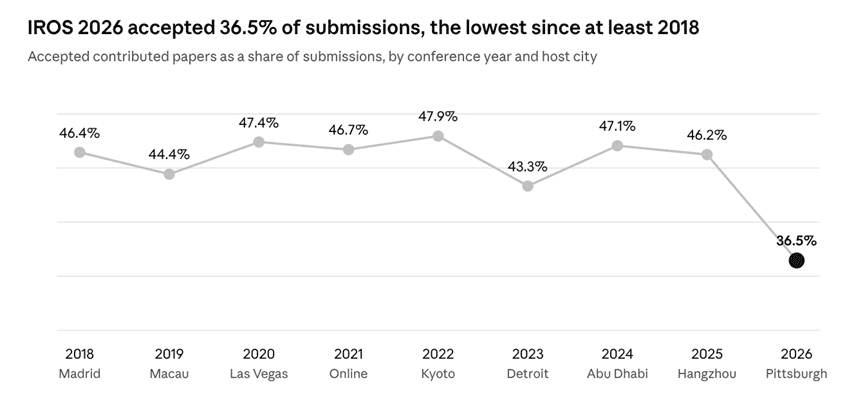
2026: acceptance notices as reported by participating labs (4,348 submitted, 1,585 accepted); 2018–2025: CS Conf Stats
IROS also asks every accepted paper to be presented in person by an author or a knowledgeable colleague. Neither the organizers nor this data say why fewer papers made the cut. A stricter review and travel costs to the U.S. are both plausible factors, and they hit some countries harder than others.
Who published: the host effect swings both ways
In Hangzhou, 55% of all papers had at least one author from mainland China. In Pittsburgh, that share fell to 33%, and the U.S. share rose from 21% to 38%.
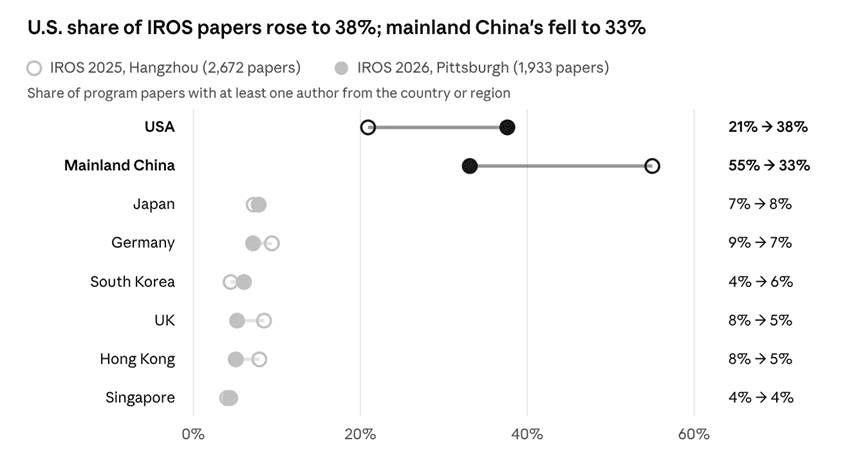
RobotToday analysis of the official IROS 2025 and 2026 program indexes · a paper counts for every country or region with at least one author there
In absolute terms, U.S.-linked papers rose from 559 to 727, while mainland China's fell from 1,469 to 640. By first author, the U.S. led with 605 papers to mainland China's 556. Counting mainland China, Hong Kong and Macau together gives 667 papers, still 60 fewer than the U.S.
South Korea was the main exception to the shrinking program: its count held almost steady, from 119 to 117, lifting its share from 4.5% to 6.1%. Germany, the UK and Hong Kong each lost about half their papers.
Cross-border work also thinned. The share of papers with authors from more than one country fell from 32% to 22%, and papers co-written by Chinese and U.S. authors dropped from 164 to 69.
The institutions: Tsinghua stays first, U.S. schools climb
Tsinghua University again had a hand in more IROS papers than any other institution, though its count fell from 156 to 88. Carnegie Mellon, in host city Pittsburgh, rose from 56 to 74 and moved to second.
| Institution | Country / region | Papers 2026 | Papers 2025 |
|---|---|---|---|
| Tsinghua University | Mainland China | 88 | 156 |
| Carnegie Mellon University | USA | 74 | 56 |
| Zhejiang University | Mainland China | 61 | 140 |
| Shanghai Jiao Tong University | Mainland China | 50 | 146 |
| National University of Singapore | Singapore | 49 | 57 |
| Purdue University | USA | 45 | 22 |
| MIT | USA | 42 | 33 |
| The University of Tokyo | Japan | 42 | 48 |
| Georgia Tech | USA | 36 | 17 |
| Technical University of Munich | Germany | 36 | 83 |
| KAIST | South Korea | 36 | 24 |
The swing was sharpest outside the top five. Harbin Institute of Technology fell from 128 papers to 30 and Beijing Institute of Technology from 109 to 34. Purdue, Georgia Tech and the University of Southern California each roughly doubled, USC from 13 to 30.
Counts include every paper with at least one author from the institution, with spelling variants merged. HKUST's Hong Kong and Guangzhou campuses are counted separately, with 35 and 34 papers.
What they studied: learning takes a bigger slice
Robot learning, which covers reinforcement learning, imitation learning and learning from demonstration, appeared in 37% of IROS 2026 papers, up from 31% in Hangzhou. Reinforcement learning was again the single most common keyword, on 199 papers.
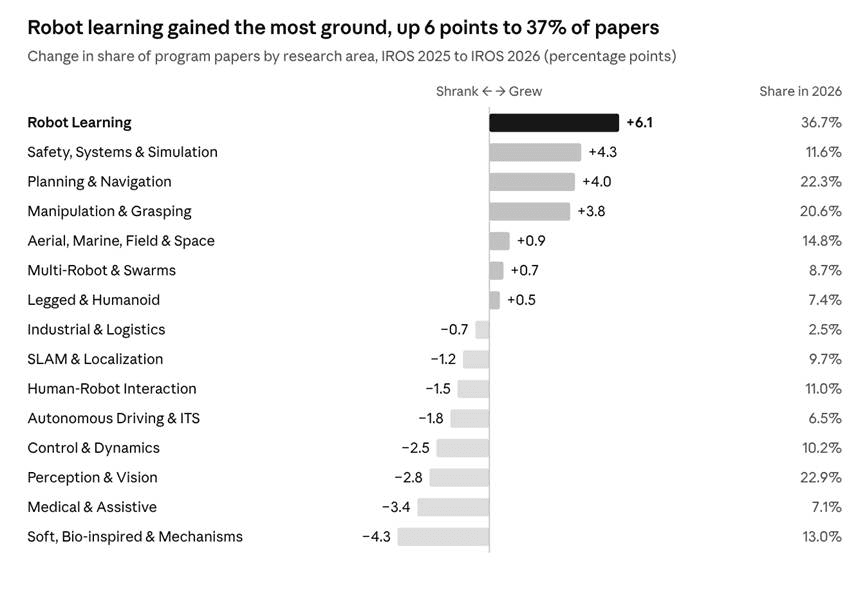
RobotToday analysis of author-selected IROS keywords, grouped into 15 research areas · a paper can belong to several areas
Planning and navigation, manipulation, and safety and systems work also gained share. The areas that shrank most were soft and bio-inspired robotics, medical and assistive robots, and perception. Some of that is the host effect again. Medical robots and micro- and nano-robots were among Hangzhou's largest sessions, and 85% of the micro- and nano-robot papers there had authors from mainland China or Hong Kong.
The foundation-model wave reaches the robot
Paper titles show how fast large models have moved into robotics. Only 4 titles at IROS 2025 mentioned vision-language-action (VLA) models; at IROS 2026, 65 did. Titles naming large language models, vision-language models or language-guided control rose from 4.4% of papers to 7.3%.
| Term in the paper title | IROS 2025 | IROS 2026 |
|---|---|---|
| Vision-language-action (VLA) | 4 | 65 |
| LLM, VLM or language-guided | 117 | 141 |
| Diffusion or flow matching | 62 | 75 |
| Dexterous or multi-fingered hands | 49 | 59 |
| Humanoid | 42 | 48 |
| World model | 7 | 14 |
| LiDAR | 92 | 51 |
| Quadruped | 46 | 25 |
The raw counts understate the shift, because the 2026 program was 28% smaller. Measured as a share of all papers, humanoid titles rose by about half and dexterous-hand titles by about 70%. Quadruped and LiDAR titles fell in both count and share, a sign that attention is moving from legged mobility and classic sensing toward manipulation and learned policies.
Title matching gives a floor, not a full count: many papers use these methods without naming them in the title.
Industry is still a minority in the author lists
About one in ten IROS 2026 papers had at least one author at a company, roughly the same share as in 2025. Academia still writes most of the field's research record.
| Company | Papers 2026 | Papers 2025 |
|---|---|---|
| Bosch | 15 | 11 |
| NVIDIA | 13 | 8 |
| Huawei | 10 | 13 |
| Mercedes-Benz, CARIAD or Volkswagen | 8 | 9 |
| Amazon | 8 | 9 |
| Meta | 8 | 4 |
| Toyota | 7 | 14 |
| Honda Research Institute | 7 | 17 |
NVIDIA and Meta grew, while Japanese and Korean corporate labs that were prominent in Hangzhou appeared less often: Honda fell from 17 papers to 7, Toyota from 14 to 7 and Samsung from 13 to 6. China's humanoid start-ups were nearly absent as authors. Galbot appeared on two papers, and Unitree on none, even though Unitree robots were the test platform for several of this year's award finalists.
The awards tell a different story
Volume and recognition did not line up. South Korea had a hand in only 6% of program papers, yet it placed four of the ten finalists for the Best Paper and Best Student Paper awards, more than any other country. Mainland China placed three, the U.S. two and Germany one. According to reports from the Sept. 30 awards lunch, the Best Paper went to LT-Mem, a long-term robot memory system from Korea's DGIST.
Across the eight category awards, 22 more papers made the shortlists. By first author, mainland China placed eight and the U.S. seven. Three of them, on tray carrying, tennis and whole-body control, ran on Unitree's G1 humanoid.
What it means for industry
Learning is now the default toolkit. More than a third of papers carry a robot-learning keyword, and VLA models went from 4 paper titles to 65 in a year. Finalists such as Shallow-π, which compresses a VLA to run on NVIDIA Jetson chips, point to the next step: making these models cheaper and more reliable on real robots.
Manipulation and humanoids are gaining ground. Dexterous-hand and humanoid titles grew faster than the program, while quadruped and LiDAR titles declined.
One conference is not a census. The swing between Hangzhou and Pittsburgh shows how much location shapes who shows up. National comparisons need several years and several venues.
An IROS paper is a harder signal to earn. With acceptance near 36%, a 2026 IROS paper cleared a higher bar than at any edition in the last nine years.
How we counted
Papers. All papers on the official program indexes: 1,933 for IROS 2026 and 2,672 for IROS 2025. Both include journal papers presented at the conference, so they exceed the accepted-paper totals.
Countries. Each author's listed affiliation was mapped to a country or region. A paper counts once for every country with at least one author; first-author counts use the first listed author. Mainland China, Hong Kong, Macau and Taiwan are counted separately. About 3% of author affiliations could not be placed.
Topics. Authors choose up to four keywords from IROS's list. RobotToday grouped these into 15 research areas; a paper can belong to several.
Title terms. Counted by pattern matching on paper titles, so they are lower bounds.
Acceptance rates. 2026 figures are from the conference's acceptance notices as reported by participating labs; earlier years are from CS Conf Stats. IROS has not published them on its website.
Sources: IROS 2026 Paper & Author Index · IROS 2025 technical program · affiliation mapping adapted from the open-source IROS 2026 Paper Explorer









Leave a comment