



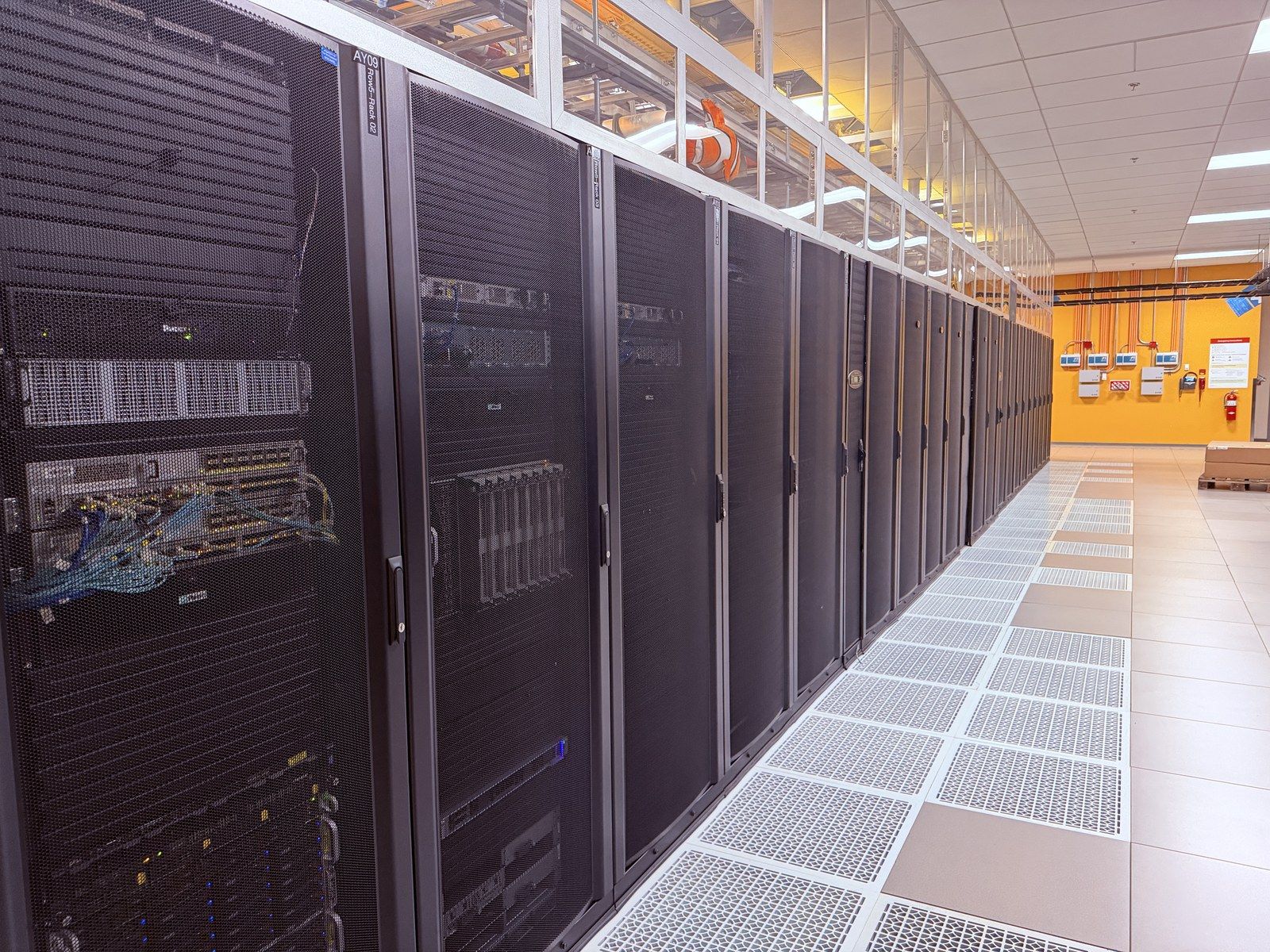
The Penn State spinout says its software can cut cooling energy 15% to 30% at a typical data center. The harder part of the sale, its CEO says, is convincing operators that an algorithm will not break anything.
Leona from RobotToday interviewed Dr. Jie Zhao, chief executive officer and co-founder of Glacian Technologies Inc.
PITTSBURGH — Ask Jie Zhao what a data center operator actually wants and the answer comes back without hesitation.
“The top three KPIs for any data-center operator are reliability, reliability, and reliability,” he said. “They would rather pay more for energy than take a chance that AI might mess something up.”
That is the wall Glacian has to get through. The company, incorporated in January, sells a software layer that sits above the chillers, cooling towers and pumps a data center already owns, and decides how to run them. An AI model looks for a better way to operate the plant. A physics model of that same plant then checks the decision, and if the math does not hold up, the command never reaches the equipment.
Glacian won the EXPlore pitch competition at Pittsburgh Tech Week on Sept. 15, taking home $10,000, and signed its first paying customer the same day. The first commercial installation is due to start within weeks.
Cooling is old. The heat is not.
Computer rooms have needed cooling since the 1950s, and Zhao is careful not to oversell the novelty of the problem. “The topic is not new, but the challenge is new,” he said. A rack the size of a refrigerator used to throw off roughly 10 kilowatts of heat. Fill that same footprint with AI hardware and the number can be a hundred times higher.
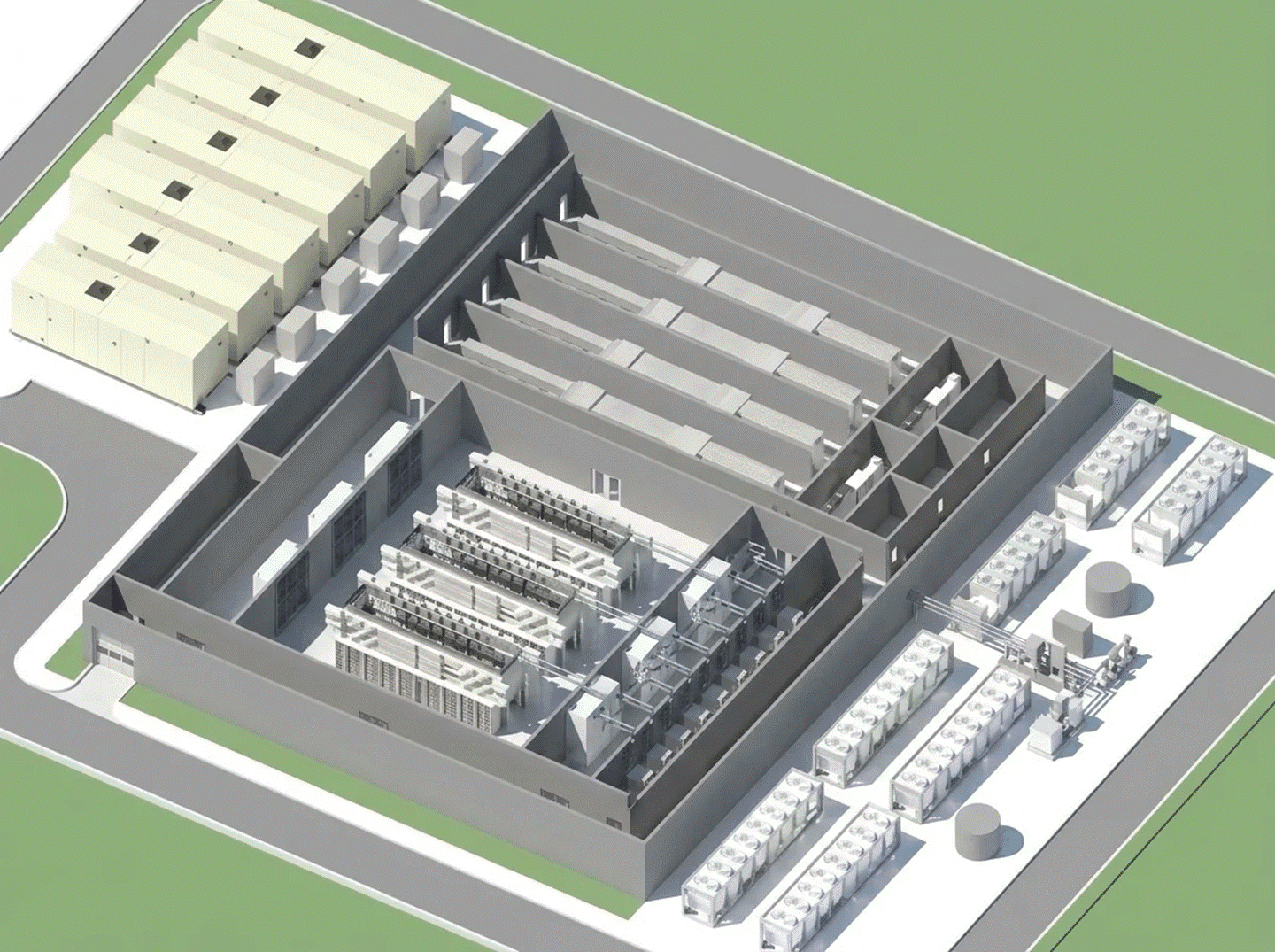
What turns heat into an economic problem is the grid. An operator applies for a power allocation and gets a fixed number, and every kilowatt that goes to cooling is a kilowatt that cannot be sold as compute. In older facilities, Zhao said, cooling can consume as much as 40% of the electricity coming into the building.
The industry keeps score with power usage effectiveness, or PUE, which divides total facility power by the power reaching the servers. A building at 1.0 would spend nothing on anything but computing. By Zhao’s account, existing data centers average about 1.5 to 1.6, the worst he has seen run at 2.0, and new hyperscale construction lands somewhere around 1.1 to 1.2.
Those older buildings are the customers Glacian wants, and it intends to stay with them for the next three to five years. “The existing market alone has enough volume and enough real need,” Zhao said, “even if you ignore all of the new construction.”
It is also a market that is moving toward the company rather than away from it. Pennsylvania and Ohio, Zhao said, have become two of the busiest regions in the country for new data-center construction, helped by cheap natural gas and, in western Pennsylvania, plenty of water.
The model that can say no
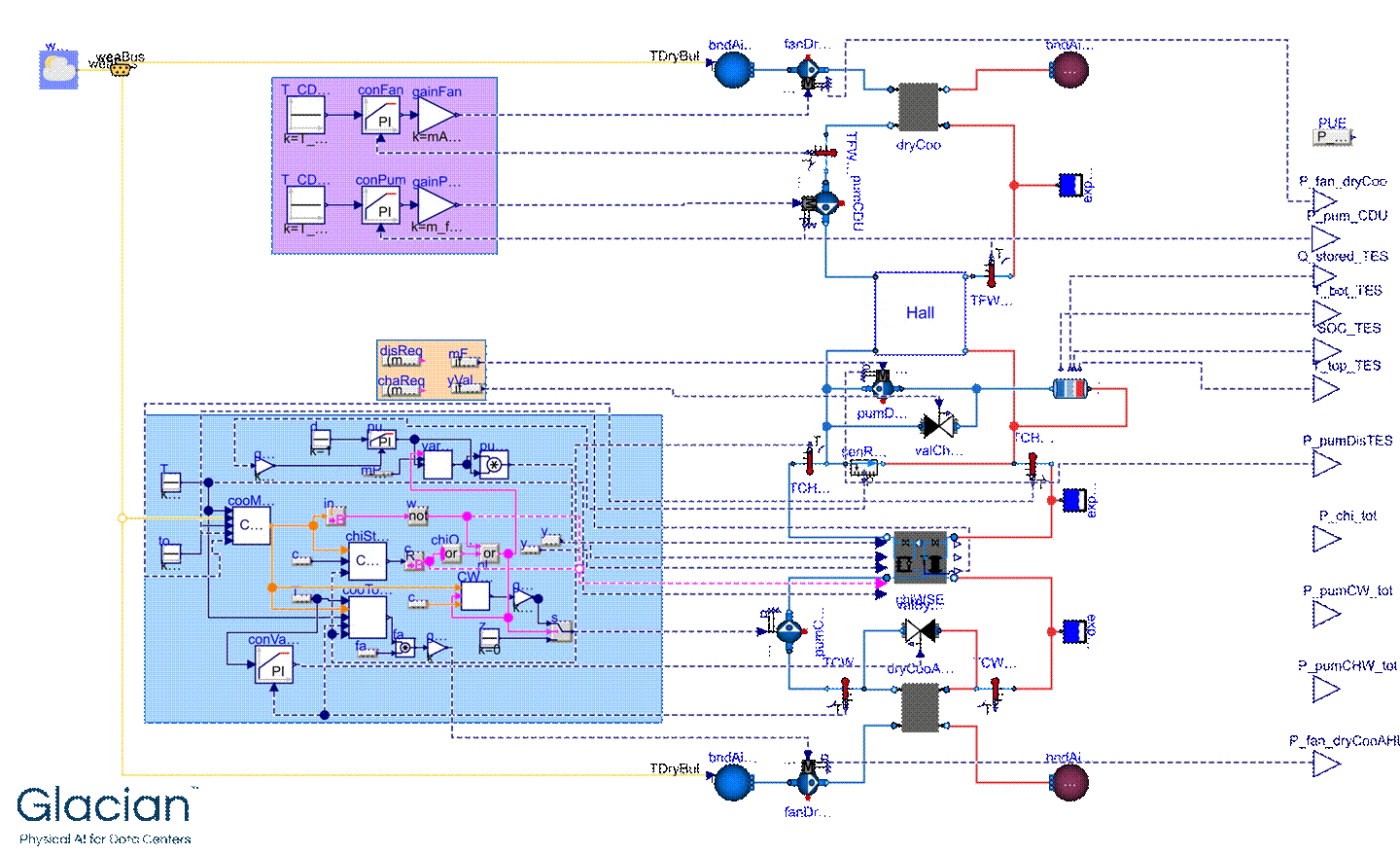
Glacian describes what it sells as physical AI, which in practice means two pieces of software that do not trust each other. The AI reads live data from the plant and hunts for better operating points, such as chilled-water temperatures, valve positions and flow rates. A physics-based digital twin of the same plant, built from the equipment’s own performance curves and calibrated against measured operation, sits behind it.
“Every time the AI makes a decision, changing a valve, temperature, or flow rate, that decision is sent back to the physics model first,” Zhao said. “If the input violates a physical constraint, it will not run. The decision is rejected, and the AI command is not sent to the actual hardware.”
Researchers have spent years trying to teach machine-learning models physics by writing the equations into the algorithm, an approach known as physics-informed neural networks. Zhao argues that keeping the two apart carries more constraints and is easier to explain. “We essentially have a third-party, independent model validating the AI’s decisions,” he said.
The twin earns its keep in other ways. Because it matches the real equipment closely, Glacian uses it to generate training data instead of installing sensors and waiting a year for history to accumulate. An operator planning an expansion can also run the alternatives through it, comparing two more chillers against one chiller and three cooling towers before anyone signs a purchase order. A planned feature would watch the model drift: if the twin stops predicting the machine accurately, something in the machine has probably started to fail.
The modeling comes from Dr. Wangda Zuo, Glacian’s co-founder and chief technology officer, a professor of architectural engineering at Penn State who spent time as a scientist at Lawrence Berkeley National Laboratory. Glacian says the research behind the product has drawn more than $8 million in competitive grants since 2013 from the Department of Energy, the National Science Foundation, the Department of Defense, ASHRAE, JPMorgan Chase and Penn State.
Much of that work was published as open-source software, including the Modelica Buildings Library. On top of that open-source base, Glacian licensed proprietary models, patent rights and know-how from Penn State. Zhao does not pretend the pieces are secret. What is hard, he said, is assembling them. “Open-source research gives you a lot of Lego pieces, but who can turn those pieces into the Statue of Liberty?” The company counts about 35 air-cooled system architectures, which it says cover roughly 99% of what it runs into in the field, and it is working through the hybrid air-and-liquid designs that liquid-cooled AI racks require.
The savings figures from the research years are big enough to invite skepticism, and Zhao volunteers the caveat. Two Department of Energy pilots cut cooling energy by 53% at a Florida data center and 74% at one in Massachusetts. The larger number, he said, came partly from finding a setup error that had been running unnoticed for years, before any optimization was applied. In a more recent proof of concept with a large equipment manufacturer he declined to name, Glacian took another 16% out of annual cooling energy at a facility already running at a PUE of 1.08. For a normal building, the claim is 15% to 30%.
Four weeks of watching
The engineering is only half the job. “At CMU or in Pittsburgh’s tech community, many of us trust AI,” Zhao said. “But when you go into heavy industry and traditional industrial settings, people are trained mechanically. They want ultimate human override.”
So Glacian hands over control slowly. Configuration and installation take about two weeks, most of it spent converting on-site reality to accurate digital twins. Then the software runs for four weeks without touching anything. The customer’s controls stay in charge while a dashboard shows both versions of reality side by side: the plant is holding 65 degrees, Glacian would hold 67, and here is what each choice costs in energy. Only after that month does anyone turn on autonomous control.
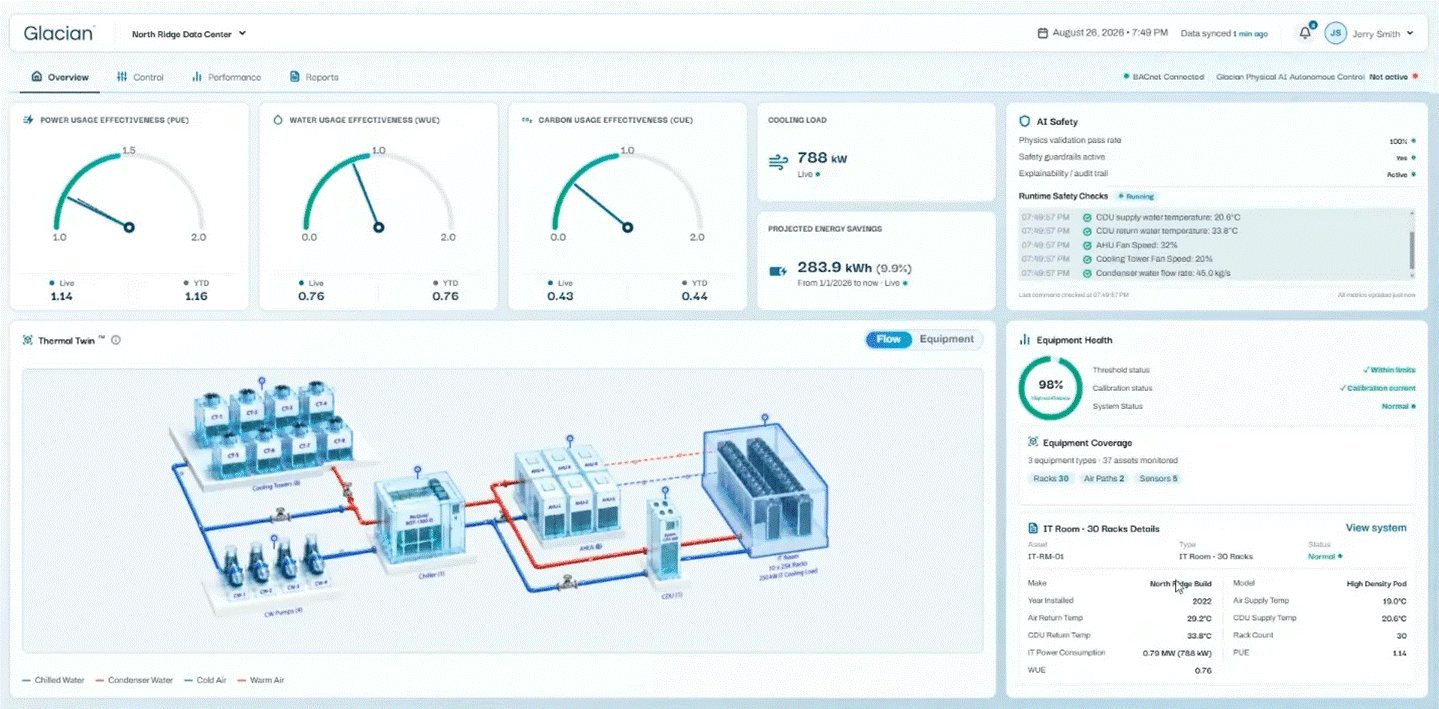
The original control system is never removed. Glacian runs above it at a higher priority, and if the box goes dark the building reverts. “If you unplug our server, the facility goes back to its original controls,” Zhao said. An operator can also shut it off from the dashboard.
The software is deployed on premises for the same reason and is in the process of obtaining security certifications.
Zhao has spent a career in industries that do not rush. First came Lutron Electronics, the building-controls manufacturer, then roughly a decade at Delos, a New York proptech company, working with commercial and residential real estate, senior living, schools and military housing. He treats that as the company’s edge rather than a detour. “We cannot simply be a shiny new startup trying to AI everything in the world,” he said. “We need to understand how the real world works.”
Thirteen years from a conference in France
Zhao and Zuo met at a conference in France about 13 years ago, when Zhao was a doctoral student at Carnegie Mellon writing about energy systems in buildings and Zuo was teaching at the University of Miami. They stayed in touch, worked together occasionally from around 2018, and began talking seriously about a company after Zuo moved to Penn State from the University of Colorado Boulder.
The commercial groundwork started in 2024, when the team went through the National Science Foundation’s I-Corps program, with support from Penn State Gap funding and Ben Franklin Technology Partners. Penn State said in April that Glacian had signed a deal to install the software at Alerify, a data center in Harrisburg, Pennsylvania, later this year.
What the next year has to prove is that the second installation looks like the first. “Our goal is to demonstrate that our standardized product can scale easily, with standardized deployment, performance, and maintenance,” Zhao said, across different cooling systems, climates and building types.
After that, the same software could run any large chiller plant, and Zhao mentions district heating and cooling systems, campuses and factories as candidates. “The concept is the same: regulating fluid flow rates and temperatures,” he said. “That is what we are good at.”



Leave a comment