


The last report in the WRC 2026 series. Report 1 mapped all 248 exhibitors, Report 2 covered the 139 that build finished robots and Report 3 the 137 that supply the parts. This one covers the 47 that supply the software, the compute and the interface.
1. Executive summary
The smallest layer, and the one with the least public documentation. 47 companies. Of eighteen figures re-checked against independent sources, two stood as filed, eleven needed the caveat rewritten and five could not be confirmed. That is the lowest pass rate in the series — but not a like-for-like comparison: the test applied here was stricter than in Reports 2 and 3, and all eighteen were picked for the weight they carried rather than sampled, so this is not a rate for the layer.
Half of it is not a software business. Only 19 of the 47 present as software or algorithm companies. 27 present as component suppliers and 25 as manufacturers. Software here is mostly sold inside hardware.
The real output is in the repositories. Five artefacts can be opened, downloaded and licence-checked: DM0.5, Spirit-v1.5, EmbodiChain, ROBOTO Origin and the EgoPro dataset. In three of the five the licence on the artefact is narrower than the phrase "open-source" suggests, so the terms are worth reading before building on them.
One clean set of segment accounts, from Seer Robotics. Controllers 19.3% of 2025 revenue at a 79.8% gross margin; software 5.3% at 89.3%; finished robots 67.9% at 38.4%. The highest margin sits on the smallest line.
Data collection is becoming a business, on paper. JD plans 10m hours of real-world video in two years using 600,000 people. That was announced in April 2026 and remains a target; WRC was a restatement, not a disclosure.
2. Scope
Report 1 classified 248 of the 316 WRC 2026 exhibitors. This report covers the 47 that carry Control & Software, Human-Machine Interaction, Compute & Chips or Cloud & Data. Only 7 exhibitors sit entirely inside the three software categories, which is too few to read anything from, so this report follows the brain, the chip and the interface as one story. 21 of the 47 also build finished robots and appeared in Report 2; 23 also supply components other than compute and appeared in Report 3.
Launches and company news come from a research pass covering 1 July to 26 August 2026. Verification was stricter here than in the earlier reports: the checkers were required to open the repository or dataset page and read the licence string themselves rather than accept the phrase "open-sourced" from a press release, and to find a public leaderboard page before accepting any ranking claim.
3. What the 47 companies build
Control & Software is the largest category at 26 companies, and it contains two businesses that have little to do with each other. One is embodied foundation models and VLA — AI2 Robotics, Spirit AI, PsiBot, DexForce, Dexmal, RoboScience, XYZ Embodied AI. The other is motion control and middleware — Seer Robotics, Kinco, Leadshine, Tsino-Dynatron, INDEMIND. Human-Machine Interaction has 12, mostly motion capture, data gloves, teleoperation and voice. Compute & Chips has 11 and Cloud & Data only 3.
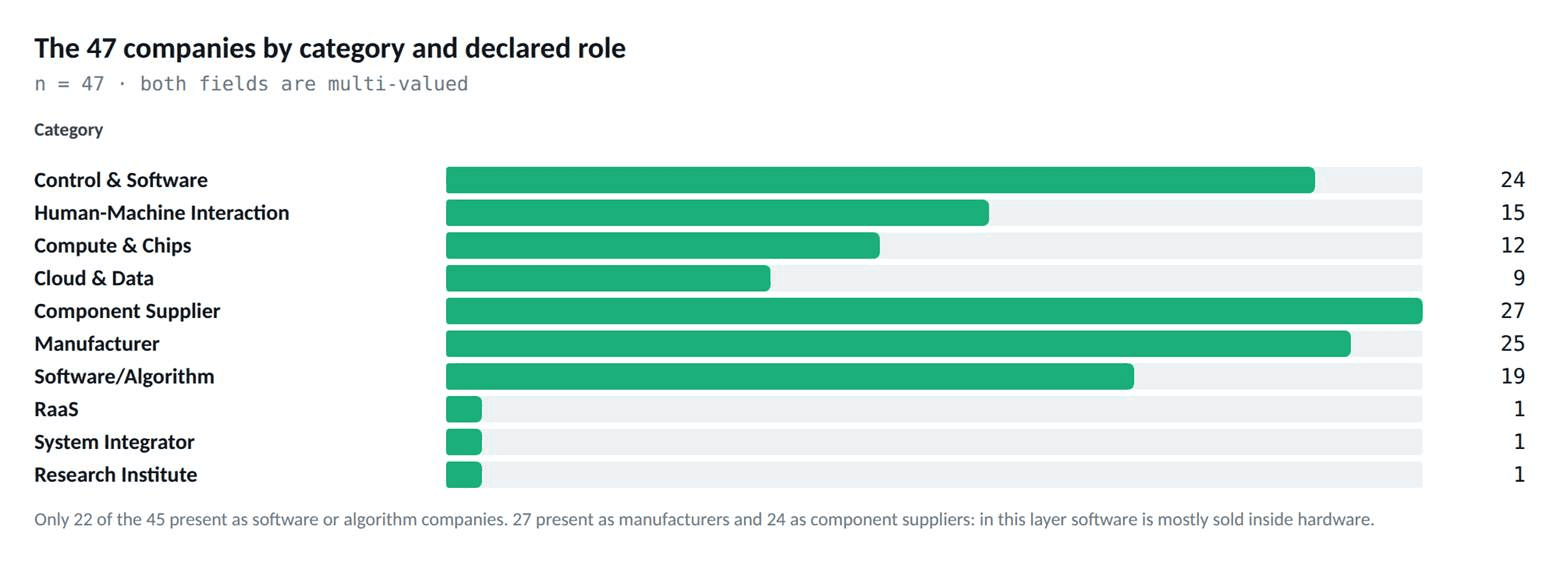
Figure 1. The 47 companies by category and by declared supply-chain role. Both fields are multi-valued.
The role field says more than the category field. Only 19 of the 47 describe themselves as software or algorithm companies. More of them — 27 — describe themselves as manufacturers. Taken with the one set of segment accounts published in this layer, in section 6, that points to software being priced inside the machine rather than sold on its own. It is an inference from how companies classify themselves, not a statement about how good the software is.
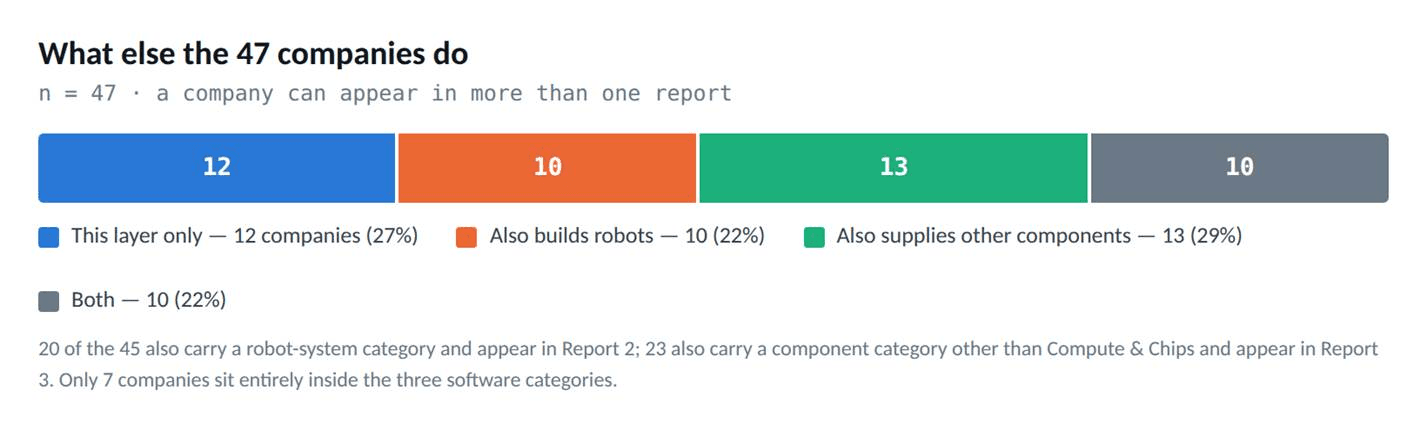
Figure 2. What else the 47 companies do. A company can appear in more than one report in this series.
Twelve of the 47 carry nothing outside this layer. Ten also build finished robots, thirteen also supply other components and ten do both. The pure-software company is the exception here, not the norm.
4. What was released
Judging what was launched is harder in this layer than in the other three: for most of the products this research pass looked at, no checkable specification could be found in any public material. This section therefore covers only what could be opened, downloaded or looked up on a public leaderboard, which leaves out work that may well be real but is not externally testable.
4.1 The open artefacts, and the licences on them
Five artefacts could be opened and read. Dexmal’s DM0.5 repository is Apache-2.0 and ships both code and weights; the README does not state a parameter count, the model card says 6B, and the weights on Hugging Face carry Google’s gemma licence, which is narrower than Apache-2.0. Spirit AI’s Spirit-v1.5 is MIT, with inference code and two checkpoints released. DexForce’s EmbodiChain simulation toolchain is Apache-2.0 and active. RoboParty went furthest: ROBOTO Origin publishes the CAD, PCB, BOM, firmware, reinforcement-learning environment and ROS 2 deployment code for a whole humanoid — under GPLv3, a copyleft licence the announcement did not mention and which obliges anyone building on it to open their derivative too.
Company | Artefact | What is actually open | Licence |
|---|---|---|---|
DM0.5 | training and inference code, plus several weight checkpoints | Apache-2.0 (code) / gemma (weights) | |
Spirit-v1.5 | inference code, base checkpoint and a fine-tuned checkpoint | MIT | |
EmbodiChain | generative simulation world-model toolchain | Apache-2.0 | |
ROBOTO Origin | CAD, PCB, BOM, firmware, RL training environment, ROS 2 deployment | GPLv3 | |
EgoPro | 10,000 h of paired head and wrist video, a subset of EgoSuite-Open100K | commercial-training-no-resale-v1.0 | |
Kaihong / M-Robots | M-Robots OS 2.0 | hosted on AtomGit; contents not inspectable from here | not disclosed |
Table 1. Each row was checked by opening the repository or dataset page and reading the licence string, not by quoting the announcement.
The EgoPro dataset is the instructive case. It exists, it is real data rather than synthetic, and it was downloaded 6,516 times in the month to the end of August. But the licence is a bespoke commercial-training-no-resale terms file, access has to be requested and then authenticated through the Hugging Face CLI, and the claim that it was donated to the OpenAtom Foundation has no confirmation from the foundation’s side. The 100,000-hour EgoSuite-Open100K and the 10,000-hour EgoPro are a parent set and a subset; the two numbers are not interchangeable.
4.2 Public leaderboards
Public leaderboards are the rarest thing in this layer, and the clearest case here shows why they are also hard to run. On 3 June 2026 Spirit AI’s Spirit v1.6 was posted at the top of RoboArena — a platform run by UC Berkeley, Stanford and NVIDIA — on 1,924 points, with Cosmos3-Nano-Policy on 1,881, and the result was widely reported. Within days the organisers said they had seen signs that results were being manipulated, revised the methodology and retroactively removed the affected evaluations; Spirit v1.6 no longer appears in the rankings. Pranav Atreya of UC Berkeley, a lead author on the benchmark, said publicly that evaluations had been removed from organisations found to be engaging in benchmark manipulation. No source identifies who operated the accounts involved, no technical finding has been published, and Spirit AI has not commented publicly. DexForce’s first place in Track 2 of WorldArena, a Tsinghua FIB-Lab benchmark with a published paper and a public leaderboard, stands.
At the other end, the RoboDojo scores quoted for DM0.5 — 24.90 overall, 19.34% success — appear on no leaderboard, on no model card and in no independent account. Until a source surfaces, this report does not quote them. Spirit-v1.5’s RoboChallenge result is real (66.09 points, 50.33% success) but the correct wording is that in January 2026 it was the first model past 50%, not the only one.
One result here deserves to be stated plainly rather than only audited: publishing a complete humanoid — mechanics, electronics, firmware and training environment — under a copyleft licence. Anyone can download it and check it, which is why it is the strongest single item in this report. The RoboArena episode makes the same point from the other side. A third-party leaderboard is only as good as the controls around who submits evaluations, and a score is only as good as the day it was checked. An artefact with a licence on it cannot be withdrawn a week later.
4.3 Compute and operating systems
The chip side was covered in Report 3: what came to Beijing was general-purpose platforms and automotive parts repositioned for robotics. Two additions belong here. GigaDevice’s GD32H7 series puts an EtherCAT IP block inside a 600 MHz Cortex-M7 microcontroller with IEC 61508 certification, which is a part designed specifically for multi-axis synchronisation. On the operating-system side, M-Robots OS 2.0, led by Kaihong and hosted on AtomGit, claims ROS 1, ROS 2 and Dora-rs compatibility and support for more than twenty robot form factors — but both its 2.0 release in May and its community launch in June happened at other events, not at WRC, and its latency figures come with no published test method.
5. How the figures were verified
Eighteen figures were handed to separate researchers who were asked to challenge them, using sources the original researchers had not touched. Two held as filed. Eleven appear here with the caveat corrected. Five could not be confirmed and are marked.
Claim | Verdict | What changed |
|---|---|---|
DexForce: first in WorldArena Track 2; EmbodiChain open-sourced January 2026 | As filed | Benchmark is a Tsinghua FIB-Lab paper with a public leaderboard. Repository real and Apache-2.0 |
RoboParty: ROBOTO Origin publishes CAD, PCB, BOM, firmware and deployment code | As filed | Repository opened and inspected. Licence is GPLv3, which the announcement did not state |
Dexmal DM0.5: 4B-parameter VLM, Apache-2.0, RoboDojo 24.90 / 19.34% | Restated | Model card says 6B; weights carry the gemma licence; the RoboDojo scores appear nowhere |
Spirit-v1.5: the only model above 50% on RoboChallenge | Restated | MIT licence. Score 50.33%. It was the first past 50%, in January 2026, not the only one |
Spirit v1.6: first in an ICRA 2026 blind test, beating Cosmos3 and Pi0.5 | Restated | The event is RoboArena, not ICRA. The 1,924 result was posted on 3 June 2026 and removed days later when the organisers reported signs of benchmark manipulation and revised the methodology; the model is not in the current rankings. The Pi0.5 comparison is unsourced |
Lightwheel: 100,000-hour dataset donated to the OpenAtom Foundation | Restated | EgoPro is the 10,000-hour subset. Access requires approval. No confirmation from the foundation |
Seer Robotics: controllers 19.3% at 79.8% margin, software 5.3% at 89.3% | Restated | Listing confirmed, 06106.HK, 24 June 2026. Segment decimals come from media accounts of the prospectus, not the filing itself |
Seer Robotics: 50,000 controllers installed, over 500,000 hours of real-robot data | Restated | 50,000 is cumulative shipments, not units online. The 500,000-hour figure has no independent source |
Seer Robotics: 1,150 customers | Restated | Two different metrics circulate: annual customers served (587 → 1,150) and connected ecosystem including integrators (2,100+) |
JD: 10m hours of data in two years, 600,000 people | Restated | JD’s own wording, but announced 16 April 2026 and still a target. 600,000 = 100,000 staff plus 500,000 externally recruited |
Reported of AI2 Robotics: 1,000+ AlphaBot 2 delivered in 2025; unit cost under RMB 6,000 in 2026 | Restated | Neither figure could be traced to the company or to any other source. What is documented is a three-year deployment order of 1,000+ units and a line rated at about 1,000 a year |
iFLYTEK: 420 robot companies and 35,000 developers on the platform | Restated | From WRC 2024, not 2026. The developer count is reported as both 15,000 and 35,000 for the same speech |
M-Robots OS 2.0: released at the show; 1 µs task switching | Restated | Released in May at an OpenHarmony event and launched as a community in June at another; neither at WRC. No test method published |
PsiBot: 99.9% operation accuracy; RMB 2bn raised | Restated | The accuracy figure appears only on the exhibitor-submitted product page, not in the company’s own April release. The RMB 2bn is cumulative and dates to March 2026 |
Chingmu Vision OptiUMI: 0.04–0.05 mm, a fifth of the cost of a laser tracker | Not confirmed | Company statement only. No range or conditions given, and no source places the product at WRC 2026 |
TendonBot: sub-millimetre data glove; 0.001° gimbal at under 25 g | Not confirmed | Figures appear only on the exhibitor page. An independent account puts small-batch production in 2027 |
Jinyuan: 94% QA pass rate on teleoperated data collection | Not confirmed | The company is genuinely in this business, but the figure has one source and no stated industry baseline |
Tachin: open tactile dataset covering 20 task types | Not confirmed | Only the glove hardware could be confirmed. No repository, licence or download location found |
Table 2. Eighteen figures re-checked against independent sources. "Restated" means the figure holds once its basis is stated precisely; "not confirmed" means no independent source could be found, not that the figure is wrong.
Three differences between announcement and record recur here: a weights licence quoted as the code licence, a number from an exhibitor-submitted product page quoted as a conference measurement, and something announced months earlier at another event described as a launch at this one. Only the first is particular to software; the other two appear in Report 3 as well. They are listed so readers can check for them, not as a mark against any company.
6. Where the business is
One company in this layer published segment accounts during the window. Seer Robotics listed on the Hong Kong main board on 24 June 2026 under the Chapter 18C route for specialist technology companies, ticker 06106.HK.
Of RMB 442m in 2025 revenue, finished robots were 67.9% at a 38.4% gross margin, controllers 19.3% at 79.8%, and software 5.3% at 89.3%. The highest margin sits on the smallest line. That is the shape of the business in this layer: software is where the margin is, hardware is where the revenue is. The controller average selling price fell from RMB 25,900 in 2023 to RMB 10,700 in 2025 — volume up, price down, which is what a component becoming standard looks like.
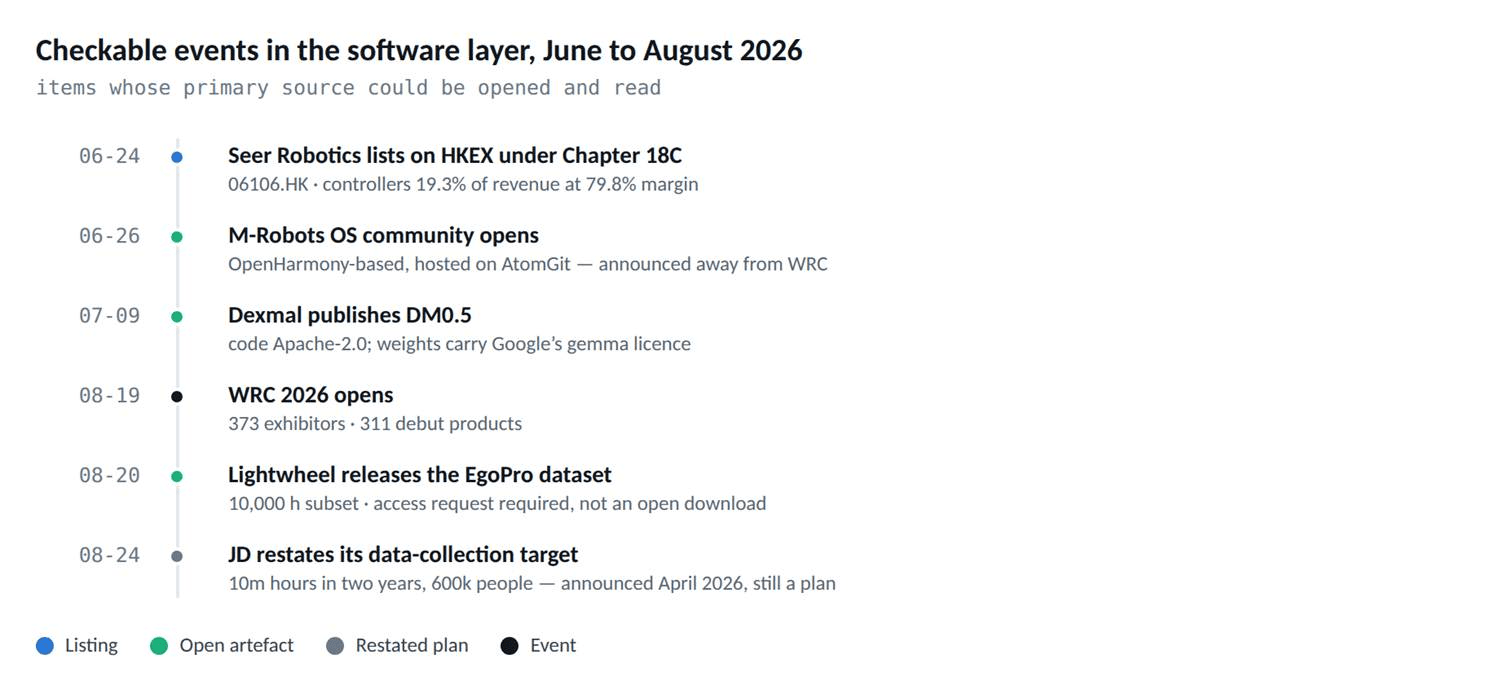
Figure 3. Checkable events in the software layer, June to August 2026.
The other business taking shape is data. JD announced in April 2026 that it would collect 10 million hours of real-world video over two years using 100,000 staff and 500,000 externally recruited collectors. Lightwheel put a 10,000-hour subset on Hugging Face. Jinyuan is selling teleoperated data collection as an outsourced service. The path is clear enough; what none of them has yet is a completed number.
7. How to read this
Three things the data supports.
Software is not yet a standalone business here. 19 of 47 companies call themselves software firms, and the one company that publishes the split earns 5.3% of its revenue from software. Software is currently the margin on hardware rather than a line of its own.
What can be verified comes from open source and academic benchmarks. Five repositories, one dataset and two public leaderboards carried nearly all the checkable evidence in this report. Almost none of it came from a company announcement.
Data collection is being built out as a business. JD, Lightwheel, Jinyuan and Tachin are all working the same problem from different ends, and one of them has put a usable dataset on a public host. What none of them has published is a completed volume, so the size of this market is still a plan.
The usual limit applies, and one more. A trade show reads a software layer worse than it reads a hardware one: what a model can actually do is not visible on a stand, it is visible when someone else reproduces it. This closes the series. The four reports cover the structure of all 248 classified exhibitors, the 139 that build robots, the 137 that supply parts and the 47 here; companies that span layers appear in more than one.
Appendix. The 47 software, compute and interaction companies
Alphabetical. Company names in blue link to that company’s page in the RobotToday supplier directory; a † marks a link that resolves to the parent group’s entry. All 47 companies in this table now have a directory page, so every name here is a live link. "Also" marks companies that also appear in Report 2 (robot systems) or Report 3 (core components); cross-layer companies repeat across reports rather than being assigned to one.
Company | Categories in this report | HQ | Booth |
|---|---|---|---|
Compute & Chips | Santa Clara | B115 | |
Control & Software | Shenzhen | C306 | |
Control & Software | Beijing | A208 | |
Compute & Chips | Wuhan | B303 / B413 | |
Human-Machine Interaction | Shanghai | A107 | |
Control & Software | Shenzhen | C303 | |
Control & Software; Cloud & Data | Chongqing | A302 | |
Human-Machine Interaction | Shaoxing | B415 | |
Control & Software | Singapore | B413 | |
Compute & Chips | Beijing | B302 | |
Control & Software; Human-Machine Interaction | Quzhou | B107 | |
Compute & Chips | Beijing | B312 | |
Human-Machine Interaction; Control & Software; Cloud & Data |
| C228 | |
Control & Software | Beijing | B429 | |
Compute & Chips | Neubiberg | B118 | |
Compute & Chips; Cloud & Data | Fremont | B320 | |
Human-Machine Interaction |
| A508 | |
Compute & Chips | Shenzhen | B409 | |
Human-Machine Interaction; Control & Software | Shenzhen | A325 | |
Control & Software; Human-Machine Interaction | Shenzhen | A413 | |
Cloud & Data; Control & Software | Santa Clara | C121 | |
Human-Machine Interaction | Beijing | B205 | |
Cloud & Data | Shenzhen | B407 | |
Human-Machine Interaction | Seongnam | B222 | |
Cloud & Data | Shenzhen | B216 | |
Control & Software; Cloud & Data | Wuhu | A106 | |
Human-Machine Interaction | Shanghai | B412 | |
Control & Software; Human-Machine Interaction; Cloud & Data | Shanghai | B217 | |
Human-Machine Interaction | Beijing | A121 | |
Compute & Chips | Cupertino | B209 | |
Compute & Chips | Hsinchu | B210 | |
Control & Software | Shenzhen | A513 | |
Compute & Chips | Fuzhou | B311 | |
Control & Software | Shanghai | C233 | |
Control & Software | Chiyoda-ku | B111 | |
Control & Software | Beijing | B101 | |
Human-Machine Interaction | Kunshan | A326 | |
Control & Software; Human-Machine Interaction | Suzhou | D408 | |
Control & Software | Beijing | A207 | |
Control & Software | Hangzhou | D302 | |
Compute & Chips | New Taipei City | D401 | |
Control & Software | Hangzhou | C138 | |
Human-Machine Interaction | Wuhan | C115 | |
Control & Software | Shanghai | A107 | |
Control & Software; Compute & Chips | Beijing | C122 | |
Control & Software | Kitakyushu | B109 | |
Zhongyi (Shenzhen) Embodied Intelligent Technology Co., Ltd. | Cloud & Data | Shenzhen | A107 |








Leave a comment