

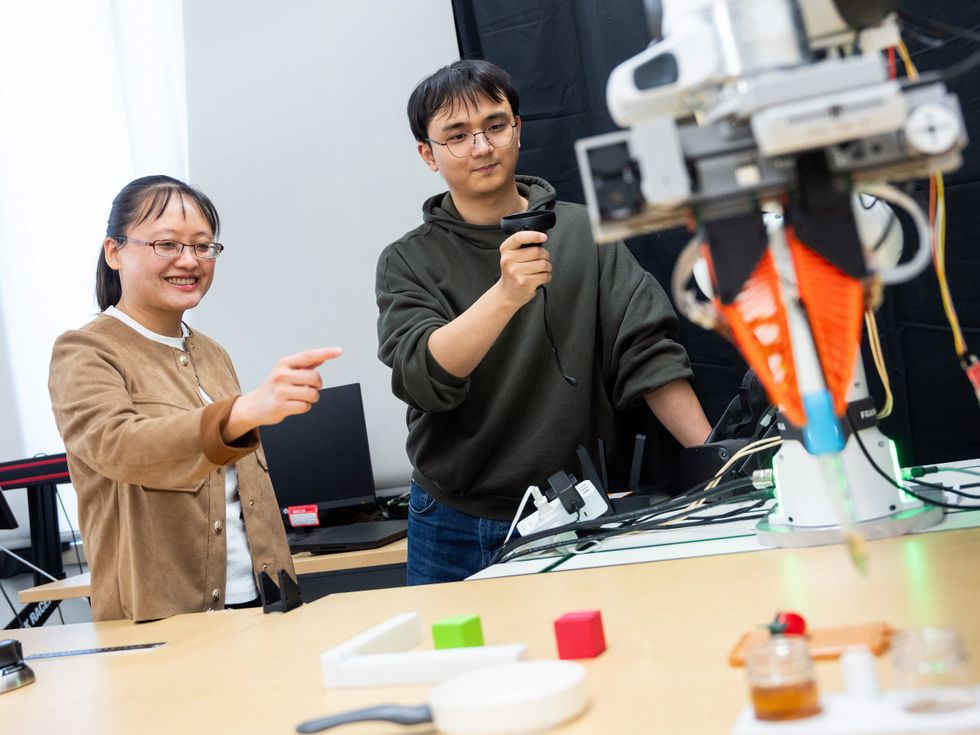
Yen-Ling Kuo, an assistant professor of computer science at the University of Virginia, has been recognized for her significant contributions to robotics and automation. Last year, she received the IEEE Robotics and Automation Society’s inaugural Outstanding Women in Robotics and Automation Early Career Contribution Award for her paper, “Diff-DAgger: Uncertainty Estimation with Diffusion Policy for Robotic Manipulation.” This innovative research introduces a method that enhances robots' ability to identify and manage uncertainty during unfamiliar tasks, thereby reducing the need for human supervision and increasing task completion rates.
Kuo’s journey began in Taiwan, where her fascination with science and technology was sparked by early exposure to programming and computer logic. After earning her degrees from National Taiwan University and MIT, she gained practical experience at Google, where she contributed to AI-driven shopping technologies. This experience motivated her to pursue a Ph.D. to deepen her understanding of neural networks.
Her current research focuses on developing computational models that enable robots to interpret both explicit data and subtle social cues, aiming to replicate human-like reasoning in machines. Kuo's work has garnered attention from the National Science Foundation, which awarded her a five-year Career Award to support her research on human-robot interactions. As robotics and autonomous vehicles become more prevalent, Kuo envisions creating robots that can seamlessly integrate into social environments, enhancing human-robot collaboration.


















Leave a comment