



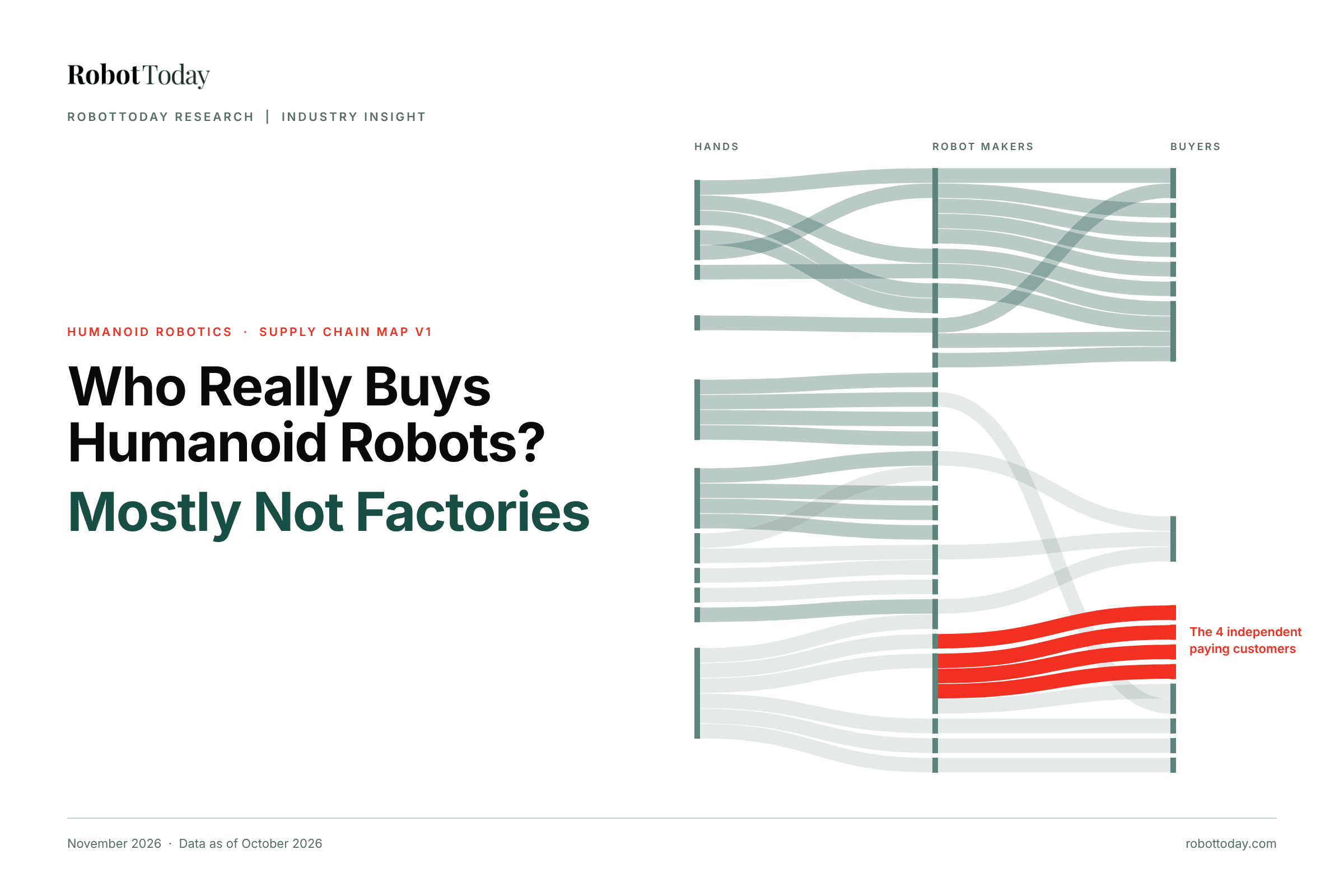
Of 49 public supply-chain links we traced, only 4 end at an independent paying customer. Most humanoids go to labs, state-backed data centers or the robot makers’ own investors.
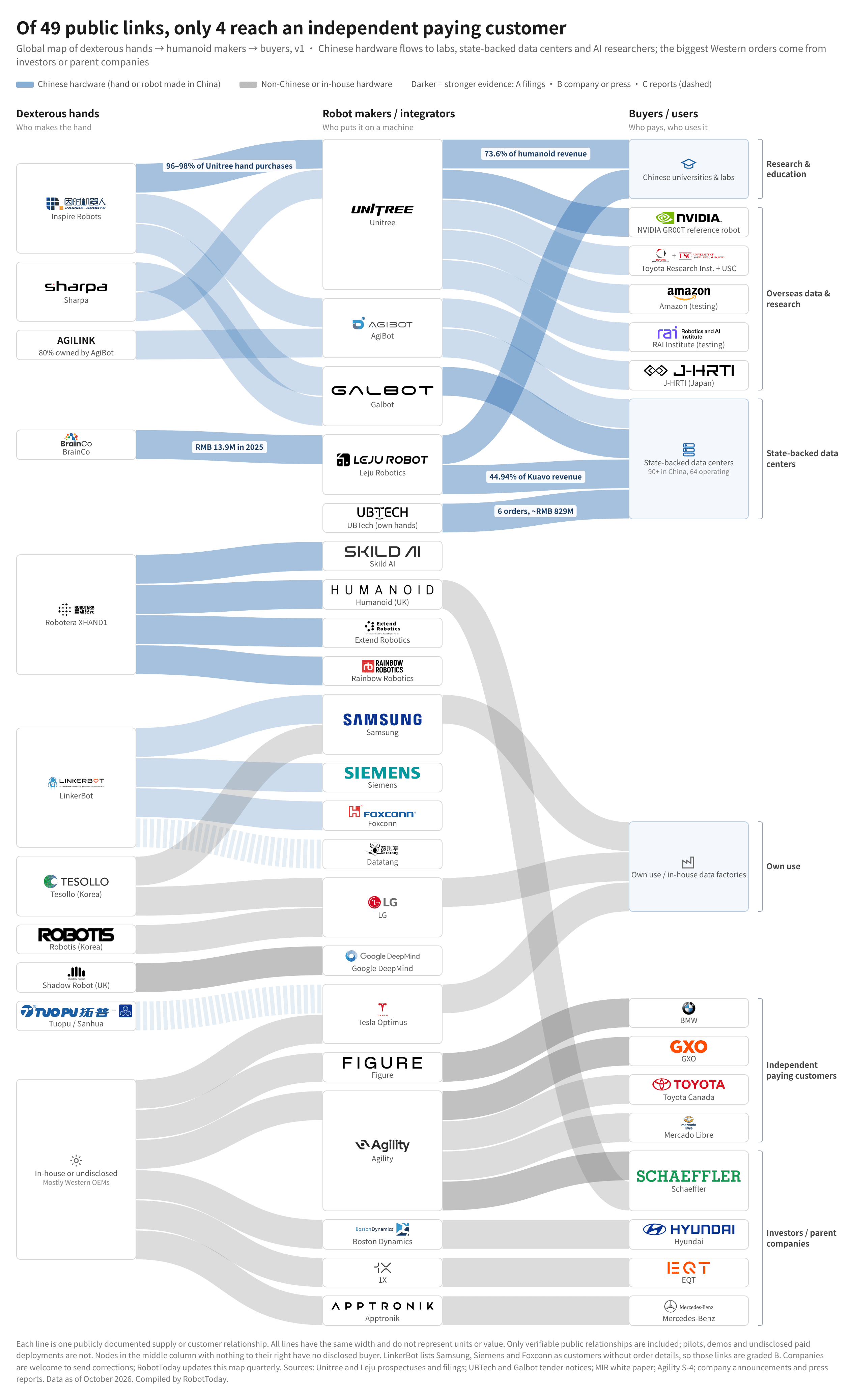
Who buys dexterous robot hands, and who buys the humanoids they end up on? We went through prospectuses, SEC filings, tender notices, company announcements and press reports, and kept only the relationships we could source. The result is one map: 11 hand makers, 21 robot makers and integrators, 16 kinds of buyer, and 49 links between them.
The picture is narrower than the order headlines suggest. Only four of the 49 links end at a customer that pays for robots and has no ownership tie to the robot maker: BMW, GXO, Toyota Canada and Mercado Libre. Every other link ends at a research lab, a state-backed data collection center in China, an AI lab abroad, the robot maker itself, or the robot maker’s own investors and parent companies.
How to read the map
Left: hand makers. Middle: companies that put hands on robots. Right: who pays for or uses the robots, grouped into six buyer types.
Each line is one relationship with a public source. All lines are the same width.
Blue lines carry Chinese hardware; grey lines carry non-Chinese or in-house hardware. Darker lines have stronger evidence. Grade A comes from prospectuses, SEC filings, official announcements or tender notices (16 links). Grade B comes from company press releases or major media (31). Grade C is reports or rumors (2, shown dashed).
Three findings
1. No Chinese humanoid in our data goes to an independent paying customer. Chinese robot makers account for 11 links to buyers. Two go to Chinese universities and labs, four to state-backed data centers, and five to overseas data and research users: NVIDIA, Toyota Research Institute and USC, Amazon, the RAI Institute and Japan’s J-HRTI. The filings point the same way. Research and education made up 73.6% of Unitree’s humanoid revenue in the first three quarters of 2025. Data collection made up 44.94% of Leju’s revenue from its Kuavo humanoids. About 59% of UBTech’s 2025 contract value came from six data-center orders.
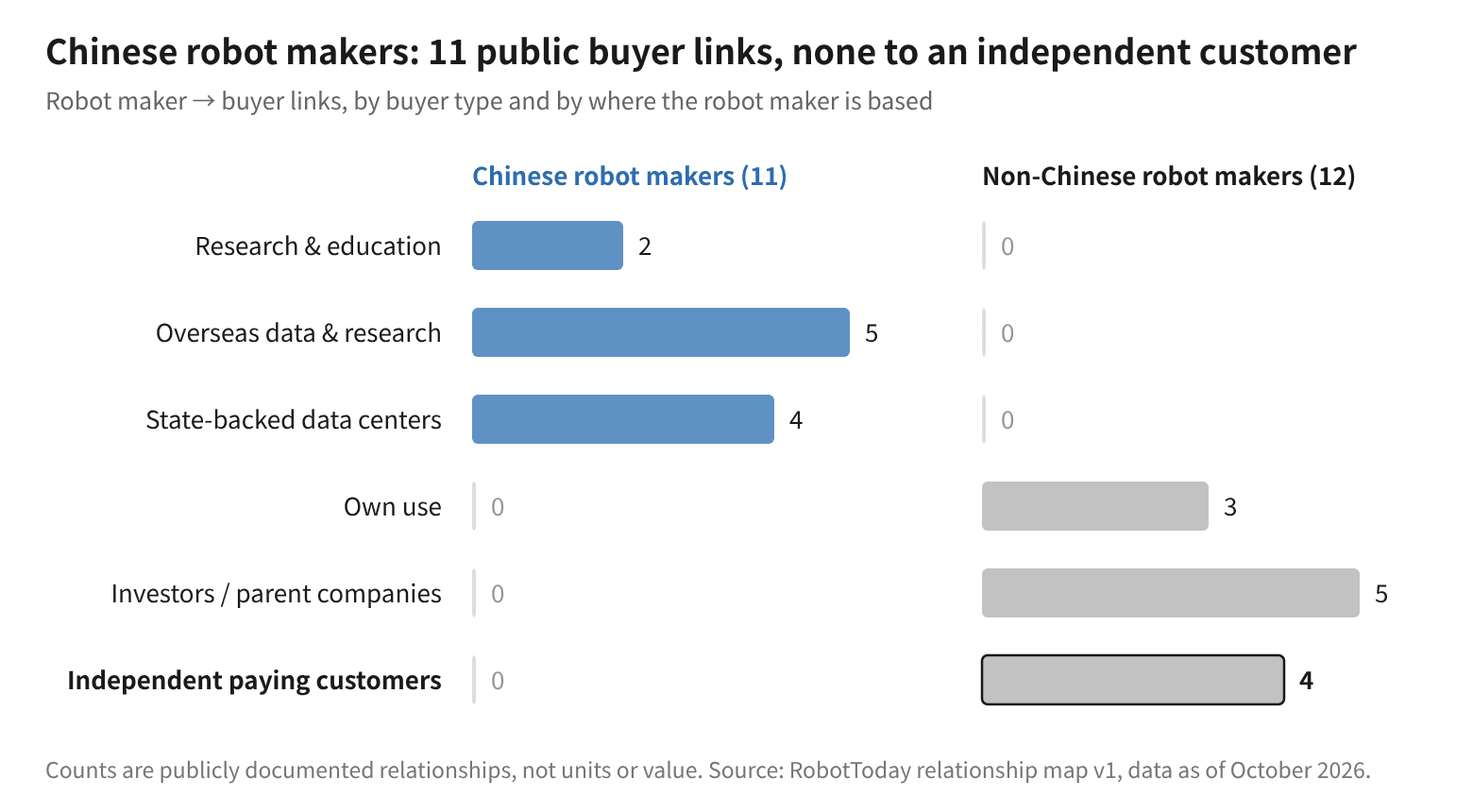
2. In the West, the big orders come from inside the family. Non-Chinese robot makers account for 12 buyer links. Five go to investors or parent companies: Schaeffler (an investor in Agility and in UK-based Humanoid), Hyundai (Boston Dynamics’ parent), EQT (an investor in 1X) and Mercedes-Benz (an investor in Apptronik). Three are the makers’ own use. All four independent paying customers sit on this side of the map, in logistics and car plants.
3. Chinese hands go abroad to AI companies, not factories. Robotera sells its XHAND1 to Skild AI, Humanoid, Extend Robotics and Rainbow Robotics. Sharpa’s hand is on NVIDIA’s Isaac GR00T reference humanoid, and Unitree robots are in use at Toyota Research Institute, Amazon and the RAI Institute. The steadiest export market for Chinese hardware is data collection and research.
This does not mean demand is fake
Research and data collection are real demand, and pilots with investors are a normal way to prove a product. But it does mean that humanoid prices and valuations have not yet been tested by an independent buyer deciding to spend its own money.
Since September, Chinese outlets including Yicai, Huxiu, National Business Daily and 36Kr have examined the “internal loop” behind China’s data collection centers. 36Kr proposed testing revenue quality by looking at repeat purchases once buyers with capital ties are removed. The model itself is changing. Phase one of the humanoid data training center at Beijing’s Shougang Park was shut in August, its equipment supplier RealMan pulled out, and Leju won the bid for phase two. Our map adds the global view. The West has a closed loop too; it sits in the capital structure rather than in hardware sales.
What the map leaves out
Only relationships we could verify from public sources are included. Car-plant pilots, training demos and framework agreements without disclosed payment are not counted, so “four” is a floor, not a full count.
Western companies disclose less, so the grey side may look thinner than it is.
LinkerBot lists Samsung, Siemens and Foxconn as customers without order details. We grade those links B.
Lines are uniform and do not compare scale.
Corrections welcome
This is version 1 of the map, with data as of October 2026. We know it is incomplete, and it may contain errors.
If your company makes hands or robots, or buys them, and you are on the map or think you should be, please send us:
supply, purchase or deployment relationships that are public or can be made public;
corrections or additions to the links shown, with something we can verify, such as an announcement, press release or contract summary;
objections to an evidence grade.
Email: [email protected]. We will check each submission, update the next version and publish a correction log. The map is updated quarterly.


Leave a comment