



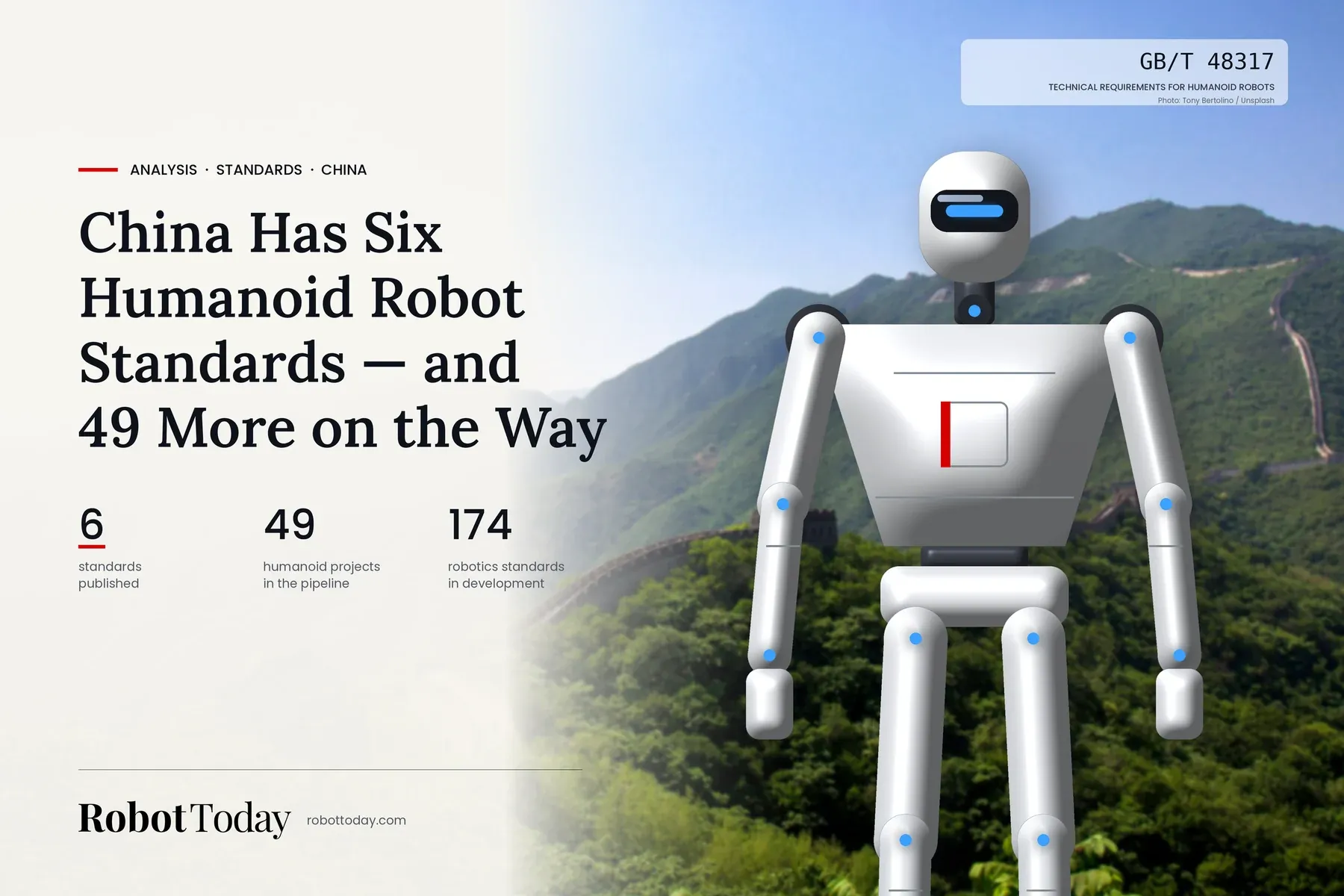
While international safety work on humanoids is still at the committee-draft stage, Beijing has published its first national humanoid standards and is pushing dozens more through the pipeline. A RobotToday analysis of 174 active robotics standard projects shows what is coming, who is writing the rules, and why it matters for companies outside China.
On September 28, 2026, China's State Administration for Market Regulation approved the country's first six national standards dedicated to humanoid robots. They take effect on April 1, 2027. Five of them form a single series, GB/T 48317 Technical Requirements for Humanoid Robots, covering general requirements, environmental perception, decision-making and planning, motion control, and task-oriented manipulation. The sixth, GB/T 48316, specifies simulation testing platforms.
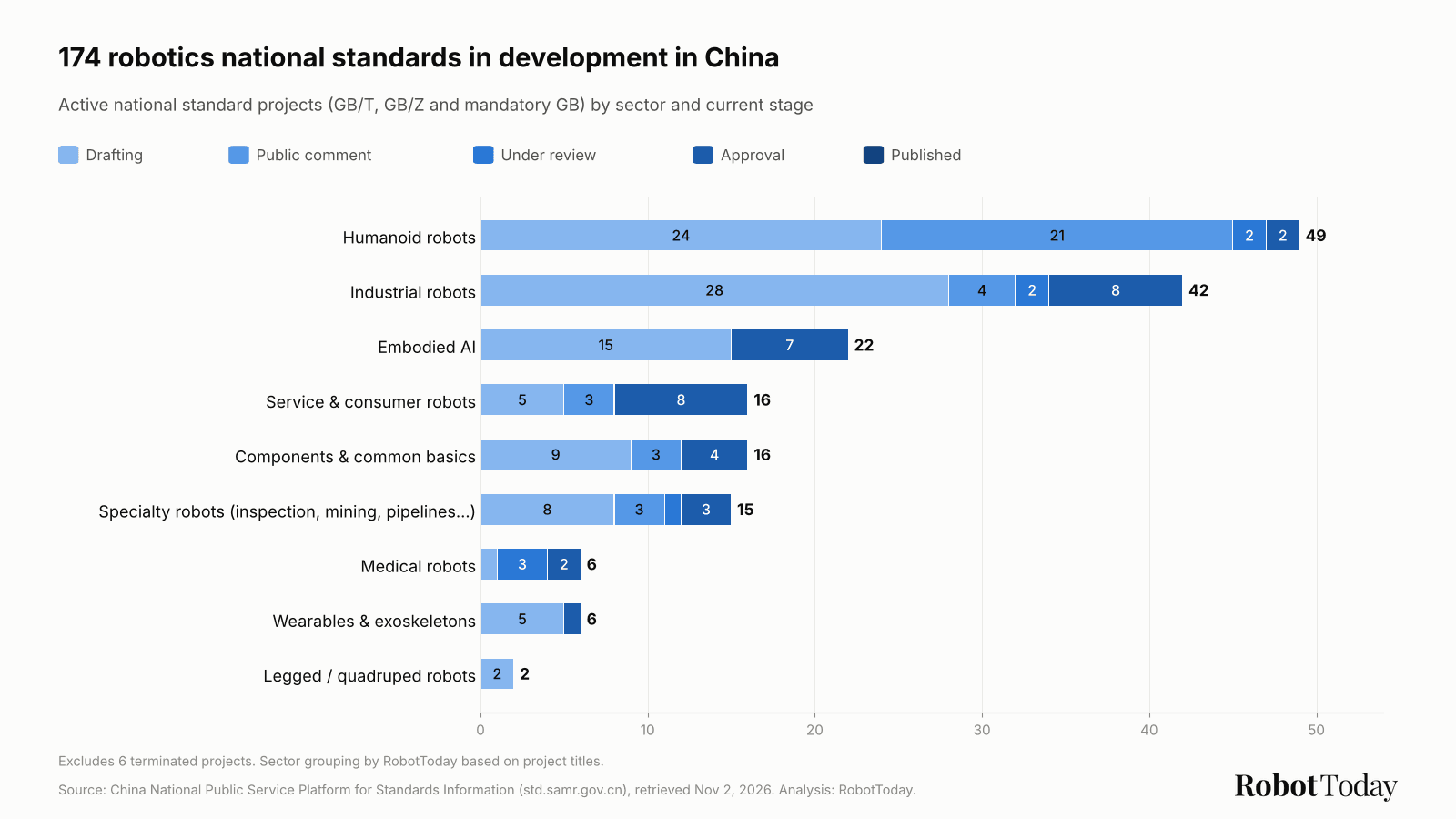
These six are only the start. RobotToday reviewed every robotics-related record on China's official national standards database, the National Public Service Platform for Standards Information (std.samr.gov.cn). We found 49 more humanoid-specific national standard projects in progress, and 174 active robotics and embodied-AI standard projects in total. Of those 174, 105 were launched in 2026 alone.
There is still no internationally recognized standard written specifically for humanoid robots. ISO/TC 299's ISO 25785-1, which covers safety requirements for industrial mobile robots with actively controlled stability (a category that includes legged and humanoid machines), is still a committee draft. China is the first major economy to build a complete national standards stack for the category, and it is building quickly.
A 60-second primer on Chinese standards
GB is a mandatory national standard. Products sold in China must comply.
GB/T is a recommended national standard. It is voluntary in principle, but procurement specs, test labs and certification schemes routinely cite it, so in practice it becomes the benchmark.
GB/Z is a guidance technical document. It is used for fast-moving fields, and most of China's embodied-AI documents take this form.
SAC/TC591, the National Technical Committee for Robot Standardization, owns most robotics standards. Its Humanoid Robot Subcommittee (TC591/SC5) runs the humanoid program.
Every project moves through the same stages: drafting, public comment, technical review, approval and publication. Drafts and explanatory notes are posted publicly during the comment stage.
The humanoid stack: built in matched series
China is not writing humanoid standards one at a time. It is building them as interlocking multi-part series, each mapped to a layer of the machine and its development cycle.
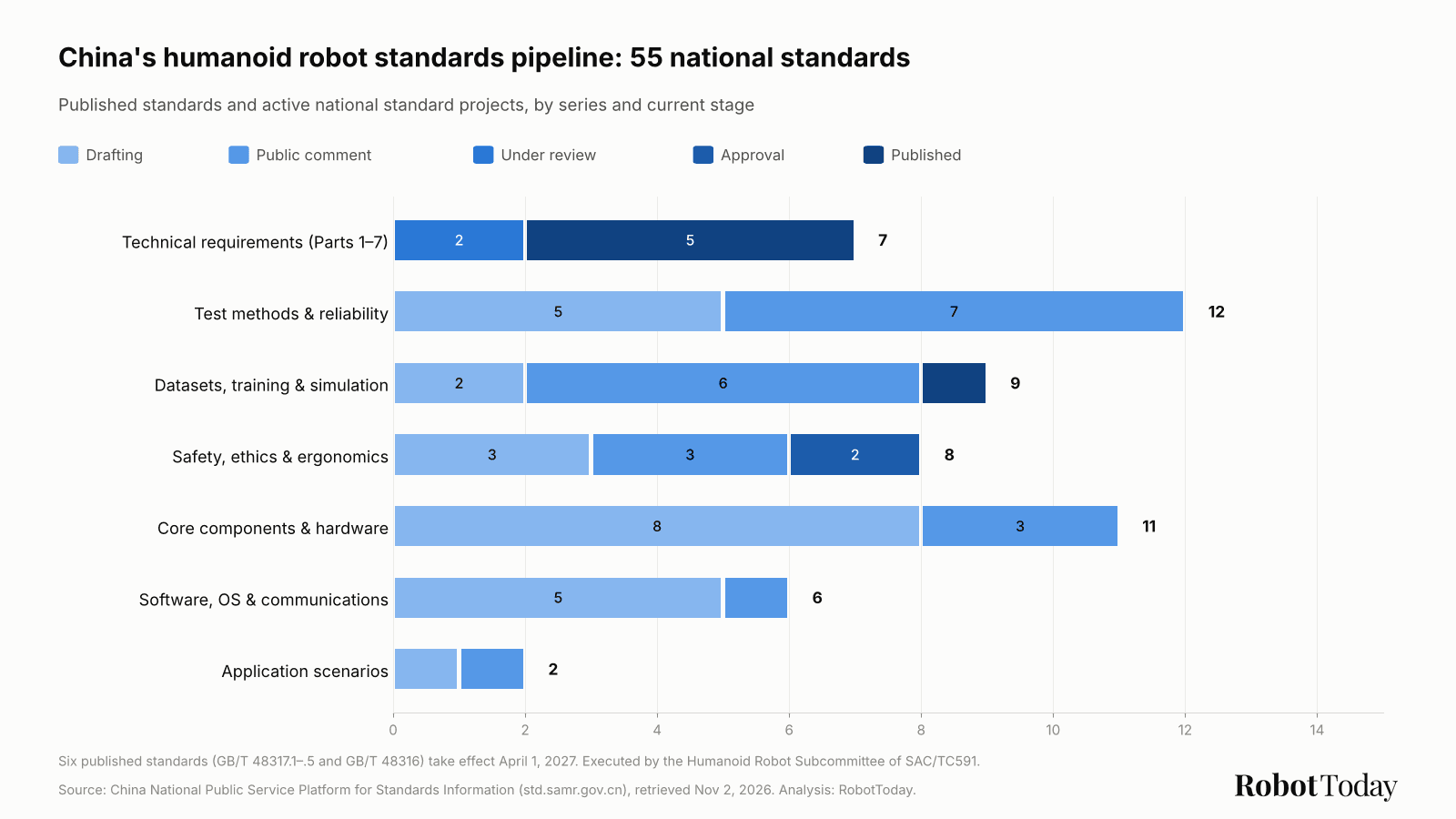
Technical requirements, Parts 1–7: Parts 1–5 are published. Part 6 (localization and navigation) and Part 7 (human-robot interaction) are under technical review, which makes them the most likely next humanoid standards to be released.
Test methods, Parts 1–7: each part maps one-to-one onto a technical-requirements part. All seven were issued on March 31, 2026, and are now in public comment. A separate three-part reliability test series covers general rules, linear joints and rotary joints.
Datasets, Parts 1–6: general rules, whole-body manipulation, motion control, human-robot interaction, cognition and decision-making, and quality evaluation. Parts 1–5 are in public comment. Shanghai has also published a local standard, DB31/T 1707-2026, on managing humanoid datasets.
Safety requirements, Parts 1–5: these are split by deployment scenario into general, industrial, personal and household service, public service, and special-purpose use. Parts 1–3 are in public comment.
Components: joint motor drivers, reducers, vision sensors, joint torque sensors, controllers, energy management, a three-part integrated electric joint series (rotary, linear and interface), and EMC.
Software and systems: a humanoid operating system, body communication interfaces, short-range interaction, cloud-edge-device collaboration, multi-robot fleet management and modularity.
The first six standards also show how fast the process can run. Their project numbers show they were launched in 2025, and they were published in September 2026. Leading drafters included the Beijing Research Institute of Automation for Machinery Industry (RIAMB) for Part 1, Unitree for Part 2, Pujiang National Laboratory for Part 3 and the simulation standard, the Beijing Humanoid Robot Innovation Center for Part 4, and UBTech for Part 5. Each drew 31 to 54 drafting organizations.
| Standard | Title | Lead drafter |
|---|---|---|
| GB/T 48317.1-2026 | Technical requirements for humanoid robots — Part 1: General | RIAMB |
| GB/T 48317.2-2026 | Part 2: Environmental perception | Unitree Robotics |
| GB/T 48317.3-2026 | Part 3: Decision-making and planning | Pujiang National Laboratory |
| GB/T 48317.4-2026 | Part 4: Motion control | Beijing Humanoid Robot Innovation Center |
| GB/T 48317.5-2026 | Part 5: Task-oriented manipulation | UBTech Robotics |
| GB/T 48316-2026 | Humanoid robots — Technical specification of simulation testing platform | Pujiang National Laboratory |
China's first humanoid robot national standards. Published Sept. 28, 2026; effective April 1, 2027.
The next wave lands in 2027
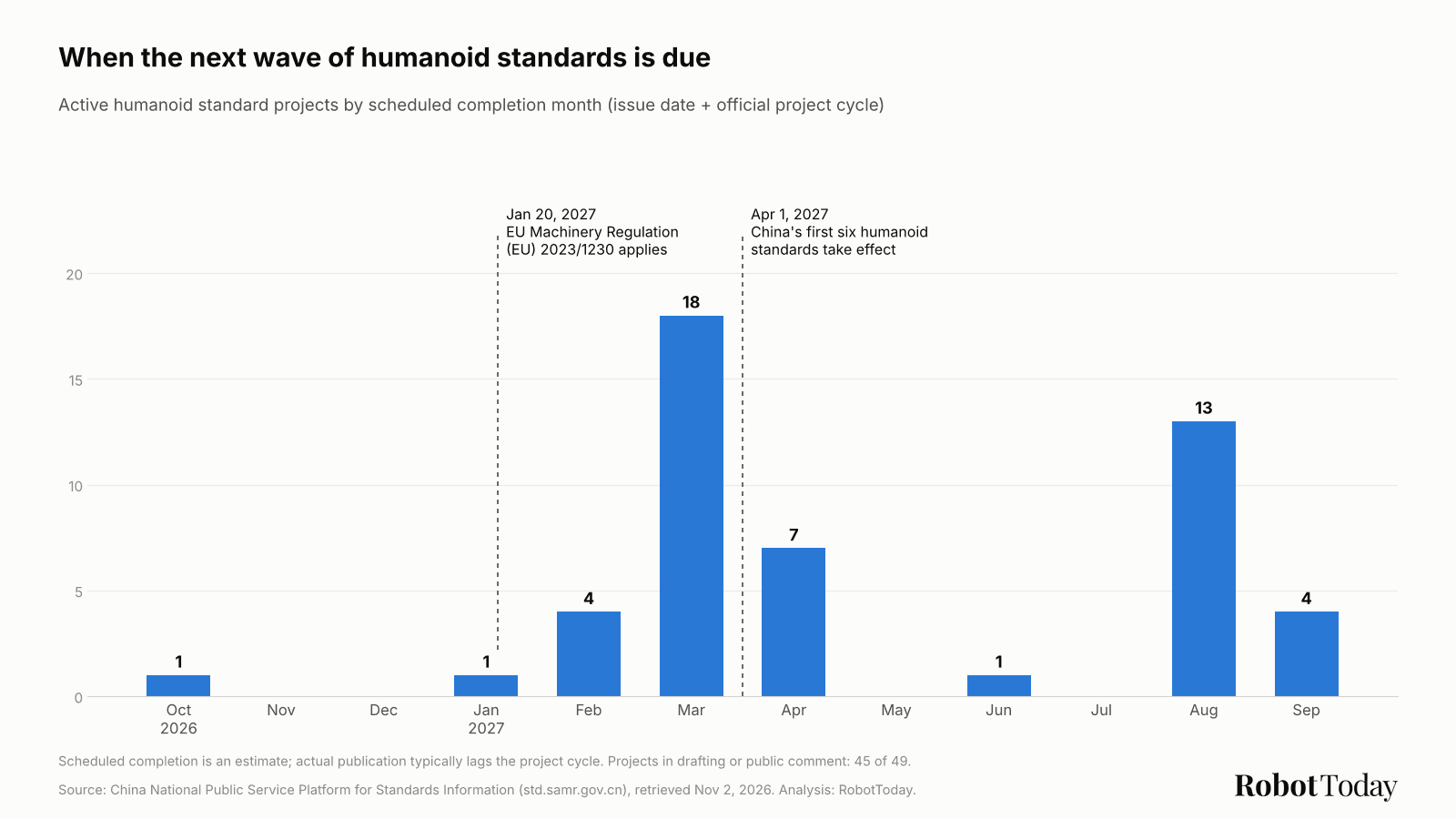
Every project on the platform has an official project cycle, usually 12 to 18 months. Adding that cycle to each project's issue date shows two clusters for the humanoid program: one around March and April 2027, which coincides with the first six standards taking effect, and another around August and September 2027. Treat these as scheduled deadlines rather than firm publication dates, since Chinese standards often run past their nominal cycle. Even so, the direction is clear: the test-method, safety and dataset series are moving toward publication over the next 12 months.
Who is writing the rules
Across the 55 humanoid standards and projects, the drafting lists are dominated by China's leading humanoid makers and component suppliers. UBTech is named on 32, Xiaomi Robotics on 26 and Unitree on 23. Others that appear repeatedly include the Beijing Humanoid Robot Innovation Center, 58 Intelligent Technology (Hangzhou), tactile-sensor maker PaXini, dexterous-hand maker Linkerbot, ZTE and China Mobile. Telecom and ICT companies such as Huawei, China Mobile and TD Tech lead the communications and operating-system projects.
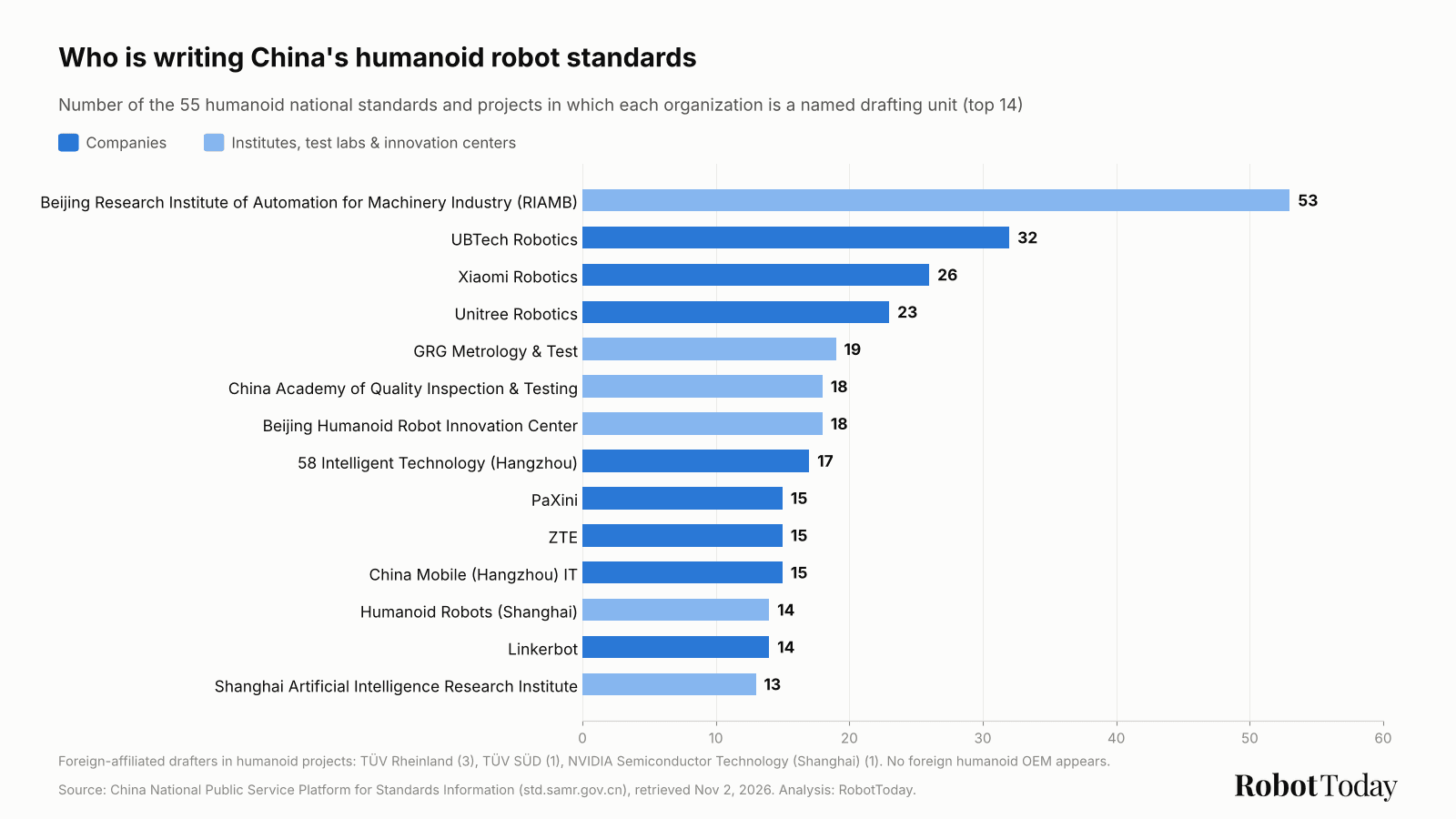
Foreign participation is close to zero. On the humanoid side we found only certification bodies TÜV Rheinland (three projects) and TÜV SÜD (one), plus NVIDIA's Shanghai entity on the guidance document on humanoid robot ethics. No Western humanoid OEM appears on any drafting list. Industrial robotics is different: KUKA (now owned by China's Midea) appears on six industrial-robot projects, FANUC's Shanghai joint venture and Yaskawa's China entities appear on several, and Nabtesco's Shanghai unit leads a national standard for precision cycloidal reducers for robots.
Industrial robots: a mandatory safety rewrite
There are 42 active industrial-robot standard projects. For any company selling robot arms or robot cells into China, the most consequential is the revision of the mandatory safety standard. In April 2026, the Ministry of Industry and Information Technology (MIIT) launched a two-part revision, Safety Requirements for Industrial Robots, Part 1: Robots and Part 2: Applications and Cells. It will replace GB 11291.1-2011 and GB 11291.2-2013 on a 12-month project cycle. The original GB 11291 parts were based on ISO 10218, which was itself substantially revised in 2025, so watch how closely the new Chinese text tracks it. Recommended companion standards on applying the safety requirements and on safety grading and assessment were launched alongside it.
Two electromagnetic-compatibility standards for industrial robots are also being upgraded from recommended to mandatory. They replace GB/T 38336-2019 and GB/T 38326-2019, are currently in public comment, and are slated to take effect 18 months after publication. Outside safety, the pipeline is filling up with detailed performance test methods (trajectory, stiffness, force/position control, accuracy degradation, accelerated MTBF), digital-twin and autonomous-programming specifications, and reliability and charging standards for industrial mobile robots.
Embodied AI: a parallel track
A second set of standards bodies is writing rules for the AI layer. The AI subcommittee of China's national IT standards committee (TC28/SC42) has 16 embodied-AI guidance documents in progress. They cover intelligence-level grading, large-model systems, training grounds, simulation platforms, operating systems, data generation, dexterous manipulation, trustworthiness and ethics. Seven are already at the approval stage. Two have been published: GB/Z 218.1-2026 on real-world embodied-AI data quality and GB/Z 220-2026 on data-generation platforms. China's national data standards committee (TC609) is separately drafting three high-quality embodied-AI dataset documents, led in part by the Beijing Humanoid Robot Innovation Center and Galbot.
Data is therefore being standardized along three lines at once: TC591's humanoid dataset series, TC28's embodied-AI documents and TC609's dataset work. If these converge on shared formats and quality metrics, China's humanoid makers will be able to pool and trade training data in a way the fragmented Western ecosystem currently cannot.
Why it matters outside China
First-mover reference. With ISO 25785-1 still in draft and no published international humanoid standard, China's test methods and grading schemes may become the de facto benchmark that labs, buyers and regulators elsewhere look to first. The humanoid series is written from scratch. Unlike many Chinese robotics standards, none of these projects is an adoption of an ISO standard.
Market access. Any Western humanoid or component maker that wants to sell into China, the world's largest robot market, will be measured against GB/T 48317 and its companion test methods. Industrial-robot OEMs face a new mandatory safety baseline within roughly a year.
A 2027 convergence. The EU's new Machinery Regulation (EU) 2023/1230 applies from January 20, 2027. China's first humanoid standards take effect on April 1, 2027. Companies shipping humanoids and cobots to both markets will be working through two new compliance regimes within the same quarter.
Who sets the rules. The people drafting China's humanoid standards are the same companies competing hardest for global humanoid market share. That gives them an early say in how capability, safety and reliability are defined and measured.
What to watch over the next 12 months
Publication of humanoid technical requirements Parts 6 and 7, which are now under review.
Final texts of the humanoid safety requirements series. Parts 1–3 are in public comment, and how the industrial and household parts handle fall hazards and physical human-robot contact will be closely read.
A batch release of embodied-AI GB/Z documents, seven of which are at the approval stage.
The draft of the mandatory industrial-robot safety standard (the GB 11291 revision) and how closely it aligns with ISO 10218:2025.
Whether Chinese experts bring the GB/T 48317 framework into ISO/TC 299 discussions, including ISO 25785-1.





Leave a comment