


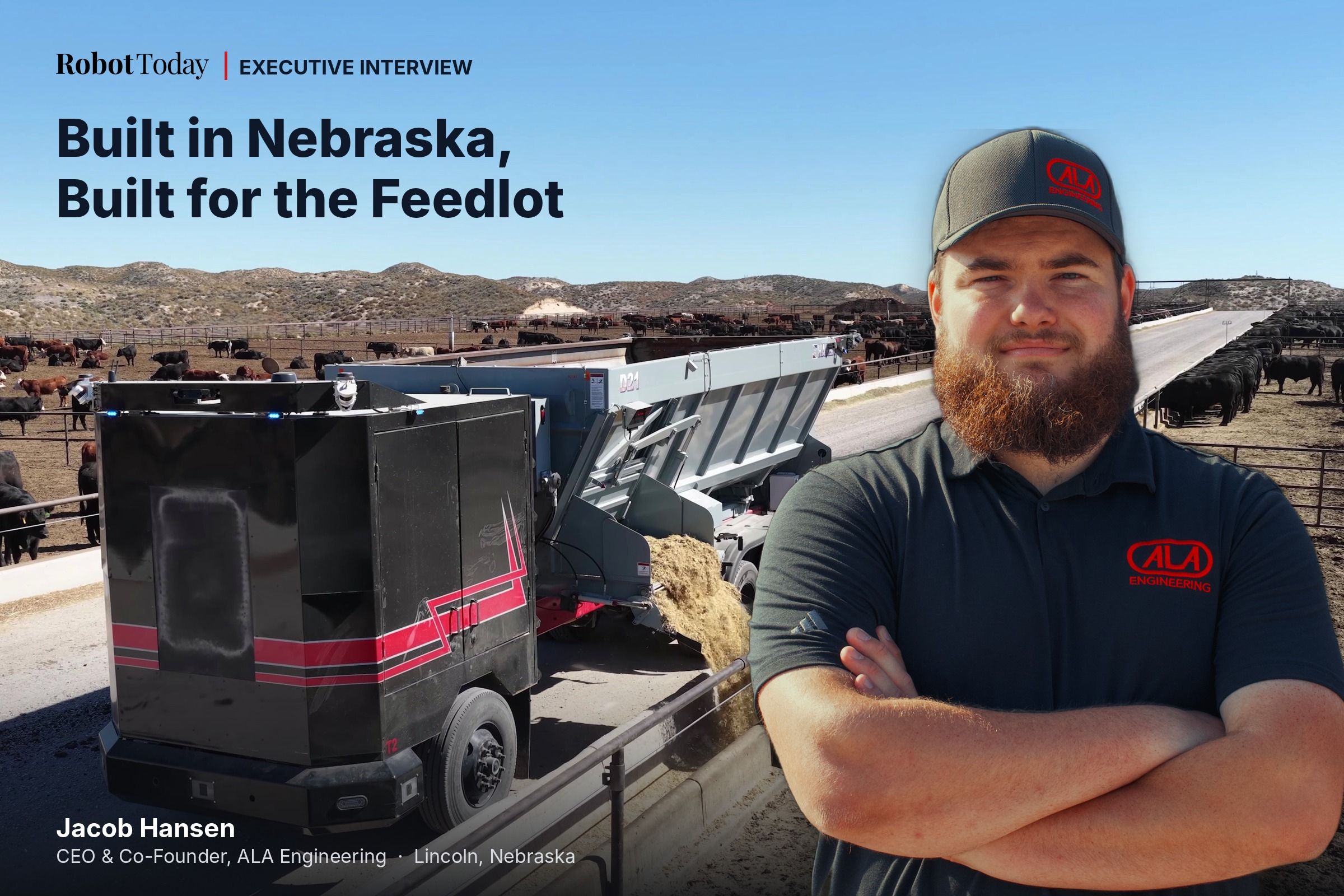
Built in Nebraska, Built for the Feedlot: ALA Engineering's Jacob Hansen on Driverless Feed Trucks
ALA Engineering has spent seven years testing a cab-less, autonomous feed truck in some of the toughest weather conditions in the United States. CEO and co-founder Jacob Hansen told RobotToday why cattle feeding is one of the first places where autonomy pays for itself, how the trucks handle a blizzard, and why a fleet of roughly 900 trucks is the real market.
A large U.S. feedlot never closes. Its feed trucks run six to twelve hours a day, every day of the year, through summer heat and Christmas Eve cold. Finding people to drive them, and keeping them, is getting harder.
ALA Engineering, based in Lincoln, Nebraska, builds a truck that does that job without a driver. Its ALA Navigator (ALAN) system combines radar, LiDAR, RGB and thermal cameras and GPS on a custom chassis with no cab. The company is a sister business of AGEO Autonomy, which develops the underlying off-highway autonomy stack. ALA expects its first commercial deployments in Nebraska in 2027.
RobotToday spoke with Hansen on October 15, 2026. His answers have been condensed and lightly edited for clarity.
The problem: a job nobody wants on Christmas Eve
RobotToday: What is the most urgent problem your customers face today?
Jacob Hansen: The biggest thing is finding the right people. It is hard to find and retain the people who keep an operation moving, particularly in this sector. Feed trucks have to run anywhere from six to twelve hours a day, 365 days a year. It could be minus 30 degrees outside on Christmas Eve, and a feed truck driver has to be out there, away from family, doing very difficult work in a terrible environment. It is not an easy job to staff. It has a high burnout rate, and it is hard to keep people around.
The people you can keep are extremely valuable, especially when it comes to animal health and safety and running the facility. They are more useful doing those higher-value tasks than sitting in a feed truck. Autonomy gives you the consistency that every day this truck is going to start, run and complete its tasks, with only one or two other people required.
You still need a person on site on Christmas Eve when it is minus 20 outside. But it is one person, who can be in his warm F-150 or running the loader while autonomy completes the feed delivery.
RobotToday: Where does the truck's job end and the human's begin?
Hansen: We are focused on the delivery of feed. We are not deciding which animals need which feed, and we are not making nutritional or veterinary decisions. There is a human in the loop every time the truck is empty. You call the empty truck up to be loaded with the next ration, a person verifies what it is going to feed, and then sends it on its way. We are trying to move that valuable human experience to other parts of the operation, away from feed delivery itself.
Safety: every sensor on one truck, and a human on site
RobotToday: How does the truck keep working in snow, dust and darkness?
Hansen: We have not only redundant sensors but redundant sensor modalities. A lower-cost, smaller robot may be forced to depend on cameras. We essentially stack every major commercially available sensor modality onto one vehicle: radar, LiDAR, RGB cameras, thermal cameras and GPS, all fused together. Where one sensor struggles with lighting or environmental conditions, another can take over.
At the same time, we enforce fairly strict site management practices. There is nothing a system designer can do about a 30-foot patch of black ice on a hill. Part of the responsibility sits with the customer and its operators to make sure the operating domain is met and a minimum safety standard for the environment is maintained. We can ask for that because feedlots are closed, private facilities with their own maintenance teams.
As conditions degrade, the truck moves into different modes. It slows down, becomes more cautious and asks for more human involvement. In really bad weather, cameras and LiDAR are heavily degraded, so we rely more on thermal and radar. The truck can still tell that the area ahead is drivable surface and keep moving slowly. But if it sees an obstacle that the cameras and LiDAR cannot confirm, it stops. There is no rerouting or maneuvering around obstacles in those conditions.
RobotToday: Does someone have to watch the truck?
Hansen: We always require a human physically on site. They do not have to be near the vehicle or focused on it. Often it is a mill operator or loader operator who carries our rugged control tablet. If a truck runs into an issue, they get a notification and go and help it. It is passive supervision of machines working elsewhere on the facility.
RobotToday: Have you had to take over manually during testing? What did you learn?
Hansen: We define an autonomous control mode and an operator control mode. In operator mode, the vehicle can be driven with a safety-rated radio remote. That is mainly used for trailering, for parking in areas where GPS is heavily degraded, or for moving a truck out of the way after a major sensor fault so it can be serviced.
In seven years of testing, there have been no safety incidents that required a manual takeover. The bigger lessons came from building our own vehicle and chassis. There were mechanical failures along the way as we learned to build a better truck through each design iteration, and there were definitely times we had to walk a truck back for service or move it away from active operations so a service truck could get to it.
The market: about 200–250 big yards and 900 trucks
RobotToday: You target feedlots with 20,000 head or more. How many are there, and how many trucks do they run?
Hansen: Exact numbers are hard to find, but we watch new operations and their size very closely. There are approximately 200–250 operations in the United States at 20,000 head and above. Some of them run up to 100,000 head. That is our initial target market. It is where we see the most need and the most customer interest.
A very rough number for those larger yards is one truck per 10,000 head. That counts trucks actively feeding. They also keep spare trucks, because feed trucks break down regularly and you need a backup ready when a main truck goes down. Smaller yards usually run more trucks per head, but smaller ones, because losing one large truck could cost them half their feeding capacity.
So at roughly 200–250 operations and one truck per 10,000 head, the napkin math gets us to about 900 trucks. On a three-to-five-year replacement cycle, that is 180 to 300 trucks a year.
| Hansen's estimate | Figure |
|---|---|
| U.S. feedlots at 20,000+ head | ~200–250 |
| U.S. feedlots at 5,000+ head | 600–700 |
| Active feed trucks per 10,000 head (large yards) | ~1 |
| Active trucks in the 20,000+ segment | ~900 |
| Feed truck replacement cycle | 3–5 years |
| Implied annual replacement demand | 180–300 trucks |
RobotToday: Do customers have to replace their whole fleet at once?
Hansen: No. The large yards are where we can bring in one truck at a time and run a hybrid fleet, with human-driven trucks working alongside autonomous ones. The autonomous trucks simply add to the feeding capacity you already have. There is a lot of money invested in standard feed trucks, so the idea is to bring in an autonomous truck as each old truck cycles out.
Once trucks start leaving our lease fleet and come up for sale, we think smaller operations can buy a used autonomous truck and make the numbers work. That opens up hundreds more operations that could see a quick return and the consistency autonomy brings.
Selling a truck: made to order, priced per customer
RobotToday: What does it take to bring on a new customer?
Hansen: We want to take our time, make deliberate decisions and build the relationship before we deploy trucks. Each truck has to be customized to fit the operation. There are different truck sizes and different styles of mixer or delivery box, so every truck is made to order. There is no one-size-fits-all feed truck we can mass-produce and sell.
We start by visiting the customer's site, and ideally bring them to one of our pilot or customer sites to see the vehicles working, so they can picture autonomy on their own operation. Once they decide to buy, we sit down and work out exactly which truck they need.
RobotToday: How do you price it?
Hansen: There is no single price. Some operations want true robot-as-a-service: they pay for feeding capacity on their yard with no maintenance on their side. Most of the ones we have talked to want a split service model. They already have the team and facilities for oil changes, engine work and the standard mechanical maintenance every truck needs. We would be responsible for broken sensors, recalibration and software updates. Those variables decide the price for each customer.
Once everything is agreed, we take the order and build the truck. Then we do site surveys and map the facility. For safety, we also install electronic logging devices in the customer's human-driven trucks, so the autonomous and human-driven trucks share the same picture. They know where each other are, the autonomous trucks always yield properly, and we can reroute when an obstacle is blocking a road. It is a fairly lengthy process.
RobotToday: What happens if a truck is damaged in the field?
Hansen: We are targeting cluster deployments, because we need to be on site quickly. Our first cluster is Nebraska, Wyoming and Colorado. We do not yet have teams in places like Texas, Idaho or Washington, and we are careful about that. Who pays for what is part of the agreement: is it truly robot-as-a-service, or a standard truck lease that happens to be autonomous?
One of the biggest risks to a truck is weather. A big hailstorm could damage several sensors or all the antennas on the roof and leave the truck unable to run in autonomous mode. We offset that with hyper-local weather forecasting and hailstorm tracking, so we can tell operators to get the truck under shelter. If damage does happen, we keep parts in stock and we are always available to come out and get the truck running again.
What comes next: new hubs, then new machines
RobotToday: How will you expand beyond the first states?
Hansen: At launch, we focus on that first cluster. We hope that in mid-to-late 2027, or possibly 2028, we open a second hub with a remote service location, so we have employees within driving distance of the next cluster. That will likely be Kansas, Oklahoma and Texas. If you look at where feedlots are, it is very clear where the clusters need to be. With two or three locations, we think we can cover almost all the feedlots in the U.S.
After that, whether it is us or partners, dealer networks and support networks, that is what will let us expand into Canada, Australia, South America and the other places where the same autonomous feeding technology applies.
RobotToday: Beyond cattle feeding, which application would you pick next?
Hansen: We hope to announce a different vertical sometime next year. For now, the first AGEO partnership is also in agriculture: another manufacturer, with a different platform. Next year, we hope to announce our first non-agricultural application, or at least one a long way from feeding.
Why Nebraska: "I couldn't imagine building it anywhere else"
RobotToday: What does Nebraska give you, and what does it hold you back on: talent, capital, supply chain?
Hansen: The terrain and weather patterns in Nebraska make it very useful for building agtech. Nebraska is in a unique spot where we get the weather the North gets and the weather Texas gets. Over the course of testing, our trucks have been through various weather events, from hailstorms to blizzards and tornadoes. So we have experience in almost every weather, temperature, lighting and environmental condition, including the solar and space weather that affects GPS.
We also deliberately make testing harder. A lot of it happens at medium-sized feedlots with rougher terrain, more slope and worse drainage. That pushes the truck harder than the conditions it will typically encounter in the field. The environment in Nebraska gives us a competitive advantage and allows us to build a more capable, more reliable truck.
Second, Nebraskans have grit. It would be hard to find test technicians and deployment engineers elsewhere who will go out with these trucks at minus 20 to run and test them. Lincoln is a great place to find the talent needed for the agriculture and agtech industries.
Third, the producers. Nebraska is beef country, with feedlots of every shape and size. Some are incredibly advanced technologically, with their own software development and innovation teams. People wouldn't expect that here. In Lincoln and Lancaster County specifically, there are resources such as The Combine, Nebraska's agtech incubator and startup network, and LaunchLNK, which connects Lincoln entrepreneurs to resources, funding and community support to build and grow successful startups. ALA has benefited from programs like The Combine. Most recently, the AgWorks Corridor was launched: an 11-county initiative spanning Nebraska and Iowa that brings together businesses across the agtech sector to strengthen the region's agricultural innovation ecosystem.
There are limits for a market of our size. You don't have the density of Silicon Valley, Pittsburgh or Austin. Running a venture-backed, full-stack deep-tech company in a mid-sized market can be hard, because the investment environment has some fundamental limitations. But I couldn't imagine building it anywhere else but right here in Lincoln, Nebraska.
RobotToday's take
ALA's pitch works because it narrows the problem instead of chasing full autonomy everywhere. Five things stood out.
A closed site changes the safety case. A feedlot is private, mapped and maintained by its own staff. That lets ALA set the operating domain with the customer, put ELDs in the human-driven trucks, and stop rather than improvise when sensors are degraded. Public-road autonomy has none of those levers.
Supervision is designed to be passive. One worker with a tablet, doing another job, covers the autonomous truck. The human stays in charge of what to feed. The machine handles the driving. That split is easier for a cautious buyer to accept than "no people."
Adoption follows the replacement cycle. Feed trucks turn over every three to five years. ALA does not ask a yard to retire a working fleet. It asks for the next truck, which keeps the first purchase small and builds a hybrid fleet over time.
The market is small and countable. About 200–250 yards and roughly 900 active trucks make a niche by consumer-autonomy standards. But the buyers are concentrated, easy to identify and feel the labor problem every day. A later used-truck market could open up the 600 to 700 yards at 5,000 head and above.
Service range sets the growth rate. ALA is growing cluster by cluster because it needs people within driving distance when hail takes out a sensor. Each new hub depends on service capacity and partners as much as on demand.
The open question is capital. Hansen acknowledged that a mid-sized market like Lincoln has fundamental limits on investment compared with Silicon Valley, Pittsburgh or Austin. The planned AGEO partnership with another agricultural manufacturer, and a possible non-agricultural vertical in 2027, suggest the company sees licensing its stack as a way to grow beyond what one feed-truck line can fund.




Leave a comment