


Amazon Robotics Uses Gas Models to Plan Paths for Warehouse Robots
- Published
- Source
- amazon.science
Amazon Robotics operates more than one million robots across over 300 warehouses worldwide. In a paper presented at this year’s International Conference on Machine Learning (ICML), the authors describe a method for planning collision-free paths by modeling robots as particles in a gas. The approach connects multiagent pathfinding (MAPF) with optimal transport, which seeks minimum-cost ways to move resources between locations.
The method contrasts a cold, “lazy” gas, whose particles follow minimum-effort paths, with a hot gas, whose random motion can be computed faster but may produce suboptimal trajectories. A Schrödinger bridge provides the hot-gas model used to efficiently approximate the cold-gas optimal-transport solution. The paper extends optimal transport to multimarginal optimal transport (MMOT), representing robot locations at intermediate time steps so that movement and collision constraints can be modeled across space and time.
For anonymous MAPF, where any robot may travel to any destination, the authors report that their MMOT formulation solves the problem to optimality. They give a practical runtime of O(n^1.68) seconds and a theoretical upper bound of roughly O(n^3), achieved by preserving total unimodularity in the underlying constraint matrices. The paper’s reported result is a computational finding; the source does not disclose a deployment timeline or confirm real-time use in Amazon warehouses.
Original report
Lazy gas, hot gas, and a thousand robots
amazon.science · Amazon ScienceThis briefing is an independently written summary based on publicly available reporting and is provided for industry information and news discovery. The original report and source publication are credited and linked where applicable. RobotToday does not claim ownership of third-party source material.
Rights concerns? Contact [email protected] with the relevant URL and details. We will review the matter and take appropriate action where warranted.
More related news
- 1
- 2
- 3
-
4
RobotToday Weekly November 16–20, 2026 RobotToday · 4 days ago
- 5
- 6
- 7
- 8
- 9
- 10
- 11
- 12
Related Suppliers

Butlr
United States
Privacy-first AI people-sensing platform using thermal sensors to deliver anonymous occupancy and activity data for smart buildings.

Outsight
France
Outsight is a Paris-based LiDAR software company whose real-time 3D platform tracks people, vehicles and robots at airports, rail hubs and industrial sites.
Gleanmer
United States
MIT RLE research chip that maps 3D space for tiny robots using Gaussian occupancy mapping on just 6 milliwatts of power.
Seoul Dynamics Inc.
Korea, Republic of (South)
Korean maker of heavy-duty physical-AI mobile robots: the RAPTOR LIFT 1.5-2 t riderless autonomous forklift and the 10-15 t TYRANNO platform for yards/sites.
FullDepth Co., Ltd.
Japan
Tokyo maker of DiveUnit industrial ROVs (300Lite, HAYATE, KAI) with inspection services, now developing small AUVs for port structure checks.
Tulip Tech
Netherlands
Dutch UAV battery manufacturer founded 2020 in Den Bosch, producing high-density lithium packs (up to 450 Wh/kg) that extend drone flight times by 30–100%.
Mytra
United States
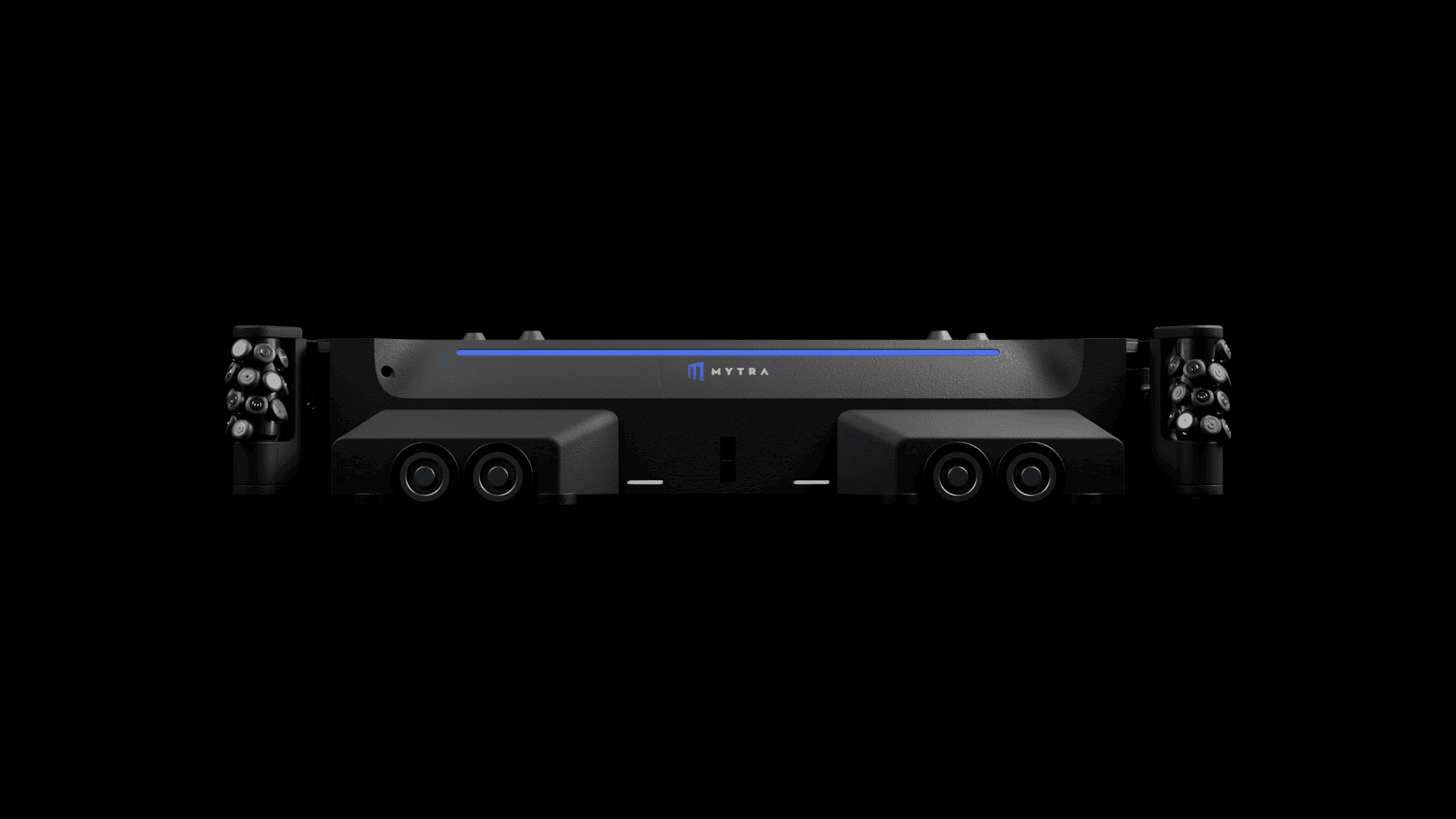
US warehouse robotics company based in Brisbane, CA, deploying Helix-design bots that lift 3,000 lbs in slotless, software-defined ASRS up to 80 ft tall.

Pelican Robotics
United States
US AI-powered warehouse robotics company founded 2022, delivering robotic pick-and-place, palletizing, and load optimization for e-commerce fulfillment.

Robohub
United Kingdom
London-based non-profit publication founded to connect robotics and AI researchers with the public; operated by the Association for the Understanding of AI.
Robocurve
United States
San Francisco public benefit corporation founded 2026 that benchmarks frontier AI models on real robot arms and maintains the Inspect Robots framework.

Oregon State University — Robotics
United States
Oregon State University is a USA research institution whose CoRIS Institute conducts robotics R&D across agriculture, underwater systems, and AI.

Turiya AI
United States
California-based multi-agent AI platform enabling manufacturers to automate engineering, quoting, and production workflows via no-code/low-code SaaS.
Robotics needs a service framework.
RSF defines a common language for robot service capability, lifecycle operations, certification pathways, and service-provider networks.
Join the RobotToday community on LinkedIn
Daily robotics news, in-depth analysis, conference highlights, and discussions with professionals worldwide.


