



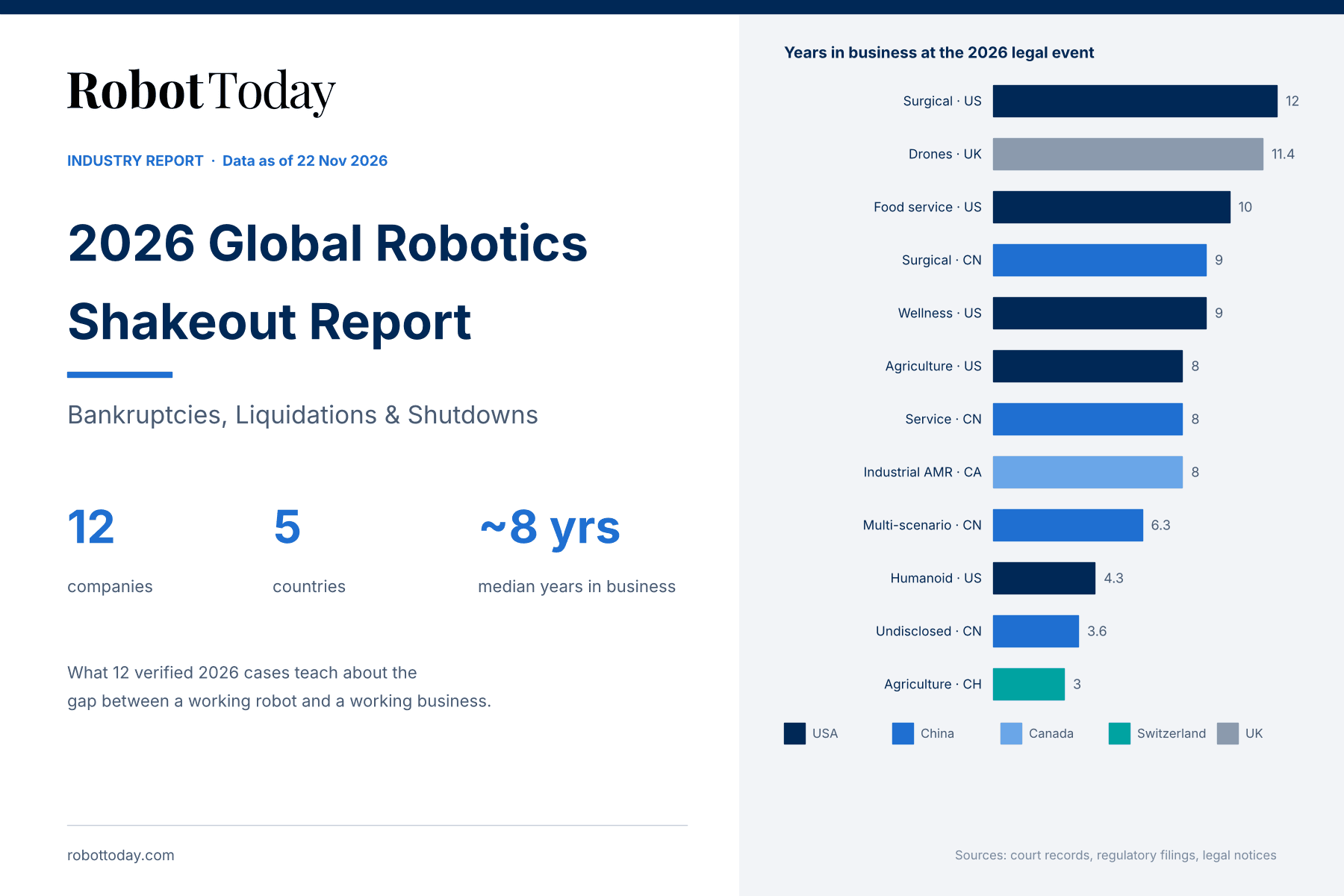
At least 12 robotics companies in the US, China, Canada, Switzerland and the UK entered bankruptcy, liquidation or an assignment for the benefit of creditors between January and November 2026. Most were not young startups: the median company had been in business about eight years. In the same months, robotics funding in China hit a record. The money did not stop. It moved to companies that can show delivery and revenue.
The 2026 cases
Twelve companies meet our test: a court-accepted bankruptcy or liquidation, a Chapter 7 or deemed bankruptcy, an assignment for the benefit of creditors (ABC), or a shareholder-approved dissolution, each traceable to a court record, filing or legal notice. They are listed by date of the legal event.
| Company | Country | Segment | Legal event (2026) | Founded | Years in business |
|---|---|---|---|---|---|
| Longhui Medical | China | Surgical (orthopedic) | 23 Jan: court accepted liquidation | Early 2017 | ~9 |
| Suzhou Houzhi Robot | China | Not disclosed | 29 Jan: court accepted liquidation | Jun 2022 | ~3.6 |
| Dendra Systems | UK / Australia | Drones (aerial seeding, ecosystem monitoring) | 2 Feb: Australian subsidiary wound up by court order; Sep: UK parent moved from administration to dissolution | Aug 2014 | ~11.4 |
| Cartwheel Robotics | USA | Humanoid | 19 Mar: involuntary Chapter 7 petition | Nov 2021 | ~4.3 |
| Aescape | USA | Wellness service | 5 Mar: assets transferred in foreclosure; 3 Apr: ABC | 2017 | ~9 |
| Floating Robotics | Switzerland | Agriculture (greenhouse) | Spring: bankruptcy; company now “in liquidation” | 2023 | ~3 |
| Monarch Tractor | USA | Agriculture (autonomous tractor) | Jan: ABC; Apr: assets acquired by Caterpillar | 2018 | ~8 |
| DeepBlue Robotics (Shanghai) | China | Commercial service | 7 May: court accepted liquidation | 2018 | ~8 |
| Picnic | USA | Food service (pizza) | 11 May: ABC | 2016 | ~10 |
| Yinghe Robotics | China | Multi-scenario service | Jul: court accepted liquidation | Mar 2020 | ~6.3 |
| Vicarious Surgical | USA | Surgical (single-port) | 21 Jul: stockholders approved ABC and dissolution | 2014 | ~12 |
| Noovelia | Canada | Industrial AMR/AGV | 2 Nov: deemed bankruptcy | 2018 | ~8 |
The list covers at least 12 legal events. It is not a full count: three more Chinese cases are reported but not yet verified, and Japan, Korea, India and most of Europe are not yet researched.
Lessons learned
The causes below are RobotToday’s analysis, based on court filings, company statements and published reporting. No single factor explains any one case.
1. Regulatory approval is not market adoption. Longhui Medical spent about seven years getting its orthopedic surgical robot approved, in September 2024. Sixteen months later a court accepted its liquidation. China’s orthopedic robot market bought only about 100 units in 2025, and most of those orders went to the top few vendors, according to Jianshiju (via Huxiu). Vicarious Surgical, founded in 2014, never reached a commercial product. In its proxy filing the company cited recurring losses and its inability to raise capital or sell the business. In surgical robotics the hard part begins after approval: hospital budgets, procurement cycles and trust in a small vendor’s long-term support.
2. Announced orders are not revenue. DeepBlue Robotics once announced orders for tens of thousands of disinfection robots. Media reports say most were never executed, and the company now owes more than RMB 23 million to over 100 employees. Yinghe Robotics raised more than RMB 600 million and ran five business lines at once, from emergency response to healthcare; none reached volume sales, according to press reports. Framework agreements and letters of intent make good headlines. They do not pay salaries.
3. Hardware runways must match hardware costs. Cartwheel built a working humanoid prototype with a seven-person team and about $3 million. Its founder said the company never found a capital partner to take it to manufacturing. Floating Robotics, an ETH Zurich spin-off, worked with growers on greenhouse picking robots but did not reach commercial scale. Dendra Systems, founded in 2014 to plant trees and monitor land by drone, spent more than a decade selling to mature, regulated industries before its UK parent entered administration in September 2025 and its Australian arm was wound up in February 2026. Building, certifying and servicing physical machines takes years of capital. A seed-sized budget for a category that needs a Series B is a timing risk, not just a funding gap.
4. The robot is not the business model. Aescape deployed robotic massage beds through partner venues and carried more than $150 million of debt before its lender foreclosed. Picnic’s pizza-assembly station had to prove its labor and waste savings to restaurant operators with thin margins. Monarch Tractor raised more than $200 million, then lost its contract manufacturer, Foxconn, and auctioned its remaining tractors. In each case the question was not whether the machine worked, but who pays for it, on what terms, and who builds it at scale.
5. Thin balance sheets cannot absorb outside shocks. Noovelia, a Québec maker of autonomous mobile robots, told creditors that about 18 months of Canada–US trade tension made industrial customers delay equipment purchases. Its statement of affairs showed C$12.5 million of liabilities against C$0.87 million of assets. Industrial automation sells into capital budgets, and those are the first to freeze when tariffs change.
6. The failures are mid-life, not early-stage. The median company on the list had been in business about eight years; only three were younger than five. They had products, customers and in several cases regulatory approvals. What they lacked was the step from pilot to repeatable sales before investor patience ran out. In the same period, Chinese embodied-AI and robotics funding reached RMB 124.5 billion in January–August 2026, per ITJuzi, about 2.7 times all of 2025. Capital has not left robotics. It is concentrating on companies that can show delivery.
What survives
A legal ending is not always the end of the technology. Several 2026 cases ended with the assets in new hands:
Monarch Tractor → its technology and assets went to Caterpillar, per USPTO filings reported by TechCrunch.
Aescape → its assets were bought by Aescape Recovery Inc., which continues to run the business.
Picnic → its assets were sold through the ABC to an undisclosed buyer.
Suzhou Houzhi Robot → the court-appointed administrator invited prospective investors in August, a step that can lead to a restructuring rather than a sale of parts.
Outside our list, Zebra Technologies sold its former Fetch Robotics unit to Skild AI in April 2026 after deciding to exit autonomous mobile robots.
For buyers, these processes are a low-cost way to acquire tested hardware, software and patents. For customers of a failed vendor, the open question is who will service machines already in the field.
Scope and sources
Period: 1 January – 22 November 2026, by date of the legal event.
Included: court-accepted bankruptcy or liquidation, Chapter 7, deemed bankruptcy, ABC, or shareholder-approved dissolution, each traced to a court record, regulatory filing or legal notice, or to consistent reports of one.
Not included: companies still operating, including those under Chapter 11 or a pending reorganization petition (for example Zhicheng Power / SMOROBOT, whose petition has not been accepted and which says operations continue); companies with no legal proceeding; events dated 2025 or earlier.
Years in business: founding date to the 2026 legal event. Floating Robotics is listed as founded in 2023 per ETH reporting; CB Insights gives 2019.
Causes: RobotToday analysis, not findings of any court.
Case sources are linked in the table above. Additional sources: Vicarious Surgical Form 8-K, Noovelia restructuring (Insolvency Insider), Picnic (GeekWire), DeepBlue Robotics employee claims (36Kr), Floating Robotics (HortiDaily), Cartwheel founding (A3), Dendra Systems UK insolvency record (Companies House).

Leave a comment