


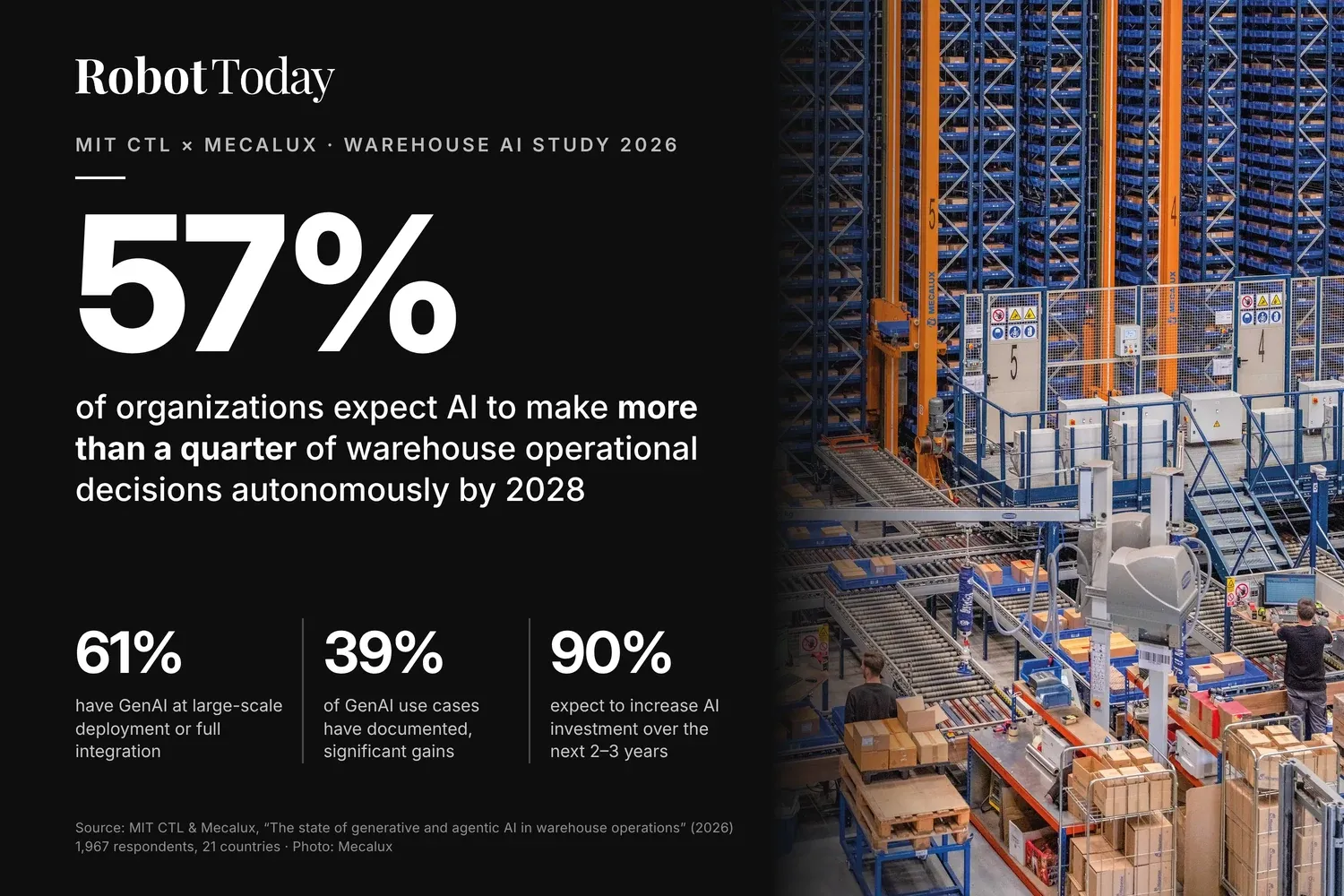
MIT CTL–Mecalux Study: 57% of Companies Expect AI to Run Over a Quarter of Warehouse Decisions by 2028
More than half of organizations (57%) expect AI to make or execute more than a quarter of their operational warehouse decisions autonomously by 2028, according to a new global study from the Intelligent Logistics Systems Lab at the MIT Center for Transportation & Logistics (MIT CTL) and warehouse technology company Mecalux. The report, The state of generative and agentic AI in warehouse operations, is based on 1,967 responses from senior supply chain and warehousing professionals in 21 countries.
Adoption is already high: 61% of organizations report GenAI at large-scale deployment or full integration, and 56% report the same for agentic AI. Most applications are still young, though; about three in four have been at their current stage for less than a year. And while 87% of GenAI and 81% of agentic AI use cases show at least moderate improvement, only 39% and 36% respectively have significant gains that are quantified and documented. Where respondents could estimate the gain, the typical figure was around 20% on their main target metric.
AI agents are getting authority within limits. They most often act without human approval on inventory movements (51% of agentic use cases) and data corrections (42%), compared with 22% for customer-facing commitments and 12% for financial decisions. The most common oversight model is “human-on-the-loop,” in which AI works within set limits while staff monitor and can step in.
“The objective is to move beyond general sentiment and to provide practical guidance on where these technologies are delivering operational value today and where they remain experimental,” said Matthias Winkenbach, Director of the Intelligent Logistics Systems Lab.
Governance tracks with results. Organizations with comprehensive, actively enforced AI governance are about twice as likely to report significant, documented improvements (51% vs. 26% for GenAI; 46% vs. 23% for agentic AI), though the report notes this is an association rather than proof of cause. Integration remains the biggest obstacle: 40% name legacy-system integration as the top constraint to scaling GenAI.
Adoption varies by country. The United States, the largest group in the survey with 676 respondents, reported 69% scaled adoption for GenAI and 63% for agentic AI. China, with 433 respondents, reported 38% and 29%. The report points out that 52% of Chinese respondents work for third-party logistics providers, which report lower adoption in all regions, but says the gap remains substantial after accounting for industry and company size.
Looking ahead, 90% of organizations expect to increase AI investment over the next two to three years, and 29% expect to raise it by more than 25%. On jobs, 56% say AI has mainly shifted employees toward higher-value tasks, while 11% report reduced headcount and 9% report increased headcount.
Source: MIT CTL–Mecalux Press Release; full report



Leave a comment