



Ten deals in ten years reveal a disciplined playbook. Deere buys the missing piece of its loop, proves it with farmers, then scales it through dealers.
Key takeaways
Deere buys capabilities, not brands. It closed ten ag robotics and AI deals between 2017 and 2026. Only two carried disclosed prices: Blue River at $305 million and Bear Flag at $250 million.
Every deal fills one slot in a sense–decide–act loop. See & Spray proved the loop at scale in row crops. Sentera, GUSS and Orchard AI now copy it into orchards and vineyards.
The next window is “hands.” Picking, pruning and thinning remain empty in both crop lines.
1. The deal map: three phases, three playbooks
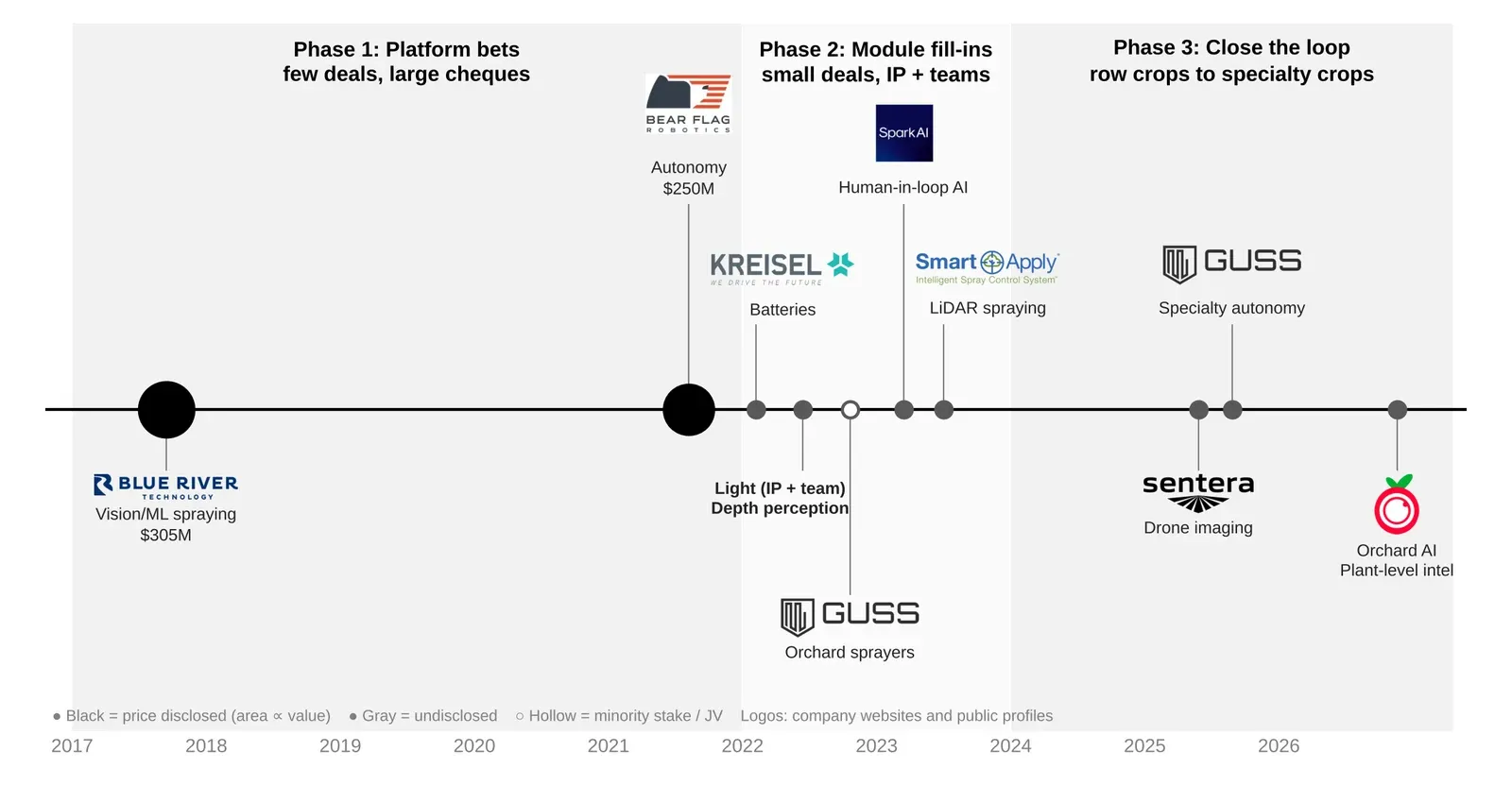
Deere has spent a decade building an agricultural AI stack piece by piece. Its deals fall into three distinct phases. Each phase uses a different deal size and a different logic.
Source: Deere press releases; Deere Form 10-K (FY2021, FY2022)
Phase 1 (2017–2021) was about platform bets. Blue River brought computer vision and machine learning. Bear Flag brought autonomous driving. Together they formed the base of Deere’s perception and autonomy stack.
Phase 2 (2022–2023) filled in modules. Light added depth perception. SparkAI added human-in-the-loop help for edge cases. Smart Apply added LiDAR-guided spraying, and Kreisel added batteries.
All of these were small deals. Deere’s fiscal 2022 annual report puts five deals that year at just $134 million combined. That total includes the 40% GUSS stake and Light.
Phase 3 (2025–2026) closes the loop and widens the scope. Sentera added aerial scouting. Full ownership of GUSS added a specialty-crop autonomy platform. Orchard AI, announced on 19 November 2026, added plant-level crop intelligence.
2. Deal logic: fill the loop, not the catalogue
Source: RobotToday analysis. Maturity ratings are editorial judgements.
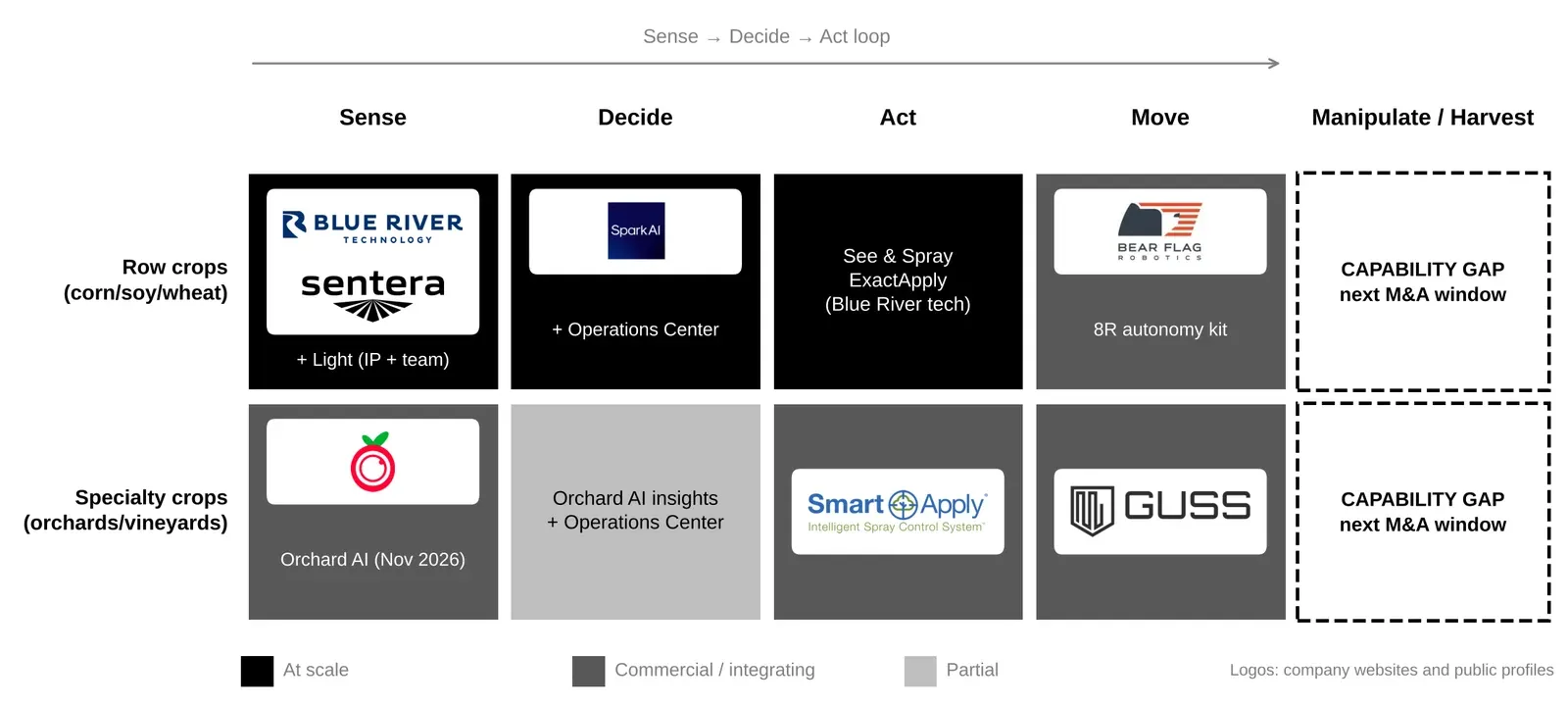
Each acquisition maps to one step in a closed loop. In row crops, the division of labour is clear. Blue River and Light sense. Operations Center decides. ExactApply’s individual nozzle control acts. Bear Flag moves the machine.
Specialty crops follow the same template. Orchard AI’s FruitScope uses vehicle-mounted cameras to measure fruit count, size and canopy health. Smart Apply matches spray volume to canopy density. GUSS lets one operator supervise up to eight sprayers.
Shane Thomas of Upstream Ag Insights draws a useful parallel. He argues Orchard AI gives Deere in orchards what Blue River gave it in row crops.
Peer moves support this reading. Kubota bought Bloomfield Robotics in 2024. Bloomfield also uses vehicle-mounted cameras for plant-level analysis. Two major OEMs now bet on the same layer, so specialty-crop perception is becoming a competitive front.
3. Deal mechanics: partner first, buy later
Source: Deere press releases; RobotToday analysis.
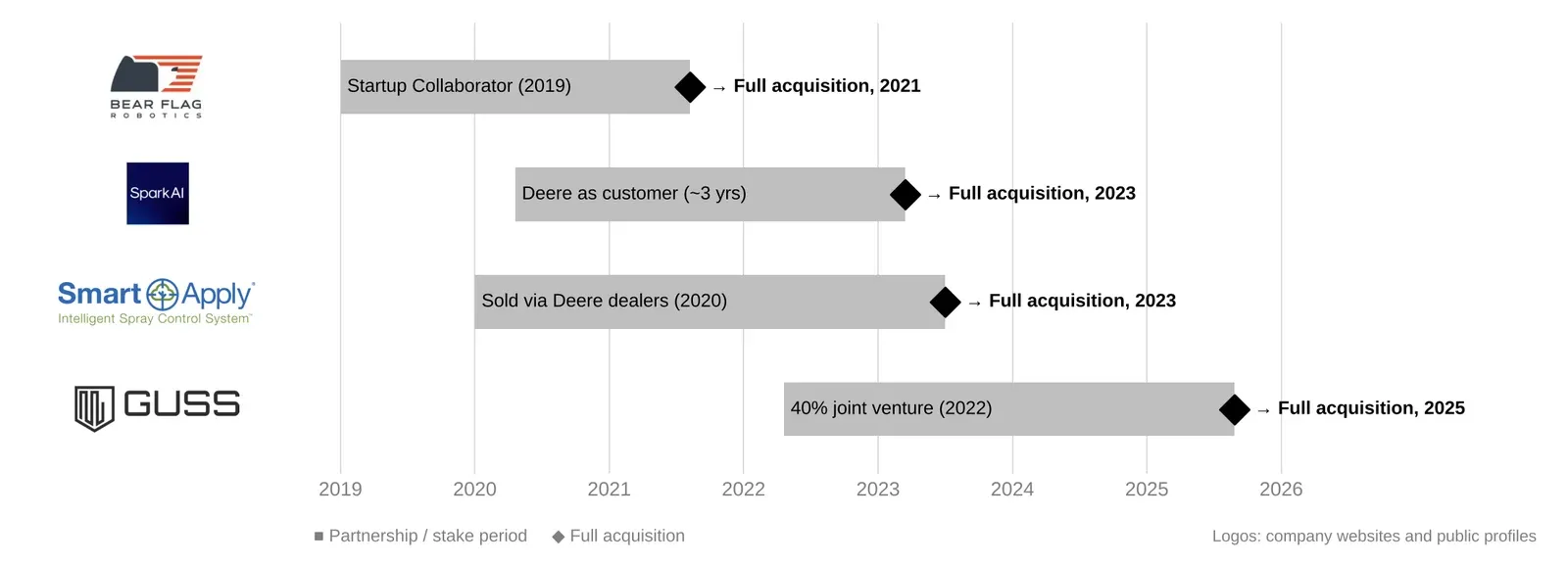
Deere rarely buys a stranger. Its typical path runs from customer, channel or joint venture, through validation, to full ownership. The validation period usually lasts two to three years.
Bear Flag joined Deere’s Startup Collaborator programme in 2019. Deere was a SparkAI customer before buying it. Smart Apply sold through Deere dealers from 2020. GUSS began as a 40% joint venture in 2022.
This approach cuts integration risk. It also means Deere pays mainly for teams and IP. In the Bear Flag deal, goodwill made up $189 million of $244 million in total assets, about 77%. Identifiable intangibles came to only $54 million.
4. Peer comparison: many small deals vs one big platform
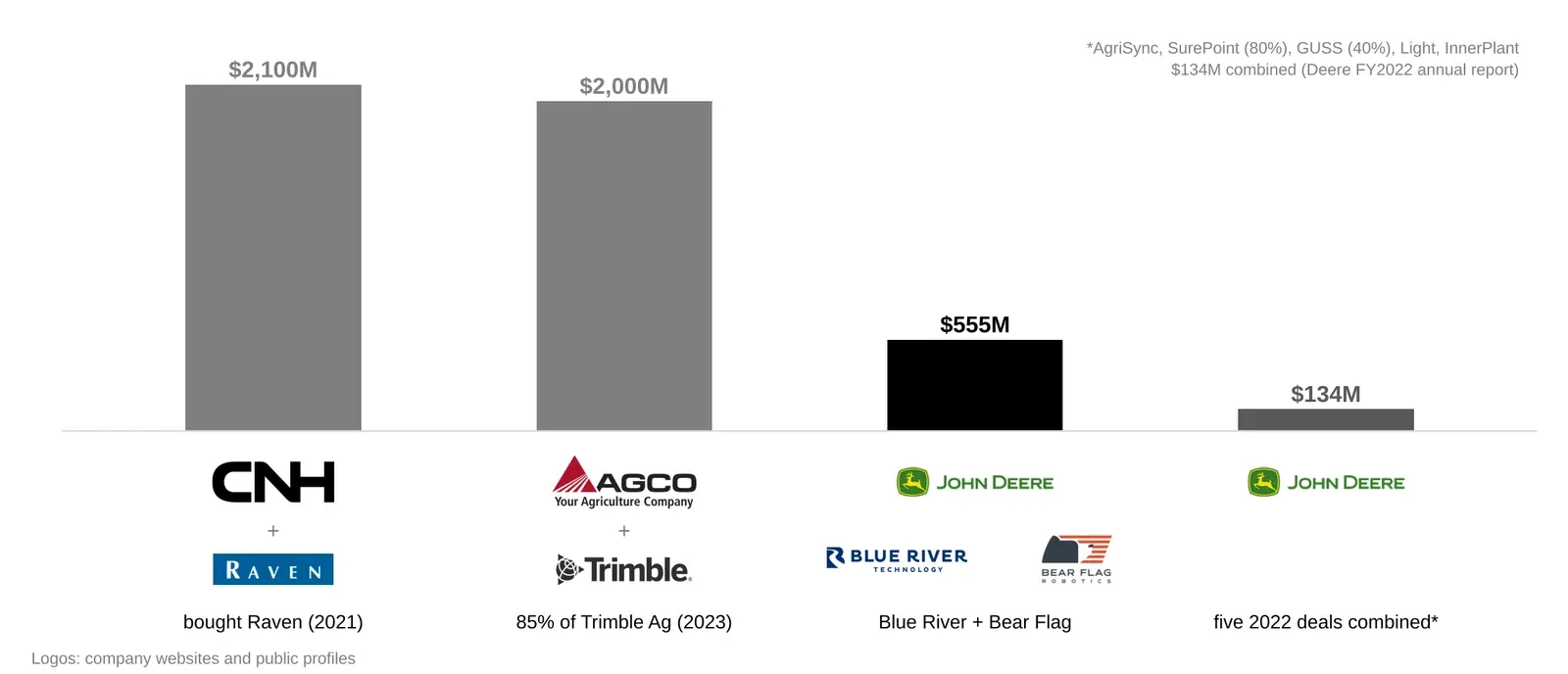
Source: CNH and AGCO deal announcements; Deere Form 10-K.
Deere’s rivals took the opposite route. CNH bought Raven for $2.1 billion in 2021. AGCO paid $2 billion in 2023 for 85% of Trimble’s agriculture business, forming PTx Trimble. Both bought mature precision-ag platforms in one move.
Deere builds its core stack in-house and buys only missing modules. This approach is capital-efficient and keeps integration under control. The cost is time. Blue River took about eight years to reach five million acres of See & Spray use.
5. Monetisation: from selling machines to charging per acre
Deals matter only if they change the revenue mix. See & Spray offers the clearest evidence so far.
| Metric | Data |
|---|---|
| Acres covered, 2025 | More than 5 million acres ⚠ |
| Herbicide savings | Non-residual herbicide use cut by nearly 50% on average; about 31 million gallons of mix saved ⚠ |
| Pricing model | Pay per unsprayed acre: $1 per fallow acre, $5 per in-crop acre; unlimited annual licence added for 2026 |
| Order penetration | Roughly one-third of North American sprayers on order include See & Spray (September 2026) ⚠ |
The pay-for-results model supports one of Deere’s Leap Ambitions targets: recurring revenue at 10% of sales by 2030. Operations Center already covers about 500 million engaged acres. Every new acquisition plugs into that channel on day one.
6. What comes next: where the M&A window opens
| Target area | Priority | Rationale |
|---|---|---|
| Picking / mobile manipulation | ★★★★★ | Empty in both crop lines; labour is scarcest in specialty crops |
| End-effectors and force sensing | ★★★★☆ | Core components for manipulation; suited to IP-plus-team deals |
| Specialty-crop decision layer | ★★★★☆ | Orchard AI data must become actionable agronomic prescriptions |
| Fleet orchestration / farm OS | ★★★☆☆ | GUSS’s one-operator, many-machines model can extend across machine types |
| Small electric robots | ★★★☆☆ | Kreisel battery know-how can serve small-plot use cases |
What it means for startups. Deere does not buy complete machines. It buys modules that plug into its loop. The most likely targets share three traits:
They solve one clear step in the loop rather than offer a full solution.
They run on Deere machines or inside Operations Center.
They have two to three years of real farm data, built through partnerships or dealers.
Our view. Deere’s next defining deal will probably not be another sensing company. It will be the company that gives Deere hands. Reliable orchard picking would be the most strategic asset in agricultural robotics.
Data notes
⚠ marks figures reported by Deere and not independently verified by a third party. Deal values follow company announcements and Form 10-K filings. We do not estimate undisclosed deal values. Orchard AI terms were not disclosed.
Sources
Deere Form 10-K, FY2021 and FY2022 (Bear Flag purchase price allocation; other 2022 acquisitions)
Deere press release: Bear Flag Robotics acquisition (5 Aug 2021)
Deere press release: GUSS Automation acquisition (27 Aug 2025)
Deere press release: See & Spray across five million acres (4 Nov 2025)
Global Agriculture: See & Spray adoption nearly doubling (Sep 2026)





Leave a comment