

1. At a Glance
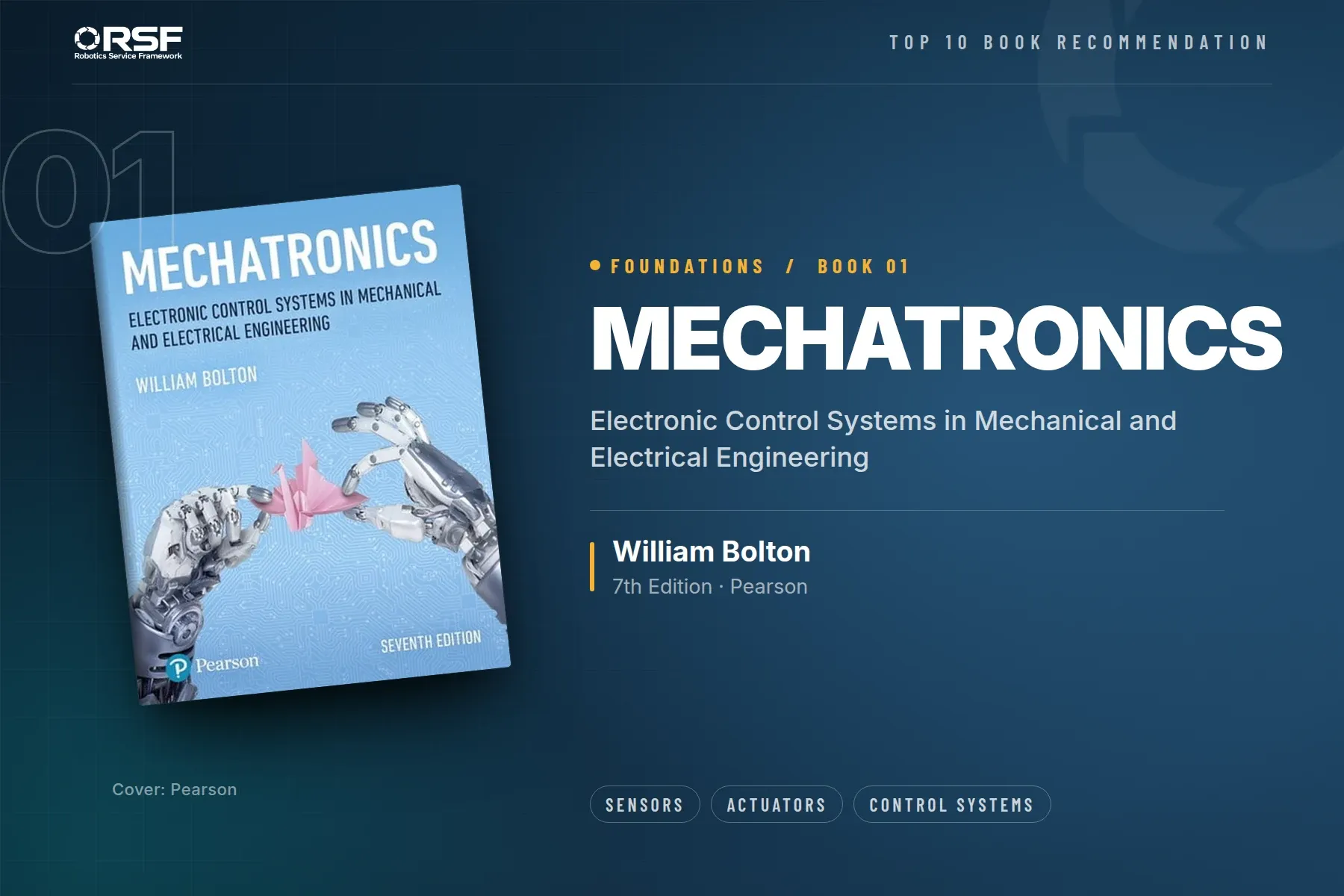
Full title | Mechatronics: Electronic Control Systems in Mechanical and Electrical Engineering |
Author | William Bolton |
Edition | 7th edition, Pearson — latest edition, verified 2026-07-25 (earlier editions from the 4th onward cover the recommended chapters) |
Access | Paid; print and eText via Pearson. No legal free edition. |
RSF mapping | Layer 2 (Electrical & Control) · Modules 2, 5, 6 · companion PLC text supports Module 4 |
Difficulty | ★★☆☆☆ — algebra-level math; associate-degree friendly |
Official page (Pearson, verified 2026-07-25):
https://www.pearson.com/en-gb/subject-catalog/p/Bolton-Mechatronics-Electronic-Control-Systems-in-Mechanical-and-Electrical-Engineering-7th-Edition/P200000003775/9781292250977
2. Why This Book
Ask where robot faults actually live, and the answer is rarely "in the algorithm." Across industrial arms, AMRs and humanoids, most service calls trace back to Layer 2: encoders, servo drives, sensors, cabling, signal conditioning, power. That is exactly the territory academic robotics textbooks treat as solved background. Craig assumes clean joint angles arrive at the controller; Bolton explains the encoder that produces them, the cable that carries them, and the circuit that cleans them up.
Bolton wrote Mechatronics for technician and early-undergraduate readers, and it shows in the best way: algebra-level math, hundreds of labeled diagrams, worked examples drawn from real machines rather than idealized models — and a chapter devoted to fault finding, something no other book on this list offers. Through seven editions it has become the standard mechatronics text worldwide. For an RSF Professional learner it is the highest-yield book on the list: nearly every page maps to something you will touch, measure or replace on site. That is why it ranks first — ahead of more famous, more mathematical books.
3. What’s Inside
The book is organized as a walk along the signal chain, which is also how a service engineer works a fault. It opens by defining a mechatronic system, then moves through four blocks. First, sensing: performance terminology (accuracy, resolution, hysteresis, drift), then the full sensor families — displacement, position, proximity, velocity, force, pressure, temperature — followed by signal conditioning: op-amps, filtering, ADC/DAC, and why a noisy reading is not always a broken sensor.
Second, actuation: pneumatic and hydraulic systems, mechanical transmissions (gears, belts, bearings), and electrical actuation — relays, solenoids, DC/AC motors, steppers and their drives. Third, the digital side: microprocessors and microcontrollers, input/output interfacing, communication basics, and programmable logic controllers. Fourth, systems: block-diagram models of complete mechatronic systems, closed-loop control behavior, and the fault-finding chapter — systematic techniques, common hardware failure modes, and self-test concepts such as watchdogs and parity. Case studies of complete systems close the book.
4. The RSF Perspective
In the Robotics Service Framework four-layer model, Bolton is the Layer 2 textbook. RSF Professional Module 2 dedicates a full session to a "Bolton Mechatronics Deep Dive" — sensor principles, actuator control, signal conditioning — and Modules 5 and 6 lean on it for electrical-layer diagnosis. Here is how to work it, module by module.
For Module 2 (Mechanical & Electrical Layer): read the sensor chapters and the signal-conditioning material first. The goal is a mental map of the measurement chain: transducer, conditioning, conversion, controller. When Module 2 presents the J3-axis case — a robot joint reporting position deviation — this map is what lets you ask the right first question: is the encoder lying, is the cable corrupting, or is the drive misreading?
For Module 4 (Field Service Procedures): the PLC chapter previews what the control cabinet session covers; Bolton’s companion volume, Programmable Logic Controllers, goes deeper if cabinets become your daily work.
For Modules 5–6 (Fault Diagnosis): the fault-finding chapter is the single most relevant chapter of any book on this list. Read it twice. Its method — establish what signal should exist at each stage, then measure until expectation and reality diverge — is precisely the layered-diagnosis mindset RSF teaches, applied at Layer 2. Combine it with the signal-conditioning chapters to handle Module 6’s oscilloscope and multimeter sessions. The encoder-signal-loss fault threaded through the course is, in Bolton’s terms, a broken measurement chain: he gives you the vocabulary and the test points.
For Module 7 (Cross-Form Practicum): the pneumatic/hydraulic chapters carry over directly to construction robots (7.7, hydraulic contamination faults); electrical actuation maps to humanoid joint drives (7.2); sensor chapters underpin every form. What to skip at Professional tier: system modeling, transfer functions and frequency response. They matter — at Specialist tier. Nothing in the RSF Professional assessment requires a Laplace transform.
5. Difficulty & Audience
Difficulty: 2 of 5. The mathematics stays at algebra with occasional elementary calculus, all skippable without losing the thread. The real effort is breadth — the book spans mechanical, electrical, electronic and software territory, which is exactly the point. Budget 25–30 hours for the chapters recommended above. Ideal reader: RSF Professional candidates, associate-degree students, and working technicians moving from a single trade (electrical or mechanical) into robot service. Specialist-tier engineers will keep it within reach as a reference long after certification.
6. Companions & Alternatives
Pair it with Bolton’s own Programmable Logic Controllers (Newnes) for Module 4’s control-cabinet work. For a deeper reference, The Mechatronics Handbook (Bishop, ed.) is what ETH Zurich’s mechatronics course draws on. As an alternative main text, Alciatore’s Introduction to Mechatronics and Measurement Systems covers similar ground with more lab orientation. If budget is tight, a used copy of the 5th or 6th edition delivers nearly all of the value: the chapters Robotics Service Framework relies on have been stable for years.
Mechatronics W. Bolton — RSF Top 10 Robot Education Textbooks · No. 1
ITIL Foundation: ITIL 4 Edition PeopleCert — RSF Top 10 Robot Education Textbooks · No. 2
Industrial Robotics Fundamentals Ross, Fardo & Walach — RSF Top 10 Robot Education Textbooks · No. 4
Robotics, Vision and Control Peter Corke — RSF Top 10 Robot Education Textbooks · No. 5
Introduction to Robotics J. J. Craig — RSF Top 10 Robot Education Textbooks · No. 6
Probabilistic Robotics Thrun, Burgard & Fox — RSF Top 10 Robot Education Textbooks · No. 7
Modern Robotics K. M. Lynch & F. C. Park — RSF Top 10 Robot Education Textbooks · No. 8
A Gentle Introduction to ROS Jason M. O’Kane — RSF Top 10 Robot Education Textbooks · No. 9
Small Unmanned Aircraft: Theory and Practice Beard & McLain — RSF Specialist Shelf · Book S2 of 6
Underactuated Robotics Russ Tedrake — RSF Specialist Shelf · Book S3 of 6
Planning Algorithms Steven M. LaValle — RSF Specialist Shelf · Book S4 of 6








Leave a comment