

1. At a Glance
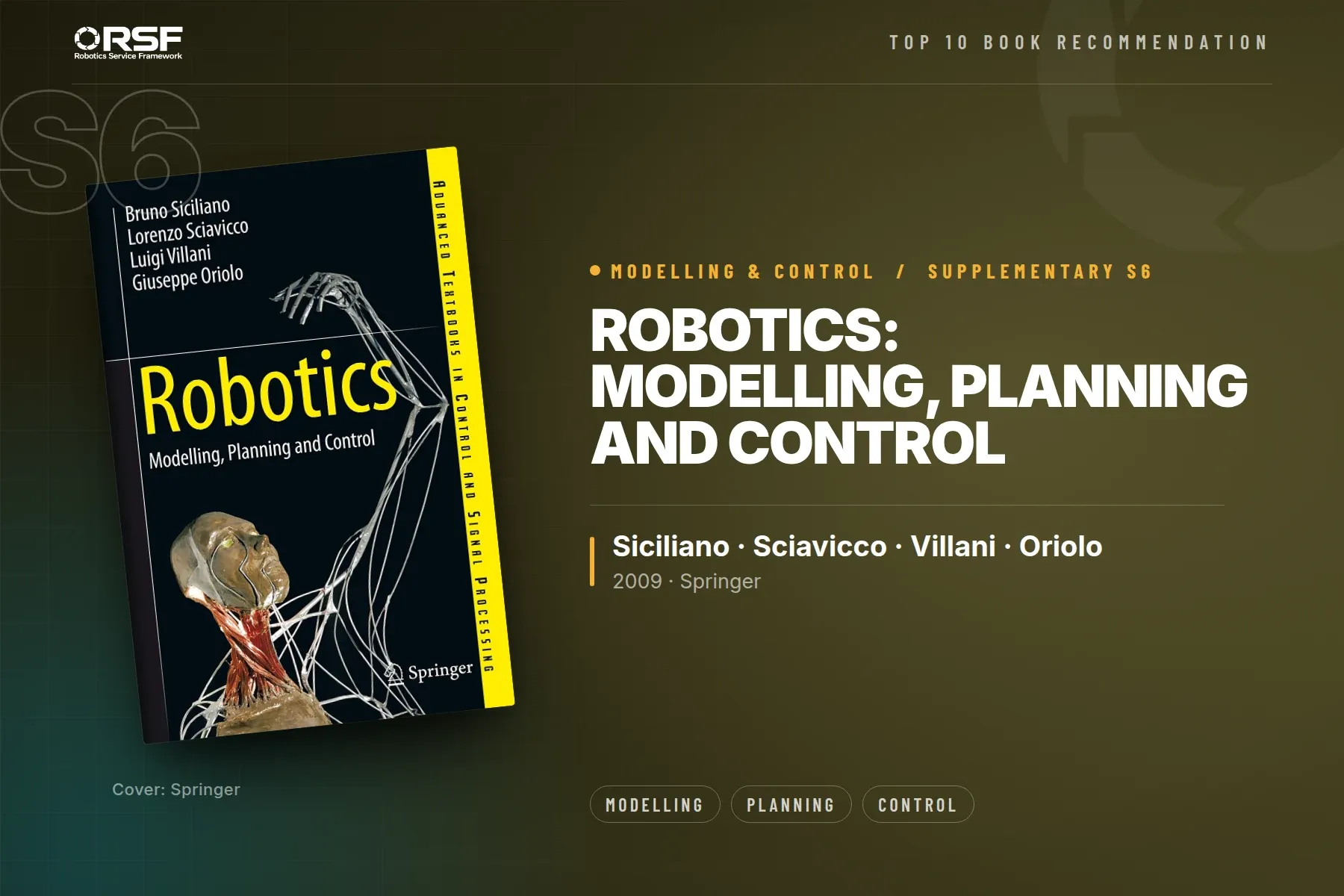
Full title | Robotics: Modelling, Planning and Control |
Authors | Bruno Siciliano, Lorenzo Sciavicco, Luigi Villani, Giuseppe Oriolo |
Edition | Springer, 2009 (Advanced Textbooks in Control and Signal Processing series) |
Access | Paid; print and eBook via Springer |
RSF mapping | Layers 1/2/3 · Modules 2/3 (general manipulator grounding) / Module 7.8 (agricultural robots — manipulation-heavy tasks) |
Tier & Difficulty | Specialist-tier alternative core text · ★★★★☆ |
Official page (Springer, verified 2026-07-25):
https://link.springer.com/book/10.1007/978-1-84628-642-1
2. Why This Book
Bruno Siciliano co-edits the Springer Handbook of Robotics (Top 10, No. 10), and this is a different kind of book by the same lead editor. The Handbook is a multi-author reference built to be looked things up in; Robotics: Modelling, Planning and Control is a single-narrative textbook built to be read front to back, covering kinematics through force control and visual servoing in one consistent notation. It is also a European-style alternative to Craig’s Introduction to Robotics (Top 10, No. 6) and Lynch & Park’s Modern Robotics (Top 10, No. 8) for a reader who wants one linear treatment rather than Craig’s Denavit-Hartenberg-only approach or Modern Robotics’ screw-theory-only approach — this book covers both perspectives side by side.
Robotics Service Framework Professional’s manipulator coverage (Modules 2–3) stays at the level of naming joints, axes and basic kinematics. A Specialist-tier engineer moving into Module 7.8’s agricultural robots — where manipulation happens in unstructured, contaminated field conditions rather than a clean industrial cell — needs the operational-space control and force-control chapters this book has and the Professional curriculum does not cover. That is the specialization gap this book fills.
3. What’s Inside
The book follows a single spine from geometry to control. It opens with kinematics, developed twice — once through the classical Denavit-Hartenberg convention and once through a more direct geometric approach — so a reader gets both the traditional notation used in most industrial documentation and the more transparent geometric intuition behind it, useful when a vendor manual uses D-H parameters but a paper on the same manipulator argues geometrically instead. From there it develops differential kinematics and statics: the manipulator Jacobian, velocity relationships between joint space and task space, and the force/torque relationships that fall out of the same Jacobian by duality.
Trajectory planning follows: joint-space and Cartesian-space trajectory generation, the practical layer between a planned path and a controller that can execute it. The book then covers actuators and sensors — motors, drives, position and force sensing — before its two motion-control chapters: joint-space control (treating each joint largely independently, the simpler and more common approach in general industrial controllers) and operational-space control (controlling the end-effector’s position and orientation directly, accounting for the full dynamic coupling between joints). A dedicated force-control chapter follows, covering hybrid position/force control and impedance control for tasks where the manipulator must regulate contact force, not just position.
The book closes with two chapters — mobile robots and visual servoing — that extend the same modeling and control framework beyond the fixed-base manipulator case. Throughout, the treatment is a single continuous narrative rather than a collection of independent topics, which is the book’s main structural difference from both Craig and the Springer Handbook.
4. The RSF Perspective
Module 7.8’s manipulation-heavy fault cases — perception failure in unstructured crop rows, soil and water contamination of end-effectors, plant-sap fouling of gripper tactile sensors — sit directly on top of this book’s actuator/sensor and motion-control chapters. The operational-space control chapter is the one to read closely: it explains why a contaminated force sensor does not just produce a noisy reading, it throws off the calibrated baseline the whole operational-space control law depends on, because that control law folds sensor feedback directly into the torque command rather than treating it as a separate diagnostic signal that can be checked in isolation.
The force-control chapter extends this further. An end-effector working in unstructured crop rows is doing contact-rich manipulation almost by definition — picking, cutting, or handling produce means regulating contact force, not just position, and hybrid position/force control or impedance control is the framework Module 7.8 assumes when it discusses tactile-sensor fouling: a fouled sensor does not just misreport, it destabilizes a control loop that was designed around clean force feedback.
More broadly, this book is worth treating as an alternative core text for Modules 2–3’s kinematics coverage, not only for M7.8. If Craig’s Denavit-Hartenberg-only treatment or Modern Robotics’ screw-theory-only treatment did not click during Professional-tier study, this book’s dual treatment — DH convention alongside a direct geometric derivation — is often the version that does, because it shows the same result two ways rather than committing to one formalism. Neither Craig nor Modern Robotics is wrong to specialize in one notation; this book simply trades some concision for coverage, which is exactly the trade a Specialist-tier reference should make.
Reading protocol: for M7.8 specialization, prioritize actuators/sensors, motion control (operational-space especially), and force control. The kinematics and differential-kinematics chapters are worth a close read if Modules 2–3 left gaps, but can be skimmed for reference otherwise. The mobile-robots and visual-servoing chapters at the end are lower priority unless a specific fault case calls for them — read them on demand rather than up front, treating the chapter order as a menu rather than a syllabus once the linear first read is done.
5. Difficulty & Audience
Difficulty: four of five stars. The mathematics assumes comfort with linear algebra and multivariable calculus throughout — Jacobians, coordinate transformations, and Lagrangian dynamics appear from the early chapters on — but each topic is developed within the book itself rather than assumed as prior knowledge, and worked examples accompany every major derivation. Budget roughly 35–45 hours to read the chapters most relevant to Module 7.8 (actuators/sensors through force control); the full book, including mobile robots and visual servoing, is closer to 60 hours.
This book is not required at Robotics Service Framework Professional tier, where manipulator coverage stops at naming joints and basic kinematics. Read it when specializing under Module 7.8 (agricultural robots) or more generally when Modules 2–3’s kinematics treatment needs a second, more thorough pass before moving to Specialist-tier manipulation work.
6. Companions & Alternatives
Pair it with the Springer Handbook of Robotics (Top 10, No. 10, same lead editor): read this book first for the linear, learn-it narrative, then use the Handbook as the look-it-up reference once the vocabulary is familiar. As alternate single-narrative classics covering similar kinematics-through-control ground, Craig’s Introduction to Robotics (Top 10, No. 6) and Lynch & Park’s Modern Robotics (Top 10, No. 8) are worth comparing — a reader who found either one’s notation awkward often finds this book’s dual DH/geometric treatment easier to follow. None of the three is strictly better than the others; they are three ways of teaching the same kinematics-through-control material, and which one clicks is often a matter of which notation a reader’s other coursework already used.
Mechatronics W. Bolton — RSF Top 10 Robot Education Textbooks · No. 1
ITIL Foundation: ITIL 4 Edition PeopleCert — RSF Top 10 Robot Education Textbooks · No. 2
Industrial Robotics Fundamentals Ross, Fardo & Walach — RSF Top 10 Robot Education Textbooks · No. 4
Robotics, Vision and Control Peter Corke — RSF Top 10 Robot Education Textbooks · No. 5
Introduction to Robotics J. J. Craig — RSF Top 10 Robot Education Textbooks · No. 6
Probabilistic Robotics Thrun, Burgard & Fox — RSF Top 10 Robot Education Textbooks · No. 7
Modern Robotics K. M. Lynch & F. C. Park — RSF Top 10 Robot Education Textbooks · No. 8
A Gentle Introduction to ROS Jason M. O’Kane — RSF Top 10 Robot Education Textbooks · No. 9
Small Unmanned Aircraft: Theory and Practice Beard & McLain — RSF Specialist Shelf · Book S2 of 6
Underactuated Robotics Russ Tedrake — RSF Specialist Shelf · Book S3 of 6
Planning Algorithms Steven M. LaValle — RSF Specialist Shelf · Book S4 of 6
Robotics: Modelling, Planning and Control Siciliano, Sciavicco, Villani & Oriolo — RSF Specialist Shelf · Book S6 of 6








Leave a comment