

1. At a Glance
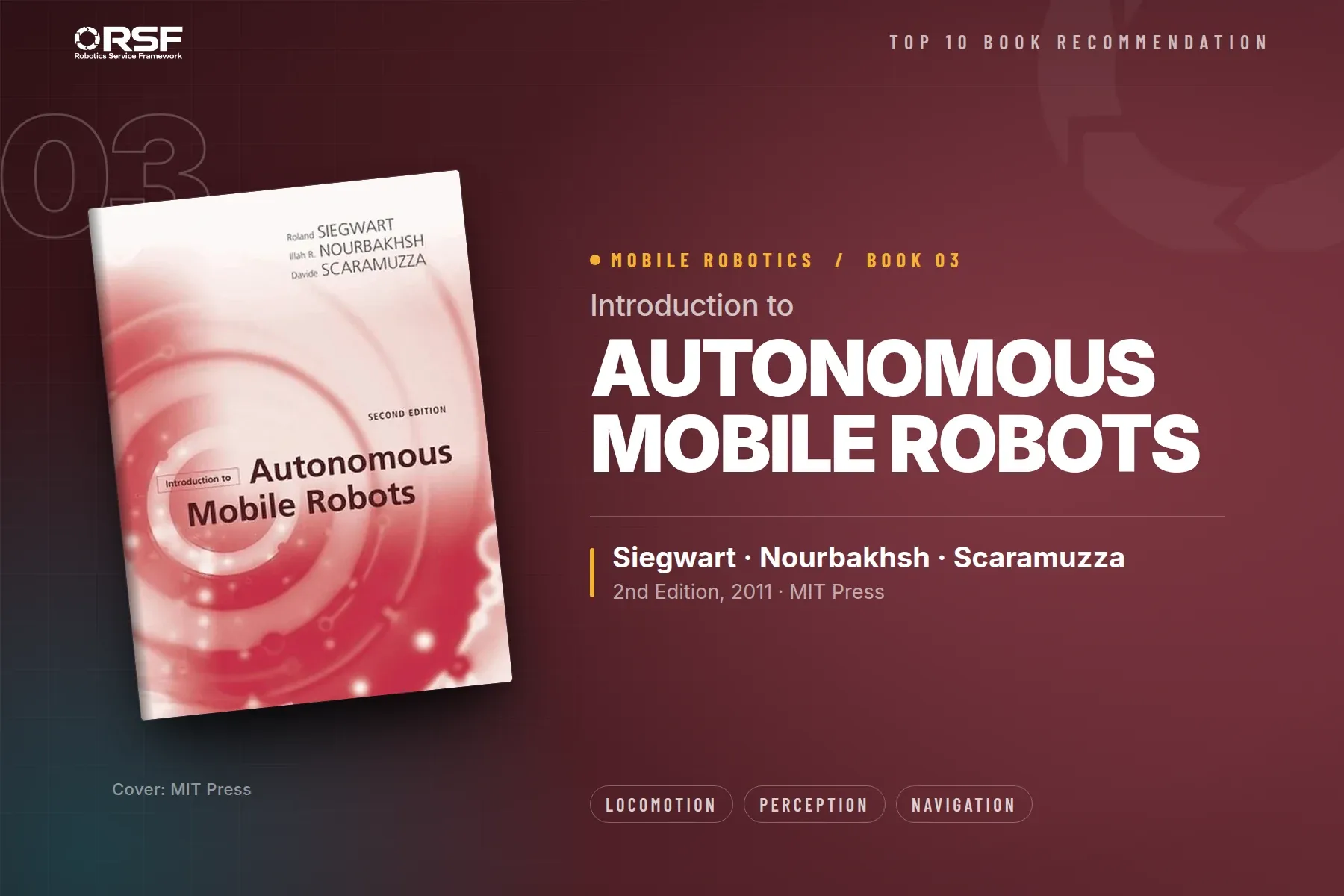
Full title | Introduction to Autonomous Mobile Robots |
Authors | Roland Siegwart, Illah R. Nourbakhsh, Davide Scaramuzza |
Edition | 2nd edition, MIT Press, 2011 — latest edition, verified 2026-07-25 |
Access | Paid; print and ebook via MIT Press. No legal free edition. |
RSF mapping | Layers 3–4 (Software · AI Perception & Decision) · Module 7.4 AGV/AMR practicum |
Difficulty | ★★★☆☆ — real math, used rather than derived; figures carry the intuition |
Official page (MIT Press, verified 2026-07-25):
https://mitpress.mit.edu/9780262015356/introduction-to-autonomous-mobile-robots/
2. Why This Book
Walk through a modern warehouse and count: the robots that outnumber everything else are the ones driving themselves. AMR and AGV fleets are today’s largest robot service market — IFR data cited in RSF’s Module 7 analysis puts them as the fastest-growing industrial category by units — and every one of those robots ships with a vendor manual full of terms the vendor did not invent: odometry, localization, cost map, scan matching. This book is where those terms come from. Siegwart, Nourbakhsh and Scaramuzza wrote the standard introductory text on mobile robots, and reading it is the difference between operating a vendor’s software and understanding the machine underneath it.
A service engineer needs it because AMR faults are rarely broken parts. The wheel is fine, the LiDAR is fine — and the robot is still lost. The fault lives in the pipeline between raw sensing and position estimate, and that pipeline is invisible unless you know it exists. This book draws the pipeline, stage by stage. It rises to third: AMR fleets are today’s largest robot service market, and this book is the theory layer under Module 7.4’s fault cases; it stops short of the very top only because it serves mainly one robot form.
3. What’s Inside
The book follows the autonomy pipeline of a mobile robot from the ground up, and its chapter sequence is the pipeline. It opens with locomotion: wheel types and their geometries, stability, and why the choice among differential drive, omnidirectional wheels and legs decides everything downstream. Then mobile robot kinematics: the math that turns wheel rotations into robot motion, with the differential-drive model — the model inside nearly every warehouse AMR — worked in detail, alongside omnidirectional configurations and the notions of maneuverability and workspace.
The perception chapters survey the sensors a service engineer actually meets on an AMR: wheel encoders, inertial units, LiDAR, ultrasonic sensors and cameras, each with its physical principle, performance characteristics and failure behaviors. The book treats uncertainty as a first-class topic — how sensor error is represented and how it propagates — before moving to localization: why dead reckoning drifts without bound, map-based approaches, and probabilistic methods including Kalman filter and Markov localization. An introduction to SLAM explains how a robot builds a map while relying on that map to know where it is, and why this circularity makes maps fragile. The final block covers planning and navigation: global path planning over a map, local obstacle avoidance, and how the two layers cooperate — and fail. Throughout, the writing stays at intuition plus essential math, with figures doing much of the work; it reads closer to a very good lecture course than to a monograph.
4. The RSF Perspective
In Robotics Service Framework’s four-layer model this book covers the seam between Layer 3 and Layer 4, and its home is Module 7.4 — the AGV/AMR section of the cross-form practicum. M7.4 is built as half industry scenario, half fault cases, and this book is the theory layer under those cases. Take them in order.
Map corruption after a warehouse layout change: the SLAM chapter explains why a map is not a photograph but a set of constraints, and why moving racks silently invalidates them. LiDAR point-cloud degradation: the perception chapters give you the sensor model — what dust, reflective surfaces and range limits do to returns — so "the LiDAR seems weird" becomes a testable claim. Wheel odometry drift on epoxy floors: the kinematics chapters show how slip enters the differential-drive equations and why the error accumulates rather than averages out, which is exactly why the localization stack fuses odometry with laser data and why EKF fusion weights matter. Fleet deadlock: the planning chapters separate the global planner from local obstacle avoidance — a distinction you need before blaming the fleet-management software.
The payoff is a change of behavior. A service engineer who knows why localization degrades stops guessing and starts measuring: match scores, scan quality, drift per meter. That is the difference between rebooting an AMR until it recovers and writing a work order that names the failing stage. The same vocabulary carries into Module 3’s software sessions — the localization and navigation stack is what those ROS 2 demos are running — and into Module 5’s layered diagnosis: is this fault in the sensor (L2), in the driver and configuration (L3), or in the belief (L4)?
What to skip at Professional tier: the Kalman filter derivations. Read the intuition boxes and the figures; the concept that a robot maintains a belief with an uncertainty, updated by prediction and correction, is all the assessment needs. The full probabilistic treatment is No. 7 on this list, and Specialist tier is the time for it. The legged-locomotion material can wait too, unless Module 7.2 or 7.3 is your target form.
5. Difficulty & Audience
Difficulty: 3 of 5. The math is real — matrices, wheel-kinematics Jacobians, probability in the localization chapters — but it is used rather than developed, and the figures carry a reader over most of it. Skipping the derivations costs little at this level. Budget 20–25 hours for the recommended path: locomotion and kinematics read lightly, perception and localization read carefully, planning read for concepts. Ideal reader: an RSF Professional candidate heading for AMR-heavy work — warehousing, logistics, factory intralogistics — or a technician already servicing a fleet who wants the theory underneath the vendor training. If your daily work is industrial arms only, the book drops several ranks for you; read No. 1 and No. 6 first. Specialist-tier learners on the mobile-robot track should read it in full, derivations included.
6. Companions & Alternatives
Downstream, Probabilistic Robotics by Thrun, Burgard and Fox is the full treatment of everything this book’s localization chapters introduce — go there at Specialist tier. Sideways, Corke’s Robotics, Vision and Control (No. 5) lets you run wheeled-kinematics and localization code in Python, turning this book’s figures into experiments. The most practical companion is free: your vendor’s AMR documentation. Hikrobot or Geek+ manuals are dense with terms this book defines; read them side by side and the manual stops being a black box. There is no cheaper-edition play here — the 2011 second edition is the current one, and used copies are easy to find.
Mechatronics W. Bolton — RSF Top 10 Robot Education Textbooks · No. 1
ITIL Foundation: ITIL 4 Edition PeopleCert — RSF Top 10 Robot Education Textbooks · No. 2
Autonomous Mobile Robots Siegwart, Nourbakhsh & Scaramuzza — RSF Top 10 Robot Education Textbooks · No. 3
Industrial Robotics Fundamentals Ross, Fardo & Walach — RSF Top 10 Robot Education Textbooks · No. 4
Robotics, Vision and Control Peter Corke — RSF Top 10 Robot Education Textbooks · No. 5
Introduction to Robotics J. J. Craig — RSF Top 10 Robot Education Textbooks · No. 6
Probabilistic Robotics Thrun, Burgard & Fox — RSF Top 10 Robot Education Textbooks · No. 7
Modern Robotics K. M. Lynch & F. C. Park — RSF Top 10 Robot Education Textbooks · No. 8
A Gentle Introduction to ROS Jason M. O’Kane — RSF Top 10 Robot Education Textbooks · No. 9
Small Unmanned Aircraft: Theory and Practice Beard & McLain — RSF Specialist Shelf · Book S2 of 6
Underactuated Robotics Russ Tedrake — RSF Specialist Shelf · Book S3 of 6
Planning Algorithms Steven M. LaValle — RSF Specialist Shelf · Book S4 of 6










Leave a comment