

1. At a Glance
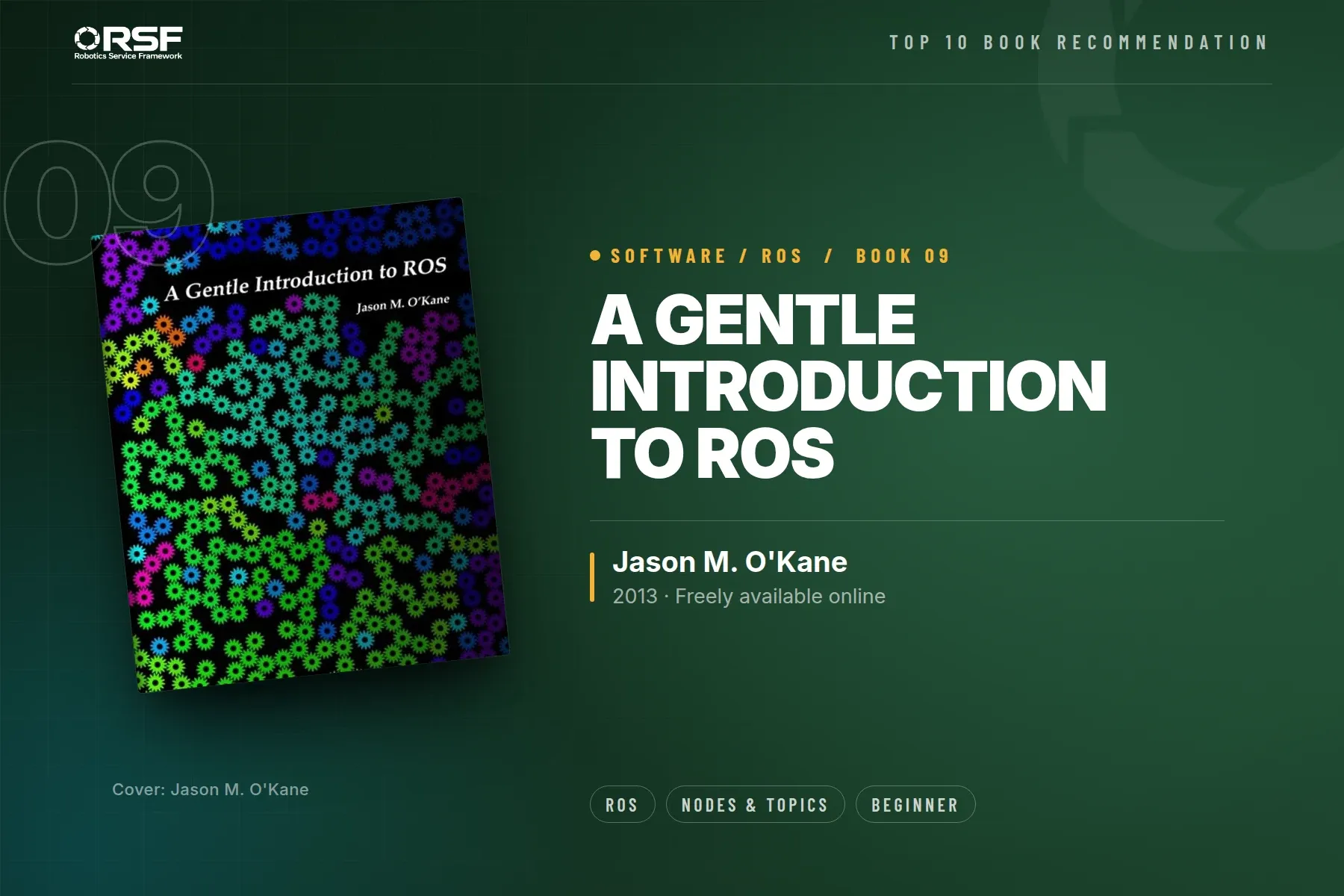
Full title | A Gentle Introduction to ROS |
Author | Jason M. O’Kane |
Edition | 2013, self-published (CreateSpace), last updated April 2018 (v2.1.6) — ROS 1 only; no ROS 2 edition exists. Read it for concepts, do the practice in ROS 2 |
Access | Free official PDF on the author’s site, downloadable by chapter or whole; inexpensive print edition |
RSF mapping | Layer 3 (Software & Middleware) · Modules 3, 6 |
Difficulty | ★★☆☆☆ — no math anywhere; assumes basic Linux command-line comfort |
Official page (author’s site, moved from cse.sc.edu; verified 2026-07-25):
https://jokane.net/agitr/
2. Why This Book
Layer 3 is where a service engineer first meets the robot as software: a screen full of scrolling log lines, a graph of nodes and topics, a launch file somebody wrote three years ago. Most ROS material is written for the people who build those systems. O’Kane wrote for the people who need to understand one — a short, patient book that explains what a node is, what a topic carries, and where to look when a message never arrived.
Yes, it is a ROS 1 book from 2013, and it now sits at No. 9 — an honest number under a methodology that scores work value alone, with open access tagged rather than scored. The book is slim, its tooling is a generation old, and what it offers today is concept transfer: nodes, topics, services, launch files, parameters, logging, bag recording all carried into ROS 2 almost unchanged, but the commands on the page are not the ones you will type. In the Robotics Service Framework scoring it earns 18.5 of 27.5 — 3 each for adoption (A), RSF coverage (B) and service practicality (C), with a perfect 5 for difficulty fit (E): the rare technical book a Professional-tier learner can actually finish. It is still genuinely free — the official PDF sits on the author’s site, by chapter or as a whole, and is flagged as free throughout this series. And no other title on this list gets you from zero to reading a live node graph faster.
3. What’s Inside
The book is short by design, and it covers exactly the working set of ROS ideas. It opens with getting started: what ROS is and is not, how packages organize code, and the command-line tools for inspecting a running system. Then writing programs: a minimal publisher and a minimal subscriber, built line by line, with the emphasis on what each call does to the ROS graph rather than on the programming language.
The middle chapters are the ones a service engineer will reread. Log messages: the severity levels, where log output actually goes, and how to control verbosity — the chapter that turns a rolling console into evidence. Graph resource names: how names, namespaces and remapping resolve, which quietly explains half of all “my node cannot see the topic” complaints. Launch files: how a dozen nodes start together, and how one wrong attribute breaks the whole stack. Then parameters, services — the request-reply counterpart to topics — and recording and replaying with bags, the mechanism that lets you capture a failure on site and replay it on a bench.
A further chapter walks the filesystem side: where packages live, how to navigate them, and how to read an error message that points into the build layout. Throughout, the style is example-driven and unusually honest. O’Kane tells you where beginners get stuck — name collisions, mismatched message types, nodes that start before the things they depend on — instead of pretending the happy path is the only path. Service work begins where the happy path ends, which is exactly why that honesty matters.
4. The RSF Perspective
In the RSF four-layer model, AGITR is the Layer 3 primer, feeding Modules 3 and 6. RSF chose it over heavier ROS books for a simple reason: a Professional-tier engineer does not program robots for a living, but must read them — and O’Kane teaches ROS as a system to observe, not only a framework to code against.
For Module 3 (Software & AI Layer): Session 3 runs a live ROS 2 demo — nodes launching, topics flowing, a fault injected and traced. This book is the why behind that demo. Read the getting-started, publish/subscribe and graph-names chapters beforehand and the demo stops being a magic trick: you know what the node graph is drawing, and what a remapped topic name implies. When the vision-fault session shows an image topic gone stale, you have the words to say which node stopped publishing and how you know.
For Module 6 (Advanced Fault Diagnosis): Session 2 covers diagnostic tools and logs, and it is applied O’Kane. The log-messages chapter maps one-to-one onto log-level triage; the bag chapter is the field engineer’s flight recorder — record the failure on site, replay it at the bench, attach it to the work order when escalating to L3 support. Module 7.4’s AMR fleet-deadlock case is diagnosed from an RCS/ROS log timeline; a learner who has worked through the logging chapter reads that timeline instead of scrolling past it. Graph snapshot, log levels, bag replay: that is the Layer 3 evidence chain, and this book is where RSF learners acquire it.
Now the ROS 1 caveat, handled honestly. In ROS 2 the master is gone — discovery runs over DDS, so there is no roscore to start and none to blame. rosbag became ros2 bag, and command names changed across the board. But nodes, topics, services, launch files, parameters and logging map concept-for-concept. The RSF protocol is therefore: read AGITR for concepts, do every exercise in ROS 2, using the official ROS 2 tutorials or The Construct’s “ROS 2 in 5 Days” as the hands-on track. What to skip at Professional tier: the C++ itself. Do not fight the compiler; read the code listings as pseudocode for what each call does to the graph. The system-level chapters — names, launch, logging, bags — are the point, and they are the exam-relevant material.
5. Difficulty & Audience
Difficulty: 2 of 5, and the low rating is earned — there is no mathematics anywhere in the book. What it does assume is basic comfort in a Linux terminal: changing directories, running commands, editing a text file. RSF’s Module 3 warm-up covers that floor. Budget 10–12 hours to read the whole book, plus a few more to redo the examples in ROS 2 — which is where the real learning happens. Ideal reader: RSF Professional candidates meeting ROS for the first time, technicians who have watched engineers stare at terminals and want to know what they are looking at, and Specialist-tier candidates who need the vocabulary before deeper ROS 2 study.
6. Companions & Alternatives
The mandatory companion is the official ROS 2 documentation and tutorials — free, current, and the environment where every AGITR exercise should actually be done. The Construct’s “ROS 2 in 5 Days” e-book adds a guided, browser-based hands-on track for learners without a Linux machine. For depth beyond Professional tier, the ROS 2 programming books by Cacace and by Joseph carry the same concepts into current tooling. Price advice is simple for once: the PDF is free from the author, so start today; buy print only if you like paper.
Mechatronics W. Bolton — RSF Top 10 Robot Education Textbooks · No. 1
ITIL Foundation: ITIL 4 Edition PeopleCert — RSF Top 10 Robot Education Textbooks · No. 2
Industrial Robotics Fundamentals Ross, Fardo & Walach — RSF Top 10 Robot Education Textbooks · No. 4
Robotics, Vision and Control Peter Corke — RSF Top 10 Robot Education Textbooks · No. 5
Introduction to Robotics J. J. Craig — RSF Top 10 Robot Education Textbooks · No. 6
Probabilistic Robotics Thrun, Burgard & Fox — RSF Top 10 Robot Education Textbooks · No. 7
Modern Robotics K. M. Lynch & F. C. Park — RSF Top 10 Robot Education Textbooks · No. 8
A Gentle Introduction to ROS Jason M. O’Kane — RSF Top 10 Robot Education Textbooks · No. 9
Small Unmanned Aircraft: Theory and Practice Beard & McLain — RSF Specialist Shelf · Book S2 of 6
Underactuated Robotics Russ Tedrake — RSF Specialist Shelf · Book S3 of 6
Planning Algorithms Steven M. LaValle — RSF Specialist Shelf · Book S4 of 6









Leave a comment