

1. At a Glance
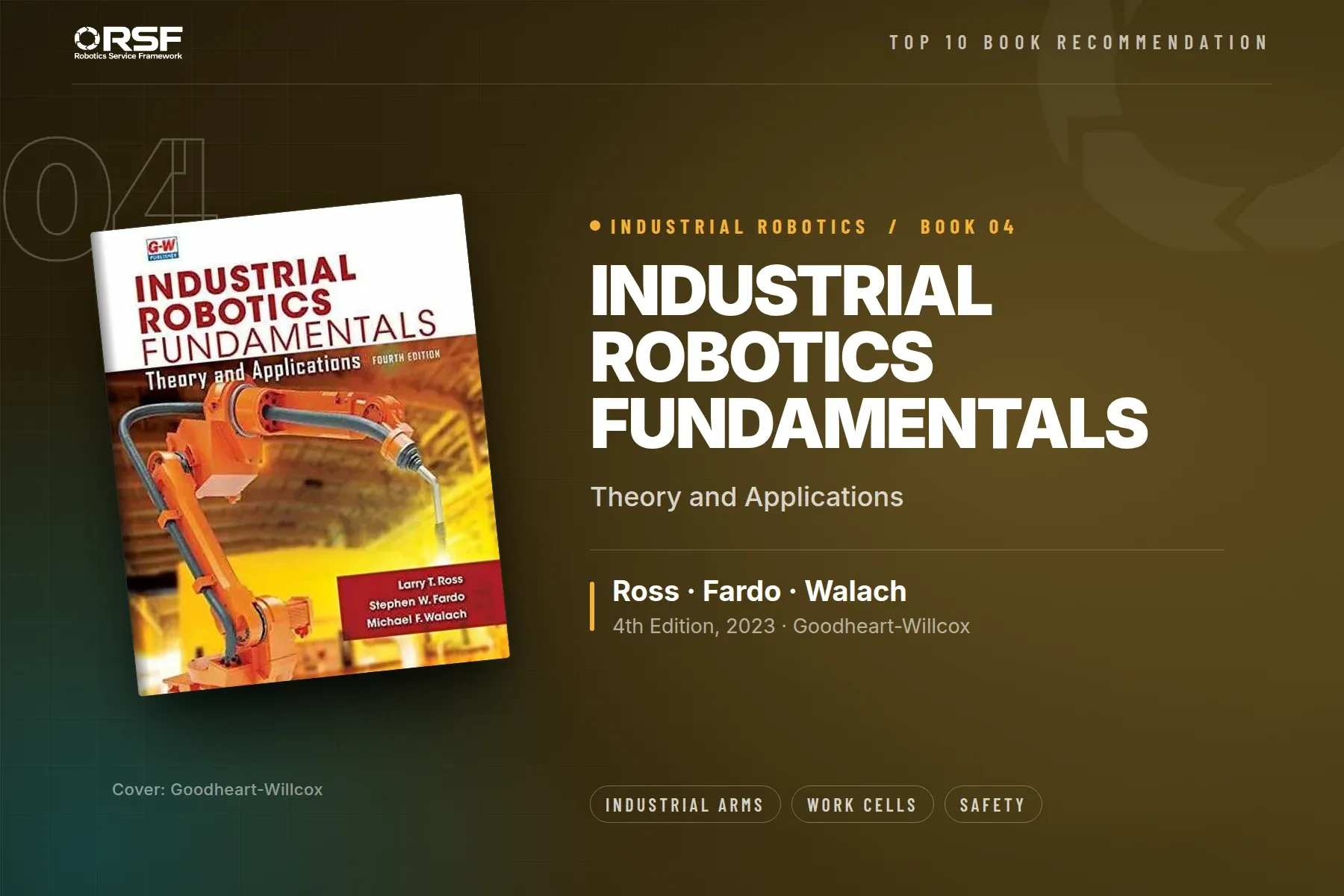
Full title | Industrial Robotics Fundamentals: Theory and Applications |
Author | Larry T. Ross, Stephen W. Fardo, Michael F. Walach |
Edition | 4th edition, Goodheart-Willcox, 2023 — latest edition, verified 2026-07-25 |
Access | Paid; textbook plus lab-workbook ecosystem from a career-and-technical-education publisher. No legal free edition. |
RSF mapping | Layers 1–2 (Mechanical Body · Electrical & Control) · Module 4 |
Difficulty | ★★☆☆☆ — with Bolton, the most accessible book on the list |
Official page (Goodheart-Willcox, verified 2026-07-25):
https://www.g-w.com/industrial-robotics-fundamentals-2023
2. Why This Book
Every other book on this list was written for a lecture hall. This one was written for the shop floor. Goodheart-Willcox publishes career-and-technical-education textbooks, and Industrial Robotics Fundamentals reads accordingly: installation, safety, operation and maintenance of real robot cells, at technician level, with review questions and a lab workbook. It is a textbook that expects grease on its pages.
That focus is exactly what a service engineer cannot get elsewhere. Craig teaches you kinematics; Thrun teaches you why perception fails; nobody else on this list teaches you how to lock out a cell before you open the fence, or what belongs in a maintenance routine. RSF scores it 22/27.5: adoption (A) 1 — none of the ten benchmark universities assigns it, which says more about universities than about the book — RSF coverage (B) 4, practicality (C) 5 and difficulty fit (E) 5, still the only book besides Bolton to take full marks on those last two. With practicality now weighted double, the only shop-floor book on the list belongs in the top tier, and No.4 is where it lands. What keeps it from climbing higher is its world: the fenced industrial cell — no warehouse AMRs, no humanoid lab. Inside that world, it is the most directly usable book here.
3. What’s Inside
The structure follows a technician’s education rather than an engineering syllabus. It opens with industrial robot types and applications — what the machines look like, what work they do, and the working vocabulary of axes, payloads and work envelopes. Then power systems: electric, hydraulic and pneumatic, treated as equals, because on a factory floor all three still earn their keep. End effectors and tooling get their own treatment — grippers, tool changers, and the practical business of making a robot hold something without dropping or crushing it. Chapters on sensors and on controllers and programming basics cover the perception and command side at the same hands-on level: what the parts are, how they connect, what can go wrong. Programming stays at the basics — enough to follow what a program does, not to architect one.
The second half is where the book separates itself from everything else on this list. Work-cell design and integration describes the environment a field engineer actually walks into: cell layout, guarding, the cell controller, and how the robot fits among conveyors and fixtures. The safety coverage — fencing, interlocks, lockout/tagout, risk assessment in the ISO 10218 / ANSI/A3 R15.06-2025 family — is written as working procedure, not as a recitation of standards. Then installation and maintenance practices, and a closing treatment of troubleshooting fundamentals. Every chapter ends with review questions, and a separate lab workbook supports hands-on courses. Nothing here is mathematically deep, and that is deliberate: everything in the book can be checked against a real cell, which is the kind of knowledge that survives contact with a job site.
4. The RSF Perspective
Robotics Service Framework maps this book to Layers 1 and 2, and above all to Module 4 — Field Service Procedures, the most practical six hours in the Professional course. M4 teaches SOPs, lockout/tagout, work orders and PLC basics. This book is its natural companion text, and the pairing works in both directions: the module gives you the drills, the book gives you the reasons.
For Module 4: read the safety chapters before the module starts. The LOTO checklist M4 drills, the PPE discipline, the pre-service and post-service confirmation flows — all mirror this book’s safety material, and the book explains what the checklist is protecting you from: where energy is stored in a cell, what an interlock actually interrupts, what a risk assessment under the ISO 10218 / ANSI/A3 R15.06-2025 family weighs. M4’s work-order session assumes you can describe the cell you serviced; the work-cell chapters supply that language — fencing, interlocks, cell controller, peripherals.
For Module 2: the power-systems and sensor chapters make a gentler on-ramp to the electrical layer than Bolton. If Bolton feels dense on first contact, start here and come back.
For Module 5: read the closing troubleshooting chapter as a before picture. It works at the machine level — symptoms, checks, likely causes — which is where most technicians start. RSF’s layered diagnosis in M5 is the upgrade: it adds the software and AI layers this book does not have, plus a method for deciding which layer to open first. Reading both shows you exactly what the four-layer model buys.
Be equally clear about what the book is not. It is arms and cells only: no AMR, no humanoid, no aquatic or aerial forms, so Module 7’s cross-form practicum finds no support here. There is no software or AI layer to speak of. And there is no service-management dimension — SLA, escalation and customer communication are Module 8’s territory, and this book has never heard of them. Use it to ground M4 and the physical half of the course; don’t ask it to carry the rest. Little needs skipping at Professional tier — this and Bolton are the two books on the list you could read cover to cover. If time is short, skim the types-and-applications survey and go straight to the safety and work-cell chapters.
5. Difficulty & Audience
Difficulty: 2 of 5 — with Bolton, the most accessible book on the list. There is no calculus and no linear algebra; the demands are attention and vocabulary. Budget 15–20 hours for the chapters that matter most here: safety, work cells, installation and maintenance, troubleshooting. Ideal reader: Robotics Service Framework Professional candidates headed for field service roles; working technicians who already move around cells and want the systematic version of what they learned by osmosis; and career changers from IT or software who have never stood next to a moving robot — for them, the safety chapters alone justify the purchase. Specialist-tier engineers will have outgrown the technical content, but not the safety discipline.
6. Companions & Alternatives
Pair it with Bolton’s Mechatronics for the electrical layer underneath: this book tells you what the cell contains, Bolton tells you how its signals behave. Bolton’s Programmable Logic Controllers backs M4’s PLC session. Then treat vendor training catalogs — ABB, FANUC, Kawasaki — as the next layer up: “RSF plus a vendor certificate” is exactly the stack this book prepares you for, and machine-specific procedures always come from the OEM. On editions: used earlier editions cost much less, but safety-standard references age fastest — for the safety chapters, stay with the current edition.
Mechatronics W. Bolton — RSF Top 10 Robot Education Textbooks · No. 1
ITIL Foundation: ITIL 4 Edition PeopleCert — RSF Top 10 Robot Education Textbooks · No. 2
Industrial Robotics Fundamentals Ross, Fardo & Walach — RSF Top 10 Robot Education Textbooks · No. 4
Robotics, Vision and Control Peter Corke — RSF Top 10 Robot Education Textbooks · No. 5
Introduction to Robotics J. J. Craig — RSF Top 10 Robot Education Textbooks · No. 6
Probabilistic Robotics Thrun, Burgard & Fox — RSF Top 10 Robot Education Textbooks · No. 7
Modern Robotics K. M. Lynch & F. C. Park — RSF Top 10 Robot Education Textbooks · No. 8
A Gentle Introduction to ROS Jason M. O’Kane — RSF Top 10 Robot Education Textbooks · No. 9
Small Unmanned Aircraft: Theory and Practice Beard & McLain — RSF Specialist Shelf · Book S2 of 6
Underactuated Robotics Russ Tedrake — RSF Specialist Shelf · Book S3 of 6
Planning Algorithms Steven M. LaValle — RSF Specialist Shelf · Book S4 of 6










Leave a comment