

1. At a Glance
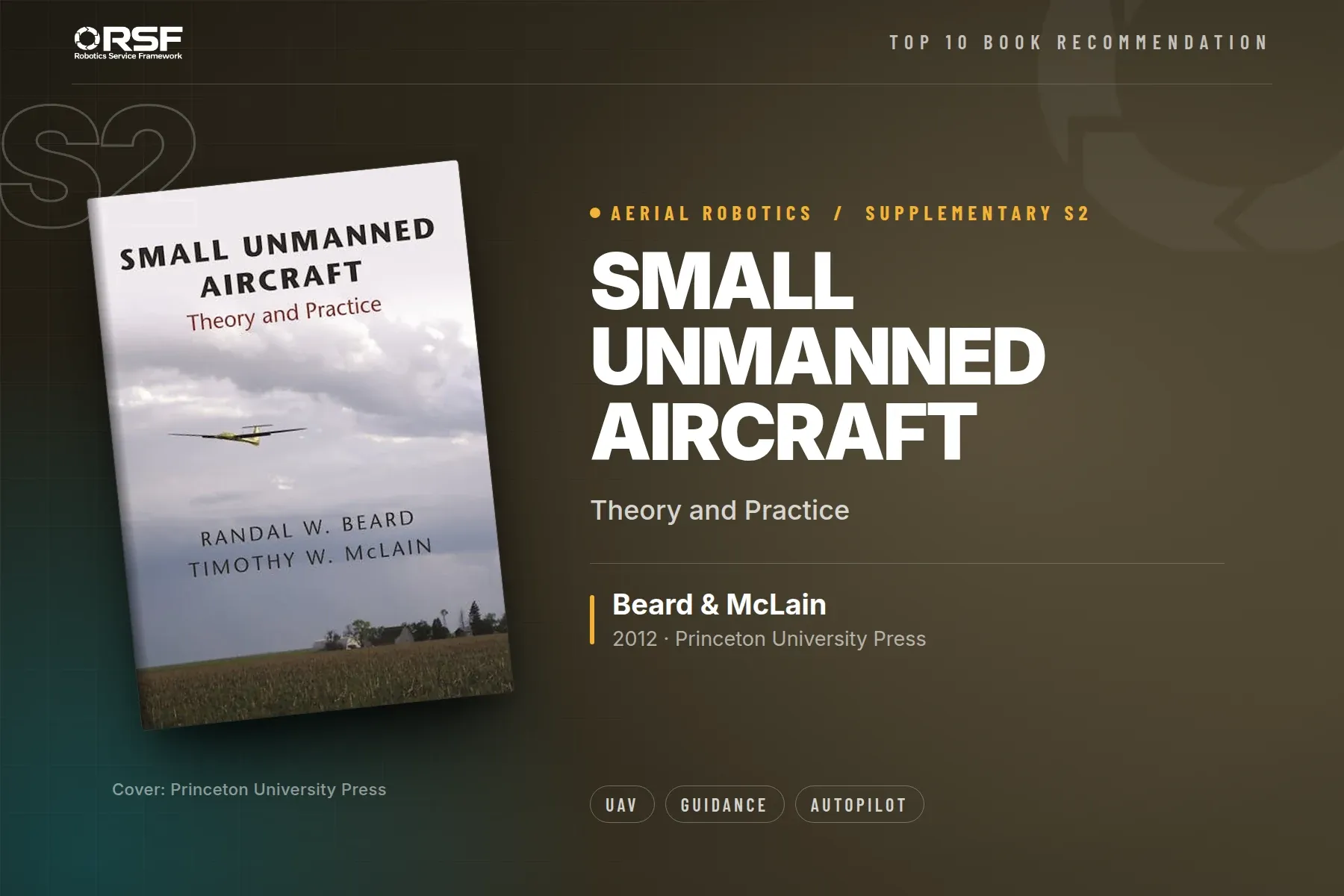
Full title | Small Unmanned Aircraft: Theory and Practice |
Authors | Randal W. Beard, Timothy W. McLain |
Edition | Princeton University Press, 2012 — current edition, verified 2026-07-25 |
Access | Paid; free companion simulation code ("uavbook"/mavsim) from the authors |
RSF mapping | Layers 1/2/4 (Mechanical Body / Electrical & Control / AI Perception & Decision) · Module 7.6 (UAV — low-altitude economy & aerial O&M) |
Tier & Difficulty | Specialist-tier deep dive · difficulty 4 of 5 |
Official page (Princeton UP, verified 2026-07-25):
https://press.princeton.edu/books/hardcover/9780691149219/small-unmanned-aircraft
2. Why This Book
Low-altitude UAV service work is expanding fast as delivery, inspection and agricultural drones move from pilot programs to fleets, and Robotics Service Framework’s Module 7.6 covers it as one of eight forms in the cross-form practicum. But a fixed-wing UAV’s autopilot is a specific, well-defined control architecture — successive loop closure around roll, pitch, altitude and airspeed — and nothing in the Robotics Service Framework Top 10 list derives it. Corke’s Robotics, Vision and Control (No. 5) and Thrun’s Probabilistic Robotics (No. 7) between them cover general control and general state estimation; Beard and McLain’s book is where those general tools get assembled into an actual fixed-wing autopilot, coordinate frame by coordinate frame. The distinction matters operationally too — a fixed-wing airframe behaves nothing like the rotorcraft most Module 7.6 fault vocabulary implicitly assumes, and this book is the place that vocabulary gets airframe-specific.
This is Specialist-tier reading, not Professional-tier. Module 7.6 gives a Professional candidate enough vocabulary to name a GNSS spoofing fault or a gimbal calibration drift. Beard and McLain is what a Specialist-tier engineer needs once UAV work becomes a specialization: understanding why a single degraded sensor cascades through an autopilot’s roll, pitch, altitude and airspeed loops in that specific order, rather than treating the autopilot as one opaque control law.
3. What’s Inside
The book opens with coordinate frames and kinematics for a fixed-wing aircraft — the frame transformations (body, vehicle, inertial) that every later chapter depends on — followed by forces and moments: the aerodynamics that turn control-surface deflections into motion. The forces-and-moments chapter in particular separates the aerodynamic forces that depend on airspeed and angle of attack from the propulsion forces the motor and propeller generate, a distinction that later becomes the difference between an aerodynamic fault and a propulsion fault when reading a flight log. From there it builds linear design models, the small-signal linearizations around a trim condition that make classical control design tractable for a nonlinear airframe.
The autopilot chapter is the book’s center of gravity: successive loop closure, the technique of designing and tuning nested control loops — inner loops for roll and pitch, outer loops for altitude and airspeed — one at a time, each assuming the inner loop it wraps is already fast and stable. State estimation follows: fusing GPS, IMU and pitot-tube data through complementary and Kalman filtering to produce the attitude and position estimates the autopilot loops consume. The guidance chapters cover path following and path planning, including sampling-based planning (RRT) for routing around obstacles; later sections extend the guidance material to cooperative and multi-vehicle scenarios, useful background once a single-aircraft operation grows into a coordinated fleet. Throughout, the book is built to be run, not just read — a free companion MATLAB/Simulink simulation toolkit (known as uavbook or mavsim) implements every chapter’s material, so the autopilot-loop and state-estimation chapters can be tuned and tested rather than taken on faith.
4. The RSF Perspective
In Robotics Service Framework’s four-layer model, this book sits across Layer 1 (airframe), Layer 2 (autopilot control loops) and Layer 4 (state estimation and guidance). Its home is Module 7.6, the UAV section of the cross-form practicum, and its structure — coordinate frames, forces, control loops, estimation, guidance — maps directly onto that module’s fault cases.
GNSS signal loss or spoofing in an urban canyon is M7.6’s clearest case: the module’s fix, "fused positioning: GNSS plus visual odometry plus IMU," is exactly this book’s state-estimation chapter — complementary and Kalman filtering across GPS, IMU and pitot data — applied to a specific failure mode. ESC or motor failure from over-current and propeller imbalance causing frame resonance both sit at the boundary between the forces-and-moments chapter and the autopilot chapter: a damaged propeller changes the forces the airframe produces, and the successive-loop-closure structure explains why that change does not stay local — a bad inner-loop signal propagates outward through roll, then pitch, then altitude, then airspeed, because each outer loop trusts the loop it wraps. Battery swelling during fast charge is largely outside this book’s scope, closer to Layer 1/2 hardware safety than to control theory. Gimbal calibration drift after impact is a state-estimation problem in miniature — the same sensor-fusion logic the book teaches for the airframe’s own attitude estimate applies to a gimbal’s. Taken together, these fault cases show why the book’s chapter order matters for diagnosis, not just for learning: forces and moments explain what changed physically, the autopilot chapter explains how that change propagates through control, and the state-estimation chapter explains why the dashboard may not show the problem until it has already cascaded.
Reading protocol: read the autopilot-loop chapter and the state-estimation chapter closely — these are the highest-value chapters for M7.6 fault diagnosis, and running them against the free uavbook simulation code turns the reading into something closer to a lab. Skip, on a first pass, the full aerodynamic-coefficient derivation chapters and the advanced RRT mathematics in the path-planning chapter; both matter for airframe design work, less for service diagnosis. Come back to them if UAV design, not just UAV maintenance, becomes part of the specialization.
5. Difficulty & Audience
Difficulty: four of five stars. The linear-design-model and forces-and-moments chapters require comfort with linear algebra and classical control (transfer functions, Bode-style loop shaping); the state-estimation chapter assumes basic probability. None of it is as demanding as Fossen’s marine-craft handbook (S1 on this shelf), but it is well past Professional-tier math. Budget 30–35 hours for the autopilot, state-estimation and guidance chapters, more if working through the uavbook simulation exercises alongside. This book is not required at Professional tier. Read it once UAV work — delivery, inspection, agricultural drones, low-altitude economy operations — becomes the chosen specialization, not before; Module 7.6’s fault vocabulary is learnable without it, but the reasoning behind the fixes is not. Readers who have already worked through Modern Robotics (No. 8) or Probabilistic Robotics (No. 7) will recognize the linear-algebra and estimation toolkit here; the new material is almost entirely in how that toolkit gets applied to a fixed-wing airframe’s specific geometry and failure modes.
6. Companions & Alternatives
Mueller’s Small Unmanned Aircraft Systems Guide, pitched at Professional tier, is the gentler primer to read first; Beard and McLain is the Specialist-tier deep dive that follows it. Corke’s Robotics, Vision and Control (No. 5) and Thrun’s Probabilistic Robotics (No. 7) are useful companions for the general control and estimation theory this book applies to a specific airframe. The free uavbook/mavsim simulation code from the authors is worth downloading alongside the book, not after. For the regulatory side of UAV service work, ICAO Doc 10019 and DO-178C, both cited in M7.6, cover the compliance context this book does not. Reading the three together — Mueller for vocabulary, this book for architecture, Corke and Thrun for the underlying math — covers the UAV specialization path from Professional-tier awareness to Specialist-tier competence.
Mechatronics W. Bolton — RSF Top 10 Robot Education Textbooks · No. 1
ITIL Foundation: ITIL 4 Edition PeopleCert — RSF Top 10 Robot Education Textbooks · No. 2
Industrial Robotics Fundamentals Ross, Fardo & Walach — RSF Top 10 Robot Education Textbooks · No. 4
Robotics, Vision and Control Peter Corke — RSF Top 10 Robot Education Textbooks · No. 5
Introduction to Robotics J. J. Craig — RSF Top 10 Robot Education Textbooks · No. 6
Probabilistic Robotics Thrun, Burgard & Fox — RSF Top 10 Robot Education Textbooks · No. 7
Modern Robotics K. M. Lynch & F. C. Park — RSF Top 10 Robot Education Textbooks · No. 8
A Gentle Introduction to ROS Jason M. O’Kane — RSF Top 10 Robot Education Textbooks · No. 9
Small Unmanned Aircraft: Theory and Practice Beard & McLain — RSF Specialist Shelf · Book S2 of 6
Underactuated Robotics Russ Tedrake — RSF Specialist Shelf · Book S3 of 6
Planning Algorithms Steven M. LaValle — RSF Specialist Shelf · Book S4 of 6








Leave a comment