

1. At a Glance
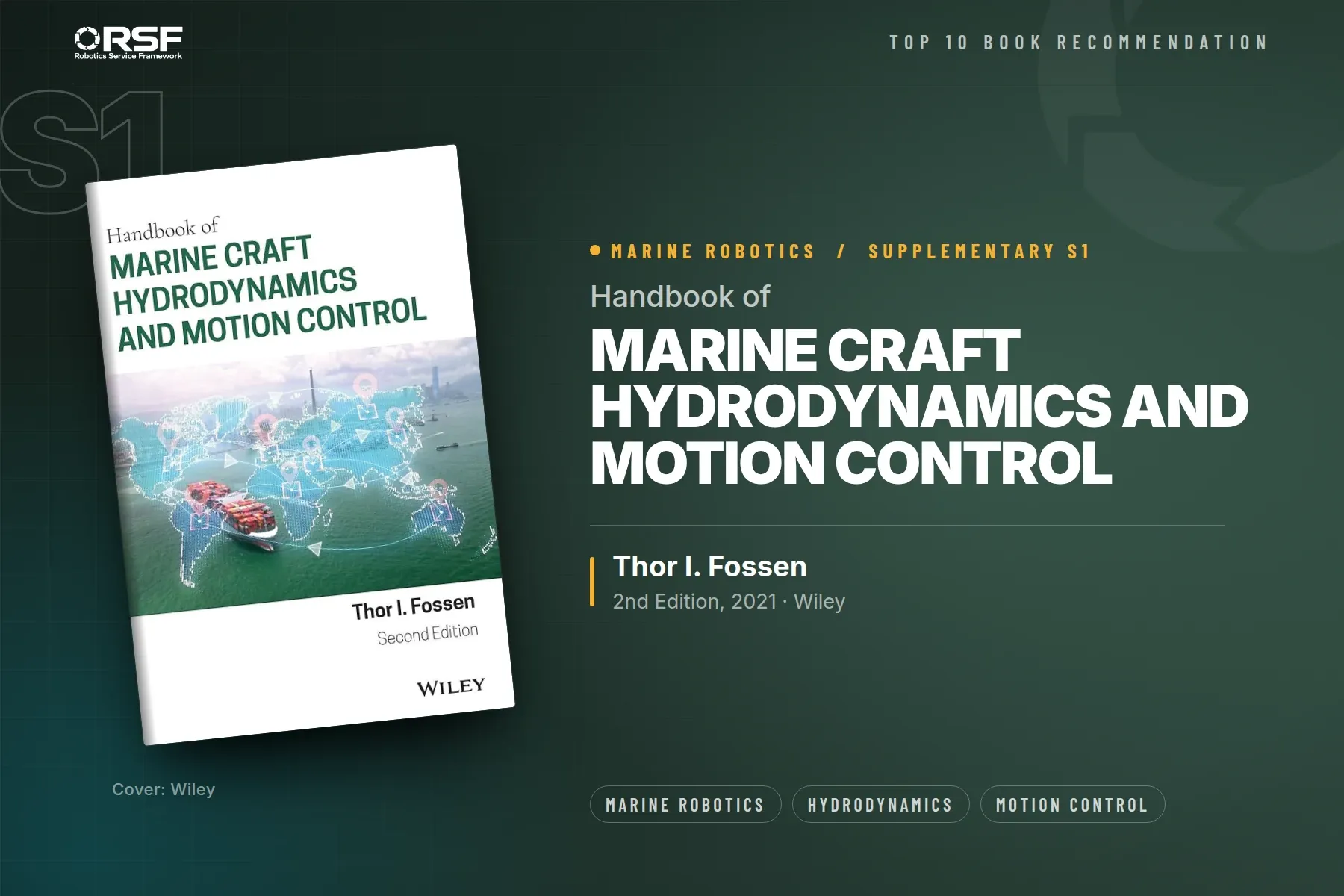
Full title | Handbook of Marine Craft Hydrodynamics and Motion Control |
Author | Thor I. Fossen |
Edition | 2nd edition, Wiley, 2021 — latest edition, verified 2026-07-25 |
Access | Paid; print and ebook via Wiley. No legal free edition. |
RSF mapping | Layers 1/2/4 (Mechanical Body / Electrical & Control / AI Perception & Decision) · Module 7.5 (aquatic robots — USV/ROV/AUV) |
Tier & Difficulty | Specialist-tier deep dive · difficulty 5 of 5 — hardest book on the entire RSF reading list, graduate-level control theory |
Official page (Wiley, verified 2026-07-25):
https://www.wiley.com/en-us/handbook-of-marine-craft-hydrodynamics-and-motion-control-2nd-edition-p-9781119575054
2. Why This Book
Aquatic robots operate on physics that wheeled and legged platforms never touch: added mass, hydrodynamic damping, wave and current loading, buoyancy that shifts with depth and salinity. Nothing in the Robotics Service Framework Top 10 list covers this territory in depth. Corke’s Robotics, Vision and Control (No. 5) grounds the general control theory a USV, ROV or AUV service engineer needs as a starting point, but it was not written for vessels, and a working aquatic-robot technician eventually meets problems that generic control theory does not name — a reference model for an autonomous survey mission, a guidance law that separates path following from trajectory tracking, a navigation filter built for an inertial-plus-DVL sensor suite underwater. Fossen’s handbook is where marine-specific guidance, navigation and control (GNC) architecture lives, written by the field’s standard-reference author.
This is not a Professional-tier book. RSF Professional’s Module 7.5 introduces aquatic robots as one of eight forms inside a six-hour cross-form practicum — enough to recognize a pressure-hull seal failure or a fouled thruster by name, not enough to derive why. Fossen is what a Specialist-tier engineer reaches for once aquatic robots stop being one of eight forms briefly encountered and become an actual specialization — when guidance, navigation and control need to be understood as three distinct subsystems instead of one black box a vendor already configured.
3. What’s Inside
The book’s spine is marine craft hydrodynamics: rigid-body kinetics for a vessel moving in six degrees of freedom, hydrodynamic forces including added mass and damping, and the environmental loads — wind, waves and current — that a wheeled or legged robot never has to model. The rigid-body kinetics chapter sets up the state variables — position and orientation in six degrees of freedom, linear and angular velocity — that every later chapter reuses, using the North-East-Down and body-fixed reference frames standard across the marine industry. A seakeeping chapter covers how a hull responds to waves, the concept behind the hull and mission design limits that a vendor’s operating envelope quietly encodes.
From there the book follows the guidance-navigation-control (GNC) split that structures the whole field. Guidance systems cover path following, trajectory tracking and the reference models that turn a mission plan into a moving setpoint. Navigation systems cover state estimation for marine vessels specifically — inertial navigation, and sensor fusion built around the sensor suite a surface or underwater vehicle actually carries, including acoustic positioning. Motion control closes the loop: PID control as a baseline, then feedback linearization, backstepping and sliding-mode control applied to ships, AUVs and USVs, each method matched to the nonlinearities marine dynamics introduces. The chapters build in that order — hydrodynamics first, then guidance, then navigation, then control — because each later chapter assumes the vehicle model the earlier ones derived. A separate treatment of ocean current models and wave spectra gives the environmental-load chapters enough structure to be used for mission planning, not just for after-the-fact explanation of why a vessel behaved a certain way in rough conditions.
4. The RSF Perspective
In Robotics Service Framework’s four-layer model, Fossen sits across Layer 1 (mechanical body — hull, thrusters), Layer 2 (electrical and control — the motion-control loops) and Layer 4 (AI perception and decision — the guidance and navigation layers that decide where the vehicle goes). Its home is Module 7.5, the aquatic-robot section of the cross-form practicum, and the fit is direct: this book is the theory underneath every one of M7.5’s fault cases.
Pressure-hull O-ring seal failure and salt-water connector corrosion are Layer 1/2 problems — the hydrodynamics chapters explain the hydrostatic loading a hull and its seals sit under at depth, and why a seal spec that works at the surface can fail on a deep survey. Thruster fouling and cavitation sit at the boundary between hydrodynamics and control: the book’s treatment of added mass and damping explains why a fouled thruster does not just lose thrust but changes the vehicle’s response characteristics, which is why a control loop tuned for a clean hull can become unstable on a fouled one. Acoustic DVL positioning drift in shallow water is a navigation-layer problem in the book’s own vocabulary — the navigation chapters cover exactly why a Doppler velocity log loses lock in shallow, reflective water, and how sensor fusion is supposed to compensate. Battery thermal management under hydrostatic pressure is the one M7.5 fault case this book does not directly address, a reminder that even a graduate-level text has edges. None of these five fault cases is solvable by hydrodynamics or control theory alone — each sits at a specific point in the guidance-navigation-control pipeline the book lays out, and knowing which point narrows a service call from "something is wrong with positioning" to a specific chapter and a specific subsystem.
Read it in two passes. First pass: part introductions and figures, to fix the guidance-navigation-control split in mind — that split alone answers most "which layer is this fault in" questions before any DVL diagnostics start. The certification context M7.5 cites, DNV-GL DNVGL-ST-0373, makes more sense once the seakeeping chapter has been read; the standard assumes the vocabulary this book teaches. Second pass, for those committing to marine specialization: the full derivations — the Coriolis and added-mass matrices, the backstepping and sliding-mode proofs — are Specialist/Expert-tier material. Skip them on a first read without guilt.
5. Difficulty & Audience
Difficulty: five of five stars, the hardest book on the entire Robotics Service Framework reading list. The math is graduate-level control theory — Lyapunov stability, nonlinear backstepping proofs, full six-degree-of-freedom rigid-body dynamics — and it does not simplify for a reader without that background. Budget 40–50 hours for the reading protocol above; considerably more for the full derivations. This book is not required at Professional tier, and not required at Specialist tier either unless aquatic robots (USV, ROV, AUV) are the chosen specialization; read it when that choice is made, not before. M7.5’s fault-case vocabulary is learnable without it, but troubleshooting past that vocabulary — why a control loop misbehaves, why a navigation filter diverges — needs this book’s depth. Engineers coming from a mechanical or electrical background without prior exposure to nonlinear control should expect the early chapters to be a steep on-ramp; those coming from an applied-math or aerospace background will find the material more familiar in form, if not in the specific marine application. Ideal reader: a Specialist-tier engineer with a working controls background who has decided marine robotics is the specialization to pursue.
6. Companions & Alternatives
Read Corke’s Robotics, Vision and Control (No. 5 on the Top 10 list) first — it supplies the general control-theory grounding this book assumes and does not re-derive. For a gentler on-ramp before tackling Fossen directly, Louis Whitcomb’s "Underwater Robotics" lectures, free on MIT OpenCourseWare, cover related territory at a slower pace. Once the certification side of aquatic-robot work matters, DNV-GL’s standards documentation (DNVGL-ST-0373, cited in M7.5) supplies the regulatory context this book assumes but does not itself cover — Fossen teaches the engineering, DNV-GL sets the compliance bar it has to clear. Together these three form a practical reading order: general control grounding, then Fossen’s marine-specific architecture, then the certification layer that governs how a finished system gets approved for operation.
Mechatronics W. Bolton — RSF Top 10 Robot Education Textbooks · No. 1
ITIL Foundation: ITIL 4 Edition PeopleCert — RSF Top 10 Robot Education Textbooks · No. 2
Industrial Robotics Fundamentals Ross, Fardo & Walach — RSF Top 10 Robot Education Textbooks · No. 4
Robotics, Vision and Control Peter Corke — RSF Top 10 Robot Education Textbooks · No. 5
Introduction to Robotics J. J. Craig — RSF Top 10 Robot Education Textbooks · No. 6
Probabilistic Robotics Thrun, Burgard & Fox — RSF Top 10 Robot Education Textbooks · No. 7
Modern Robotics K. M. Lynch & F. C. Park — RSF Top 10 Robot Education Textbooks · No. 8
A Gentle Introduction to ROS Jason M. O’Kane — RSF Top 10 Robot Education Textbooks · No. 9
Handbook of Marine Craft Hydrodynamics and Motion Control Thor I. Fossen — RSF Specialist Shelf · Book S1 of 6
Small Unmanned Aircraft: Theory and Practice Beard & McLain — RSF Specialist Shelf · Book S2 of 6
Underactuated Robotics Russ Tedrake — RSF Specialist Shelf · Book S3 of 6
Planning Algorithms Steven M. LaValle — RSF Specialist Shelf · Book S4 of 6










Leave a comment