

1. At a Glance
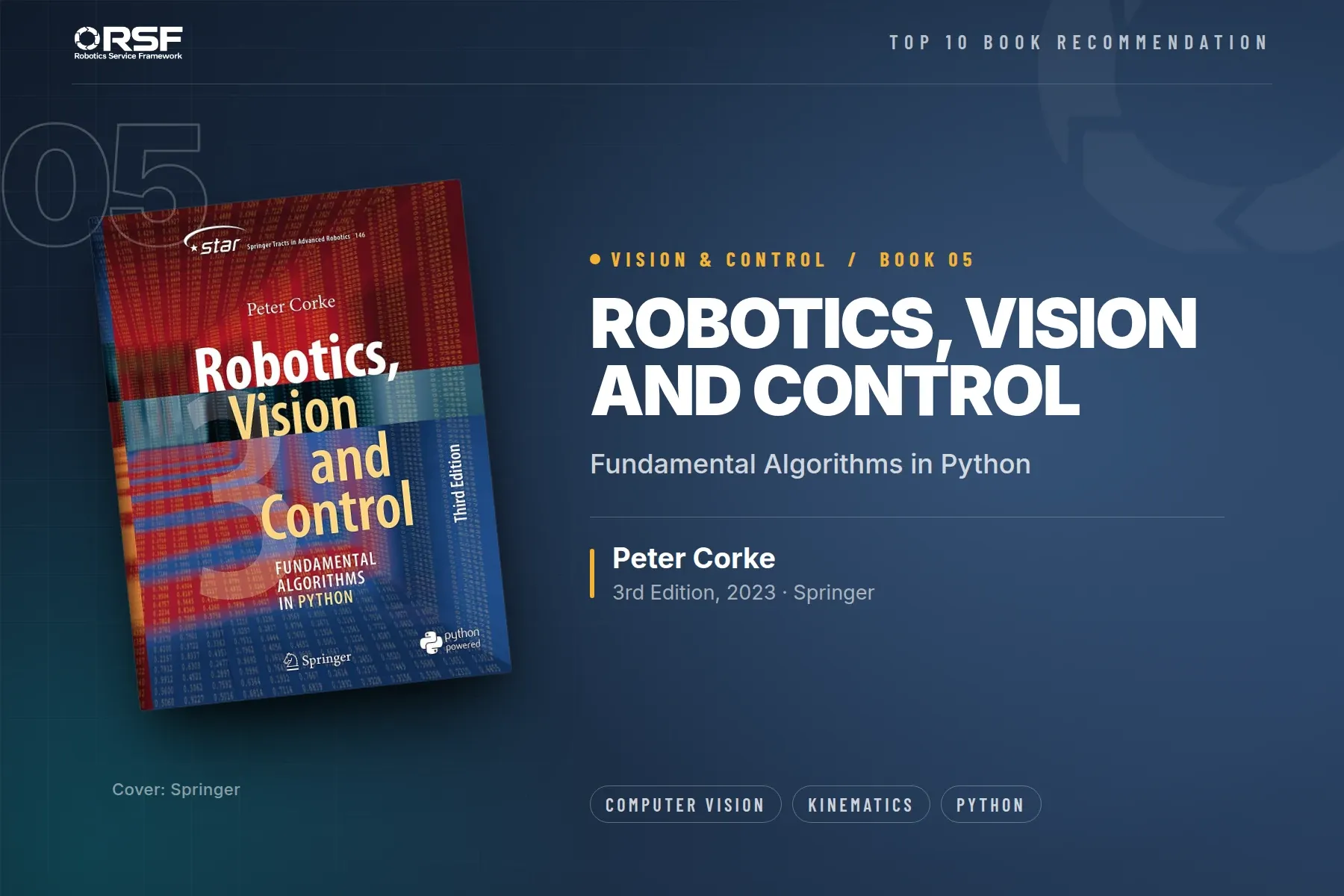
Full title | Robotics, Vision and Control: Fundamental Algorithms in Python |
Author | Peter Corke |
Edition | 3rd edition, Springer, 2023 — the Python edition, verified 2026-07-25; earlier editions use MATLAB |
Access | Paid; print and eBook via Springer. The companion Robotics Toolbox for Python and Machine Vision Toolbox are free open source on GitHub. |
RSF mapping | Layers 3–4 (Software & AI Perception) · Module 3 · supports Modules 6, 7 |
Difficulty | ★★★☆☆ — real math, but every concept runs as Python; code-friendly |
Official page (Springer, verified 2026-07-25):
https://link.springer.com/book/10.1007/978-3-031-06469-2
2. Why This Book
Most books on this list you read. This one you run. Every concept in Robotics, Vision and Control ships as executable Python: three lines in a notebook and a coordinate frame rotates, a differential-drive robot follows a path, a camera projects a scene onto pixels. The third edition rebuilt Corke’s classic around the open-source Robotics Toolbox for Python and Machine Vision Toolbox — the book is paid, but the code is free on GitHub, and a learner without the book can still run everything in it.
Why does a service engineer need it? Because Layer 3 and Layer 4 faults are invisible. You can put a multimeter on an encoder line; you cannot put one on a homogeneous transform or a feature descriptor. The only way to build intuition for what a perception pipeline should produce is to compute one yourself, and Corke turns that into a thirty-minute notebook session instead of a semester of theory. Robotics Service Framework’s curriculum analysis found the book in use at CMU and Oxford. It ranks No.5 as the bridge between reading about robots and poking at them — theory you can run (21/27.5 on the series rubric: strong on practicality and difficulty fit; adoption a notch below the classics). If that seems low for a book this useful, the slip is entirely the rubric’s doing: open access is now tagged, not scored — the companion toolboxes remain free and open source, and nothing about the book changed.
3. What’s Inside
Corke organizes the book as three broad movements, all in one notation and one codebase. The first is foundations: representing position and orientation in two and three dimensions — rotation matrices, quaternions, homogeneous transforms — then time and motion: how poses change and how to generate smooth trajectories between them. This is the vocabulary everything else uses.
The second movement splits by robot type. Mobile robots get kinematic models for car-like and differential-drive platforms, reactive navigation and path planning, then localization — how a robot estimates where it is from dead reckoning and landmarks. Arm robots get forward and inverse kinematics, the Jacobian linking joint velocities to end-effector velocity, then dynamics and control. Each idea arrives with a toolbox call you can execute immediately: define a robot model, solve its inverse kinematics, plot the answer.
The third movement is what makes the book unusual on this list: computer vision, treated with the same rigor as kinematics. Image formation explains how a 3-D scene becomes pixels — camera models, calibration, lens distortion. Image processing covers the operations service engineers meet by name in vendor logs: thresholding, filtering, morphology. Feature extraction gets you to corners, blobs and descriptors. The closing chapters connect the two halves with vision-based control — visual servoing, where camera measurements drive robot motion directly.
Nothing here is pseudo-code. The examples run against the maintained toolboxes, and the book’s figures are generated by the code on the page — you can reproduce any of them by typing the commands. That design decision is the book’s whole argument: an algorithm you have executed is an algorithm you can reason about when it fails.
4. The RSF Perspective
In the Robotics Service Framework four-layer model, Corke covers Layers 3 and 4 — the software and perception territory of Module 3 — and it earns its rank by being runnable. Here is how to work it, module by module.
For Module 3 (Software & AI Layer): this is the primary companion text. M3’s ROS2 demonstrations show you a working perception stack from the outside; Corke lets you rebuild the pieces from the inside. Before Session 2’s vision grasping failure case, spend a notebook session on image formation and feature extraction: set up a camera model, extract features from a test image, then watch the match degrade as you blur the image or dim the lighting. That half hour is the difference between reading "camera calibration drift" in a fault report and knowing what it does to the numbers.
For Module 6 (Advanced Fault Diagnosis): M6’s log-analysis sessions gain meaning once you have computed a feature match yourself. A ROS log line reporting a low inlier count or a failed pose estimate is opaque until you have seen those quantities in your own notebook output. Corke gives every number in the log a face.
For Module 7 (Cross-Form Practicum): the mobile-robot chapters — kinematic models and localization — are direct preparation for the AGV/AMR cases in 7.4, especially the camera and LiDAR perception issues; the visual-servoing chapters are background for any form that grasps or docks by camera.
What to skip at Professional tier: the dynamics and advanced-control mathematics in the arm-robot part. Read the kinematics and Jacobian material for vocabulary, skip the derivations — Modern Robotics (No.8) owns that territory anyway. What not to skip: running the code. This is the one book on the list where reading without typing wastes most of its value; thirty minutes in a notebook beats three hours of reading. And because the toolboxes are free open source, a learner who cannot afford the book can install them, follow the online documentation and examples, and still capture most of the practical benefit. RSF recommends exactly that path for budget-constrained learners.
5. Difficulty & Audience
Difficulty: 3 of 5, with an asterisk. The mathematics is real — linear algebra, transforms, some calculus — but the code softens it: when an equation loses you, run the example and inspect the output, and understanding often arrives numerically before it arrives symbolically. That makes this the most approachable three-star book on the list for anyone comfortable with Python, and harder than its rating for anyone who is not. Budget 20–25 hours for the recommended path — foundations, mobile-robot kinematics and localization, and the vision chapters — with the notebooks open throughout. Ideal reader: RSF Professional candidates heading into Module 3, technicians with some programming exposure, and anyone aiming at Specialist-tier work on the software and perception layers. Never touched Python? Spend a weekend on basics first.
6. Companions & Alternatives
For the ROS plumbing Corke deliberately stays above, pair it with O’Kane’s A Gentle Introduction to ROS (No.9 on this list, free official PDF). For deeper computer vision, Szeliski’s Computer Vision: Algorithms and Applications has a free official PDF and picks up where Corke’s vision chapters stop. For mathematical rigor on kinematics and dynamics, Modern Robotics (No.8, free preprint) is the natural complement. And remember the no-budget path: the Python toolboxes with their online documentation are free — the book is the best guided tour, not the only door in.
Mechatronics W. Bolton — RSF Top 10 Robot Education Textbooks · No. 1
ITIL Foundation: ITIL 4 Edition PeopleCert — RSF Top 10 Robot Education Textbooks · No. 2
Industrial Robotics Fundamentals Ross, Fardo & Walach — RSF Top 10 Robot Education Textbooks · No. 4
Robotics, Vision and Control Peter Corke — RSF Top 10 Robot Education Textbooks · No. 5
Introduction to Robotics J. J. Craig — RSF Top 10 Robot Education Textbooks · No. 6
Probabilistic Robotics Thrun, Burgard & Fox — RSF Top 10 Robot Education Textbooks · No. 7
Modern Robotics K. M. Lynch & F. C. Park — RSF Top 10 Robot Education Textbooks · No. 8
A Gentle Introduction to ROS Jason M. O’Kane — RSF Top 10 Robot Education Textbooks · No. 9
Small Unmanned Aircraft: Theory and Practice Beard & McLain — RSF Specialist Shelf · Book S2 of 6
Underactuated Robotics Russ Tedrake — RSF Specialist Shelf · Book S3 of 6
Planning Algorithms Steven M. LaValle — RSF Specialist Shelf · Book S4 of 6









Leave a comment