


1. At a Glance
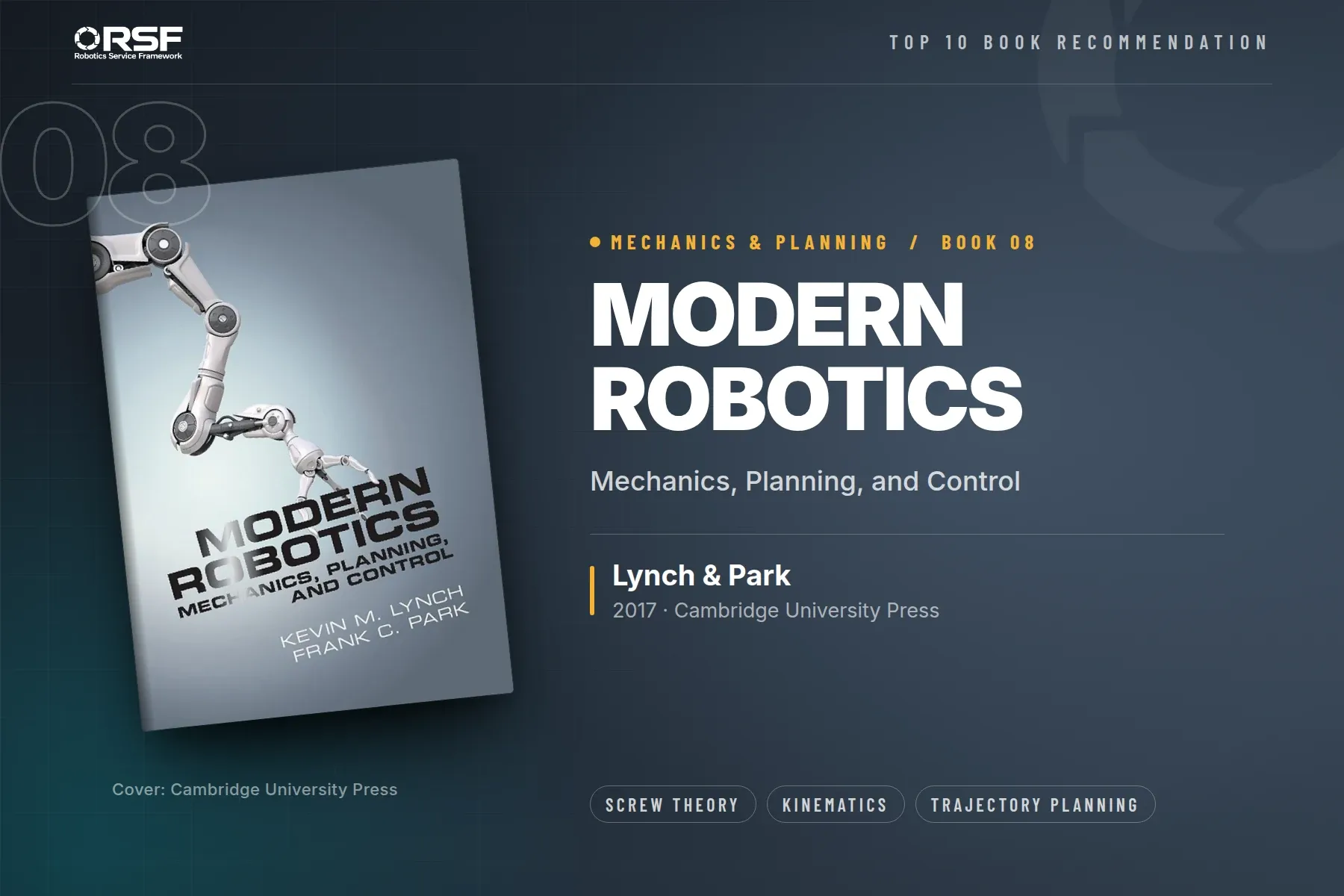
Full title | Modern Robotics: Mechanics, Planning, and Control |
Author | Kevin M. Lynch & Frank C. Park |
Edition | Cambridge University Press, 2017 — the authors maintain the official preprint and companion materials online, verified 2026-07-25 |
Access | Free official preprint PDF, video lectures and software library; print and e-book paid via Cambridge |
RSF mapping | Layer 1 (Mechanical Body) · Modules 2, 3 |
Difficulty | ★★★☆☆ — university-level math; read at definitions-and-figures depth at Professional tier |
Official page (Northwestern, verified 2026-07-25):
https://hades.mech.northwestern.edu/index.php/Modern_Robotics
2. Why This Book
Modern Robotics is the book the field agreed to make free. Lynch and Park published it with Cambridge in 2017, then put the full preprint PDF, a complete video lecture series and an open software library online, all maintained by the authors themselves. In the Robotics Service Framework curriculum analysis it appears on syllabi at CMU, Berkeley and Stanford. For a learner assembling an RSF reading list on no budget, this is the rigorous foundation that costs nothing.
Why does a service engineer need rigor at all? Because the words on a teach pendant — zero-point calibration, position deviation, singularity — are compressed mathematics. You can memorize them, or you can know what they mean, and Modern Robotics is the cleanest available source for what they mean. Its screw-theory formulation is also where the field is heading: newer manipulator software and research code increasingly speak its language.
It now sits at No. 8, and the reason deserves honesty: nothing about the book changed — the yardstick did. Under the revised methodology, open access is a tag, not points, and the ranking measures work value alone. Modern Robotics remains the rigorous free foundation of this list, but its direct service value is limited: in the RSF scoring it earns 19 of 27.5 — 4 for university adoption (A) and 4 for RSF coverage (B), against 3 for service practicality (C, the double-weighted heart of the list) and 3 for difficulty fit (E). The free preprint, videos and software library are still flagged throughout this series, and this is still the recommended Layer 1 deep-dive. Bolton meets a technician where they are; Lynch and Park ask the technician to climb. Taken slowly, the climb pays.
3. What’s Inside
The book runs from geometry to application in a straight line. It opens with configuration space — what it means to describe where a robot is, degrees of freedom, why a joint’s position is not always a single number. Then rigid-body motions: rotation matrices, transformations, and the screw-theory machinery (twists, exponential coordinates) the rest of the book is built on.
Forward kinematics follows, using the product-of-exponentials (POE) formulation instead of the Denavit-Hartenberg convention found in Craig and most industrial manuals — a deliberate modernization the research community has largely adopted. Velocity kinematics and statics introduce the Jacobian, the single most useful object in the book for a service engineer, followed by inverse kinematics and the kinematics of closed chains. The second half moves from describing motion to producing it: dynamics of open chains, trajectory generation, motion planning, and robot control, from motion control with velocity or torque inputs through force control and hybrid schemes. Two applied chapters close the book: grasping and manipulation, and wheeled mobile robots.
What makes the package unusual is the ecosystem. The complete video lectures, on Coursera and YouTube, track the book chapter by chapter. The Modern Robotics software library — MATLAB, Python, Mathematica — implements essentially every formula, so a learner can type in a transform and check the answer numerically instead of trusting their algebra. Practice problems round it out. No other rigorous robotics text ships with this much free scaffolding.
4. The RSF Perspective
In the Robotics Service Framework four-layer model, Modern Robotics is a Layer 1 book. Its home is Module 2, with a supporting role in Module 3.
For Module 2 (Mechanical & Electrical Layer): the kinematics material is the payoff. Module 2’s J3-axis case — a robot joint reporting position deviation — is stated in words the first chapters of this book define precisely. “Zero-point calibration” is fixing the reference configuration from which every joint angle is measured; if the zero drifts, every frame computed downstream is wrong by construction. “Position deviation” is a difference between a commanded and a measured joint variable. Read the configuration space and forward kinematics chapters at definitions-and-figures depth, and the pendant’s vocabulary stops being ritual.
The Jacobian chapter deserves separate time, because it answers a question every service engineer meets: why does a fault in one joint show up as an end-effector error somewhere else, in another direction, at another magnitude? The Jacobian is the map from joint-space error to tool-space error. You will not compute one on site. You need to know the map exists, that it changes with pose, and that near singularities small joint errors become large tool errors — which is why the same encoder fault can look harmless in one pose and ruinous in another.
For Module 3 (Software & AI Layer): the trajectory generation and control chapters are background for drive-tuning conversations. When an OEM engineer talks about feedforward, joint-loop gains or time-scaling a trajectory, those terms live in these chapters. Skim them before Module 3’s control sessions; do not study them.
What to skip at Professional tier: the screw-theory proofs, the closed-chain chapter, and the dynamics derivations. The working protocol is: read definitions, study the figures, read the chapter summary, watch the matching video, stop. Each chapter’s summary is honestly a better first read than the chapter itself. The proofs are for Specialist tier, where they will be waiting, unchanged, in the same free PDF. Two habits make the book tractable: watch the video before the chapter — Lynch’s lectures are shorter than the reading and set up the pictures — and use the software library as an answer key, evaluating any formula that resists you on a two-joint example to watch what it actually does.
5. Difficulty & Audience
Difficulty: 3 of 5, with high variance between chapters. The early kinematics chapters, read at definitions-and-summaries depth with the videos, are within reach of a motivated Professional-tier learner with solid trigonometry and a first exposure to matrices. The dynamics and advanced control chapters are graduate-level and not on the Professional path. Budget 20–25 hours for the recommended slice — configuration space, rigid-body motions read selectively, forward kinematics and the Jacobian chapter, plus the videos. Ideal reader: RSF Professional candidates who want the mathematics behind Module 2 rather than just its procedures, and anyone continuing to Specialist tier, where this becomes a main text. If equations are a wall rather than a ladder for you, start with Craig or the RSF Module 2 textbook and come back later.
6. Companions & Alternatives
Craig’s Introduction to Robotics is the gentler classic: similar kinematics ground, the industry-standard D-H convention, and an official Chinese translation — a real advantage for RSF’s audience. Tedrake’s Underactuated Robotics (free online) is the natural next step toward legged and humanoid machines for Modules 7.2/7.3, but only after this book. And treat the Modern Robotics videos and practice problems as part of the book, not extras: for most Professional-tier learners, the videos plus the free PDF’s chapter summaries are the right edition. There is no cheaper edition to hunt for — the official preprint is already free.
Mechatronics W. Bolton — RSF Top 10 Robot Education Textbooks · No. 1
ITIL Foundation: ITIL 4 Edition PeopleCert — RSF Top 10 Robot Education Textbooks · No. 2
Industrial Robotics Fundamentals Ross, Fardo & Walach — RSF Top 10 Robot Education Textbooks · No. 4
Robotics, Vision and Control Peter Corke — RSF Top 10 Robot Education Textbooks · No. 5
Introduction to Robotics J. J. Craig — RSF Top 10 Robot Education Textbooks · No. 6
Probabilistic Robotics Thrun, Burgard & Fox — RSF Top 10 Robot Education Textbooks · No. 7
Modern Robotics K. M. Lynch & F. C. Park — RSF Top 10 Robot Education Textbooks · No. 8
A Gentle Introduction to ROS Jason M. O’Kane — RSF Top 10 Robot Education Textbooks · No. 9
Small Unmanned Aircraft: Theory and Practice Beard & McLain — RSF Specialist Shelf · Book S2 of 6
Underactuated Robotics Russ Tedrake — RSF Specialist Shelf · Book S3 of 6
Planning Algorithms Steven M. LaValle — RSF Specialist Shelf · Book S4 of 6



Leave a comment