


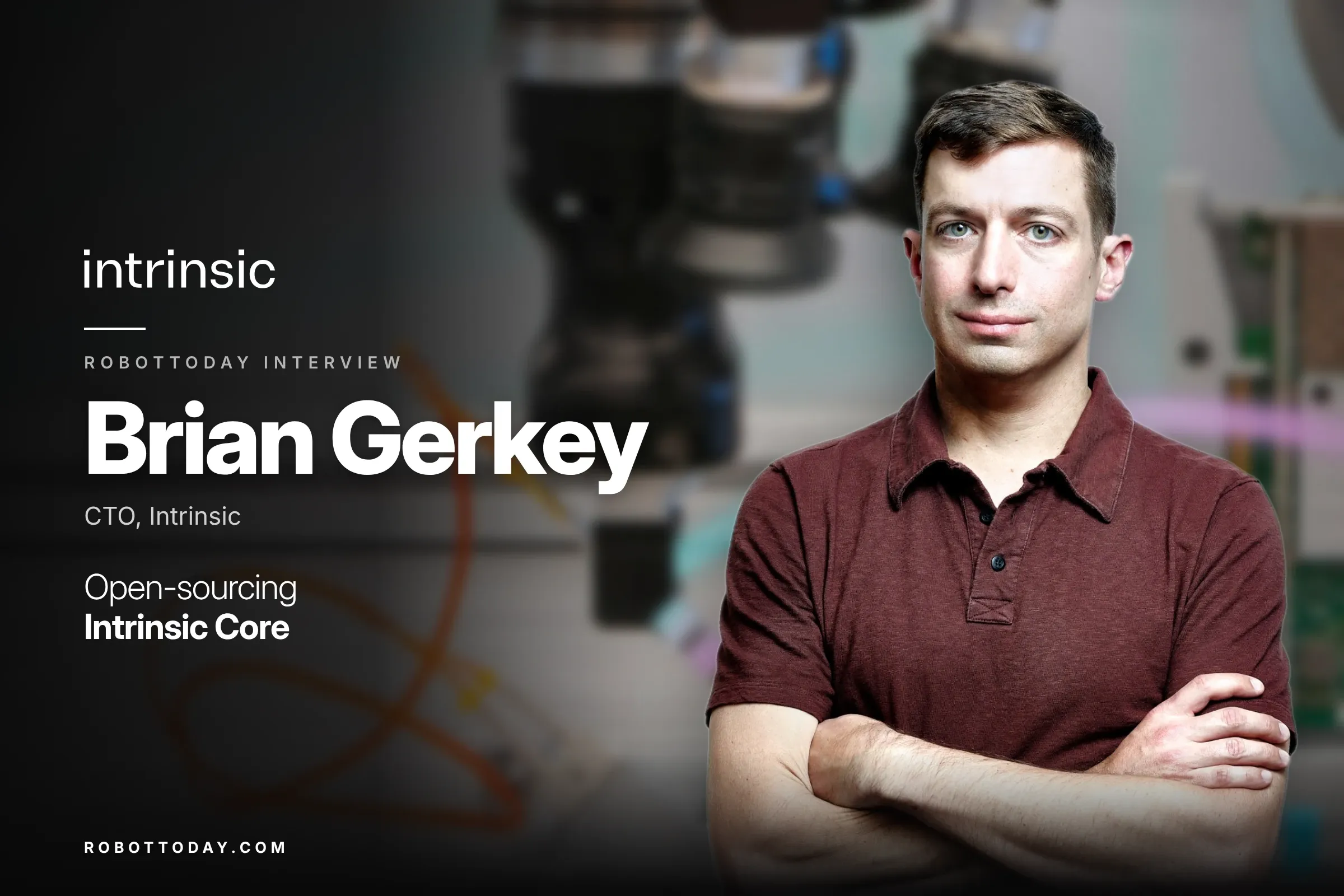
Intrinsic CTO Brian Gerkey on Intrinsic Core and the Gap Between Robot Demos and Production
Two weeks after Intrinsic open-sourced Intrinsic Core at ROSCon 2026, Gerkey spoke with RobotToday about high-mix manufacturing, operator-led changeovers and what he hopes developers will build on the new code.
EDITOR'S NOTE
Intrinsic released Intrinsic Core under the Apache 2.0 license at ROSCon 2026, opening up the base of its industrial robotics software for the first time. In this interview, Gerkey says the main obstacle for factory robots is reliability in production rather than a lack of demonstrations, and he limits Intrinsic’s claims to defined jobs such as CNC machine tending. In our view, the release should be judged by how many outside companies build working products on it.
Brian Gerkey helped build the Robot Operating System (ROS) at Willow Garage and later co-founded and ran Open Robotics, the organization behind ROS and the Gazebo simulator. Intrinsic bought Open Robotics’ commercial subsidiaries in December 2022, and Gerkey is now Intrinsic’s Chief Technology Officer. Intrinsic, which develops AI software for industrial robots, joined Google in 2026.
On September 22, at ROSCon 2026 in Toronto, Intrinsic open-sourced Intrinsic Core under the Apache 2.0 license, together with an Open Machine Tending Solution reference design for FANUC and Universal Robots arms. Several of the same capabilities were used in Intrinsic’s AI for Industry Challenge, which drew more than 5,000 developers from 115 countries. Two teams reached 100% success on a real cable-insertion workcell.
RobotToday spoke with Gerkey on October 5, after Intrinsic exhibited at IMTS 2026 in Chicago.
The interview
This interview has been edited for length and clarity.
Why factories still don’t automate
RobotToday: Many manufacturers will run a pilot but never go further. How do you make the case for real adoption?
Gerkey: What really works well, and what we do in practice, is we talk to them about the return on investment that they’re going to get from adopting this new technology. Take a machine shop as an example. We go with our solution builders and help them make the case to the manufacturer. We say: look, you’ve got these machines, and you’ve got more demand than you have labor available to run all the production jobs that you want to run. You don’t have the staff available to do an overnight shift, to do a weekend shift. We can give you the technology that helps you meet that demand.
The fact that that technology is implemented using robotics and AI should be a secondary concern. If you lead with robotics and AI, if that’s the goal, I think you’re skipping over what problem you’re actually trying to solve. That could get you initial success, it can get you attention, it can get you in a newspaper. I don’t think it’s going to give you a durable impact.
RobotToday: Why is it still so hard to deploy industrial robots, especially for smaller manufacturers? One person we spoke with put their average adoption rate at around 8%.
Gerkey: I’ve also read that, depending on which market you study, something like 80% of manufacturing facilities have essentially zero automation. Historically, it has only been economically feasible to automate very high-volume operations. You define one task as narrowly as possible. You physically engineer all the variance out of it, so that you get the same part again and again and again. You use fixtures, you hand-teach all the robot poses. That gets you multiple nines of reliability, which is what manufacturers want.
That approach gives you a very, very reliable but very narrow application. That works for a big manufacturer, because you can spend up front to build the systems. But it’s very fragile, in the sense that if I change anything about the design of that product, I probably have to get the system integrator who installed that line to come back and rethink it. That is completely unmanageable for a small manufacturer. They have smaller batch runs; they have higher mix. In the morning they do it with one type of part; in the afternoon, with a different type of part. That is an entire part of the market that’s been wildly underserved by automation historically.
What I think we are now on the verge of doing is bringing software-defined manufacturing capabilities to those folks. We still need excellent system integrators to deploy these systems, but now we can start to soak up some of that uncertainty in software. Instead of physically attaching everything to the table, we can say: put it on the table somewhere. I will observe it with my camera. I have a very good AI-powered perception system that will tell me where the object is, and I can go and pick it up.
We’re well beyond the feasibility, proof-of-concept, pilot stage. What we’re trying to close, as an entire robotics community, is the gap between prototype and production. We can now make very, very compelling prototypes. The next step is: how do we maintain all the flexibility we have in the prototype, and close the gaps so that when it runs in the factory, you get the number of nines of reliability that the manufacturer wants?
“We’re well beyond the feasibility, proof-of-concept, pilot stage. What we’re trying to close, as an entire robotics community, is the gap between prototype and production.”
RobotToday: Where does Intrinsic focus, from research through to deployment?
Gerkey: Honestly, we play at all levels. We have a world-class R&D team applying largely modern AI techniques to perception, to grasping, to motion planning. But we also know that many other groups out in the world are doing that type of work. Let’s say one of our colleagues out in the industry comes up with a really great model for grasping objects. If and when that’s working well, we want to be in the position where we’ve got all of the infrastructure that will take that model and wire it up to all the robots that matter out in the world, provide tools that allow improvement of how that model operates to get it to that level of reliability, and then help you deploy that system into the world.
If I could put one thing to measure us by, it would be traction in the outside world. Intrinsic doesn’t exist as a research lab. We have a research component, but we’re here to get systems physically going in the real world.
Changeovers on the shop floor
RobotToday: If a manufacturer switches a robot to a completely new SKU, what is the minimum the system needs to know?
Gerkey: If we’re doing this right, I think you don’t necessarily need someone who would identify as an engineer to do that job. Flowstate as a product is designed for an engineer to use, to develop an application. We call it a solution. You test that in simulation, and when you’re ready, you deploy it onto an on-prem industrial PC that is part of the workcell.
We actually see this today with Flowstate-based systems we’ve rolled out for CNC machine tending. The application itself contains enough flexibility that out on the shop floor there’s an application-specific graphical interface, an HMI, on the workcell. As an operator, as a technician, you can put in the new SKU. So what do I need to know? I need the CAD for the part. I need the input and the output. I need the batch size. I need some expectation of how it will be presented to the robot. In a fixed grid? Fixtured? In a bin? Those become parameters to a program that was previously built with Flowstate.
You probably don’t have the shop floor populated with engineers. If you have to bring an engineer out every time you have a SKU changeover, then we’re not enabling the kind of high mix that we need. We really want to make it possible for manufacturers to totally own that changeover process. That’s how they’re going to be able to run overnight jobs, even multiple jobs back to back on a single system.
RobotToday: So someone without a robotics background can now run the cell?
Gerkey: It is important to scope that expectation. I’m not pretending that we’re giving you a general-purpose robot that you, as a non-roboticist, can ask to do anything. For me, that’s more of a philosophical goal than a practical goal. If I give you the system I just described, I’m giving you a robot that does tending for a CNC machine, which it is physically attached to. You’re going to have it do rectangular parts instead of cylindrical parts, and you’re going to run 15 instead of 100. Those are the types of variances that we can handle. You can’t ask it to make you breakfast.
I could give you a robot that can tend a CNC machine and make you breakfast. It will do a very, very bad job of both of those things. We don’t want to have a mediocre way of achieving many things. We want to be really, really good at things that are economically meaningful to manufacturers.
“We don’t want to have a mediocre way of achieving many things. We want to be really, really good at things that are economically meaningful to manufacturers.”
AI and the prototype gap
RobotToday: Could AI eventually take over more of this work from people, including the interface and the CAD input?
Gerkey: Increasingly so, yes. The CAD itself is increasingly being designed by agents. If that can be automatically fed through into the robot as jobs, that’s actually something we could enable today. That’s more a matter of relatively simple workflow automation.
A more interesting question is how far back into the development process you can push that idea. Can you have agents that are building the robot application for you in the first place? That’s something we’re actively exploring. We work with customers we call solution builders, very advanced system integrators and machine tool builders, and increasingly they are using agents to help them build robot programs.
RobotToday: Where do you expect AI to make the biggest difference soonest?
Gerkey: If you pick one problem I work on, it’s closing that gap from prototype to production, and I think that’s an area where AI can help us a lot. So many compelling technology demonstrations are created, so many great papers are written, and so many great videos get posted on YouTube and elsewhere. But so few of those things end up deployed in production, doing useful work for humanity. Vanishingly few of them.
Is there a way to systematize taking those prototypes, iterating on them and carrying them into a productized form that a company can stand behind, that they can ship, service and maintain? Some of that has to do with people and process, but there’s a part in the middle where AI can really help us improve the performance and the reliability of these systems. I think that’s the biggest impact we could have.
RobotToday: Ten years ago, what did you think was still far off?
Gerkey: I’m not a perception expert, but I am astonished by how quickly machine-learned neural networks for solving perception problems have completely reinvented everything. I learned computer vision at a time when you would start from first principles. Let’s find the features. Let’s find corners. It only worked in very narrow circumstances. Over the last 10 to 15 years, deep learning and the subsequent approaches have turned that completely on its head. In perception, you can generate huge volumes of data relatively inexpensively, synthetically, from simulation. Now, we don’t necessarily know how the network we create works, but we know how to create the network that solves the problem. That’s extraordinary.
ROS and the open core
RobotToday: What from your years building ROS shapes how you build Intrinsic today?
Gerkey: It’s the breadth of applications that people create when you share a platform. When we first built ROS, we built it for one particular robot that we were building at Willow Garage, the PR2, with a researcher user in mind. But very quickly people picked it up and used it for other robots: robots that didn’t have arms, flying robots, robots that go in the water. And they used it for commercial purposes.
I think of myself as a tool builder. My experience from ROS is that if we do it right, our users and customers will end up building applications we never even thought of. That’s where we get a big lift from building a platform and sharing it, increasingly, as we announced at ROSCon, in an open-source way. We’re going to take the core of the Intrinsic enterprise stack, we’re going to call it Intrinsic Core, and we’re going to share it as an additional contribution to the ROS ecosystem.
RobotToday: Intrinsic launched the Intrinsic Intelligence Cell in June and Intrinsic Core in September. Do you expect third parties to build and sell their own capabilities on Core, the way developers did on iOS?
Gerkey: I would happily be compared to the commercial and technical impact of a company like Apple. We definitely take inspiration from the smartphone industry. We think about iOS, we think about Android, as places where having a very broadly used software platform has enabled all kinds of innovation, with third-party companies building products based on a common core.
I certainly hope that’s what comes out, in part, from our Intrinsic Core release. We’re addressing a community that is already used to using a lot of open-source tools, which I think of as the commons. We just contributed something net new to that commons. I hope that companies that already exist, as well as new companies that haven’t yet been formed, will build their products on top of this open core. That would be a great sign of success for me.
“We just contributed something net new to that commons.”
Intrinsic Core at a glance
Released September 22, 2026, at ROSCon in Toronto, under the Apache 2.0 license.
Code: github.com/intrinsic-ai/intrinsic-core (public). The repository notes that Intrinsic Core is “not an officially supported Google product.”
Includes hardware-agnostic real-time control, 6-DoF pose estimation using NVIDIA FoundationPose, motion and grasp planning, Gazebo-based simulation, camera calibration, and ROS-compatible drivers for supported robots, grippers and 3D cameras.
Released alongside the Open Machine Tending Solution, a reference design for CNC machine tending on FANUC and Universal Robots arms.
Developers can join the Intrinsic developer community (developer.intrinsic.ai) for tools, resources, exclusive content and access to the community.
About Brian Gerkey
Brian Gerkey is CTO of Intrinsic and chair of the board of the Open Source Robotics Foundation. He co-founded and led Open Robotics, and earlier worked at Willow Garage, SRI International, Stanford University and USC.
RobotToday's take
Gerkey kept his claims narrow throughout the interview. He described Intrinsic’s deployed systems as built for specific jobs such as CNC machine tending, and he said most robot demonstrations never reach production.
According to Intrinsic, solutions built on Intrinsic Core can move to Flowstate and its enterprise services without refactoring, so the free release also supports the company’s commercial business. One question is still open: Intrinsic Core’s pose estimation currently uses NVIDIA FoundationPose, and how it will work with Google DeepMind’s Gemini Robotics models has not been made public. Gerkey said he will measure success by outside adoption, and that is what we will be watching.
SOURCES
Intrinsic, “Introducing Intrinsic Core”. https://www.intrinsic.ai/blog/posts/introducing-intrinsic-core
Intrinsic, “AI for Industry Challenge”. https://www.intrinsic.ai/blog/posts/ai-for-industry-challenge
The Robot Report, “Intrinsic open sources key parts of its platform for easier development” (Sept. 22, 2026). https://www.therobotreport.com/intrinsic-open-sources-key-parts-platform-easier-development/
Open Robotics, “Intrinsic Acquires OSRC and OSRC-SG” (Dec. 2022). https://openrobotics.org/blog/2022/12/15/intrinsic-acquires-osrc-and-osrc-sg
Intrinsic at IMTS 2026. https://www.intrinsic.ai/events/imts-2026



Leave a comment