

1. At a Glance
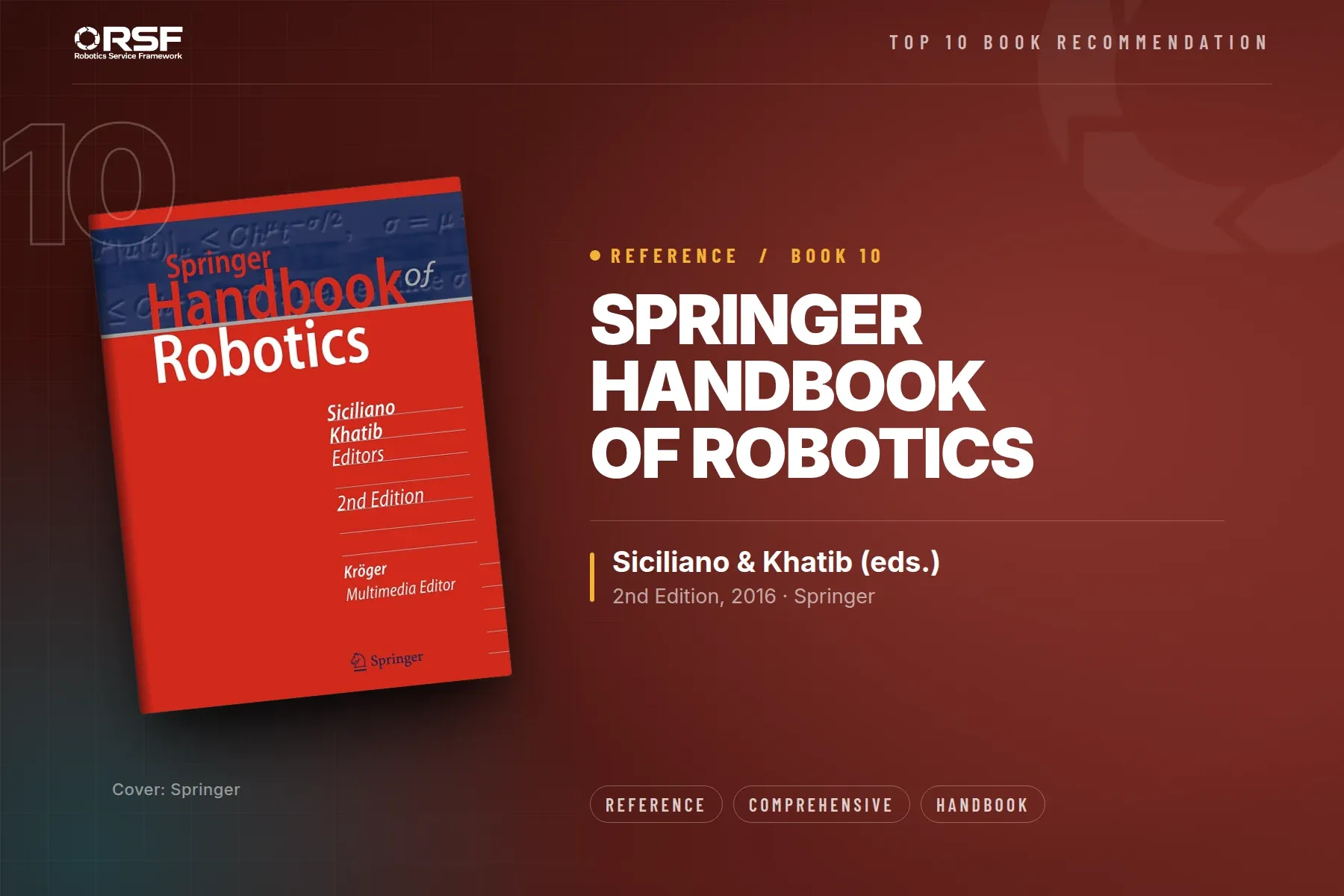
Full title | Springer Handbook of Robotics, 2nd edition |
Editors | Bruno Siciliano & Oussama Khatib (eds.) — multi-author, 80+ chapters by leading researchers in each subfield |
Edition | 2nd edition, Springer, 2016 — approx. 2,300 pages, with companion video content |
Access | Paid; print and eBook via Springer. Institutional access typically allows per-chapter download. |
RSF mapping | All four layers · Module 7 (Cross-Form O&M Practicum) |
Difficulty | ★★★★☆ as a read · ★★☆☆☆ as a reference |
Official page (Springer, verified 2026-07-25):
https://link.springer.com/book/10.1007/978-3-319-32552-1
2. Why This Book
The last book on this list is the largest and the least meant for reading. Two editors, more than eighty chapters, roughly 2,300 pages, written by the leading researchers of every subfield. Nobody reads it cover to cover. Nobody should. It ranks here for a different reason: when a fault crosses domains and the vendor documentation runs out, this is the reference of record.
Service work is turning cross-form. The team that maintains an arm on Monday may face an AMR on Wednesday and an inspection drone on Friday. Every other book on this list covers one slice of that reality; the Handbook covers all of it — legged, wheeled, aerial, underwater, industrial, medical — in one binding. A Professional-tier engineer will not study it, but the moment an unfamiliar machine shows an unfamiliar fault, twenty minutes in the right chapter beats two hours in a search engine. That moment is exactly what RSF Module 7 trains for, and it is why a book nobody reads still belongs on a top-ten reading list. No.10 is not last place; it is a different shelf.
3. What’s Inside
The second edition is organized in seven parts, and the sequence roughly retraces the Robotics Service Framework layer model before spreading out across robot forms. Part 1, robotics foundations, covers kinematics, dynamics, mechanisms and control — the mathematical core, compressed into survey chapters. Part 2, design, treats actuators, sensing hardware and mechanism design: how robots are physically built. Part 3 covers sensing and perception. Part 4 covers manipulation and interfaces, from grasping to telerobotics.
Part 5 is where the book becomes unique for service engineers: moving in the environment. Separate chapters survey legged, wheeled, aerial and underwater robots — each written by specialists in that form, each a self-contained introduction to its vocabulary, hardware conventions and failure-relevant physics. Part 6, robots at work, does the same for application domains: industrial robotics, field robotics, service robots, medical and rehabilitation robotics. Part 7, robots and humans, closes with human-robot interaction, safety and ethics.
Every chapter is a survey with an extensive reference list, so it works as an on-ramp: read the chapter, then follow the citations if you need depth. The second edition links chapters to video content through a companion app, which helps where the subject is inherently visual — gaits, grasps, underwater maneuvering. Writing level varies by chapter, as it must with this many authors, but the editors keep the structure uniform: each chapter states its scope up front and ends with conclusions and further reading.
4. The RSF Perspective
The skill this book teaches is not in any chapter. It is the usage pattern itself: a service engineer does not read handbooks, they interrogate them. Robotics Service Framework Module 7 is built around cross-form fault cases precisely because no technician can be pre-trained on every robot form; what can be trained is the move from "I have never seen this machine" to "I know what to ask." The Handbook is the best available tool for practicing that move. Vendor manuals assume you already know the form; forums know your machine but not your fault. The Handbook fills that gap.
A concrete Module 7 flow. Section 7.5 puts you in front of an aquatic robot — say an ROV with a suspected thruster issue. You have never serviced one. Open the underwater robotics chapter: twenty minutes gets you the domain vocabulary — thruster configurations, pressure housings, tether behavior — enough to read the vendor manual properly and to talk to the OEM’s L3 support without embarrassment. That is the whole transaction. Not mastery; earned vocabulary, fast.
The cross-form breadth mirrors Module 7’s subsections almost one-to-one. Legged-robot material backs the humanoid and quadruped sessions (7.2, 7.3). Wheeled robots back the AGV/AMR session (7.4). Aerial chapters back UAVs (7.6); underwater backs 7.5; field robotics backs construction and agricultural robots (7.7, 7.8); medical and rehabilitation robotics backs the exoskeleton session (7.9). The HRI and safety chapters in Part 7 feed Module 8’s customer-communication material. One volume, ten subsections covered. This is also why the Handbook, alone on this list, maps to all four RSF layers: a cross-form fault rarely respects layer boundaries, and the chapter you open treats the form’s mechanics, electronics and software in one place.
Elsewhere in the course the Handbook is a backstop, not a text. Part 1 can settle a kinematics question left open by Module 2, and the sensing chapters occasionally help in Module 6, but dedicated books on this list serve those modules better. What to skip at Professional tier: buying it. This is a team-shelf or library purchase — one copy per service team, or institutional e-access where each chapter downloads separately. The right personal investment at this stage is the habit: next time an unfamiliar form appears on a work order, spend the first twenty minutes in the relevant chapter, not in a search engine.
5. Difficulty & Audience
Both ratings in the facts table are honest. Read front to back, this is a four-star book: survey chapters compress graduate material, and the mathematics arrives without warm-up. Used as a reference, it is a two-star book: you arrive with a question, the chapter hands you scope, vocabulary and figures, and you leave before the derivations begin. Professional-tier learners should plan zero hours of linear reading. Instead, budget two to three hours during Module 7 to practice the interrogation pattern on two forms you have never touched — twenty to thirty minutes per consultation is the realistic unit. Primary audience: service teams and their leads, training providers, and any engineer whose work orders span more than one robot form.
6. Companions & Alternatives
When you commit to one form, step off the Handbook onto the form-specific shelf: Fossen for marine craft (M7.5), Beard & McLain for UAVs (M7.6), Tedrake’s Underactuated Robotics — free online — for legged machines (M7.2/7.3). The free RSF Module 7 textbook supplies the service-side framing the Handbook deliberately lacks. For a sit-down-and-learn counterpart from the same editor, Siciliano’s Robotics: Modelling, Planning and Control is the coherent textbook the Handbook is not. Buy the second edition: the 2008 first edition predates much of the multi-form and video content that earns it this spot.
Mechatronics W. Bolton — RSF Top 10 Robot Education Textbooks · No. 1
ITIL Foundation: ITIL 4 Edition PeopleCert — RSF Top 10 Robot Education Textbooks · No. 2
Industrial Robotics Fundamentals Ross, Fardo & Walach — RSF Top 10 Robot Education Textbooks · No. 4
Robotics, Vision and Control Peter Corke — RSF Top 10 Robot Education Textbooks · No. 5
Introduction to Robotics J. J. Craig — RSF Top 10 Robot Education Textbooks · No. 6
Probabilistic Robotics Thrun, Burgard & Fox — RSF Top 10 Robot Education Textbooks · No. 7
Modern Robotics K. M. Lynch & F. C. Park — RSF Top 10 Robot Education Textbooks · No. 8
A Gentle Introduction to ROS Jason M. O’Kane — RSF Top 10 Robot Education Textbooks · No. 9
Springer Handbook of Robotics B. Siciliano & O. Khatib (eds.) — RSF Top 10 Robot Education Textbooks · No. 10
Small Unmanned Aircraft: Theory and Practice Beard & McLain — RSF Specialist Shelf · Book S2 of 6
Underactuated Robotics Russ Tedrake — RSF Specialist Shelf · Book S3 of 6
Planning Algorithms Steven M. LaValle — RSF Specialist Shelf · Book S4 of 6










Leave a comment