

1. At a Glance
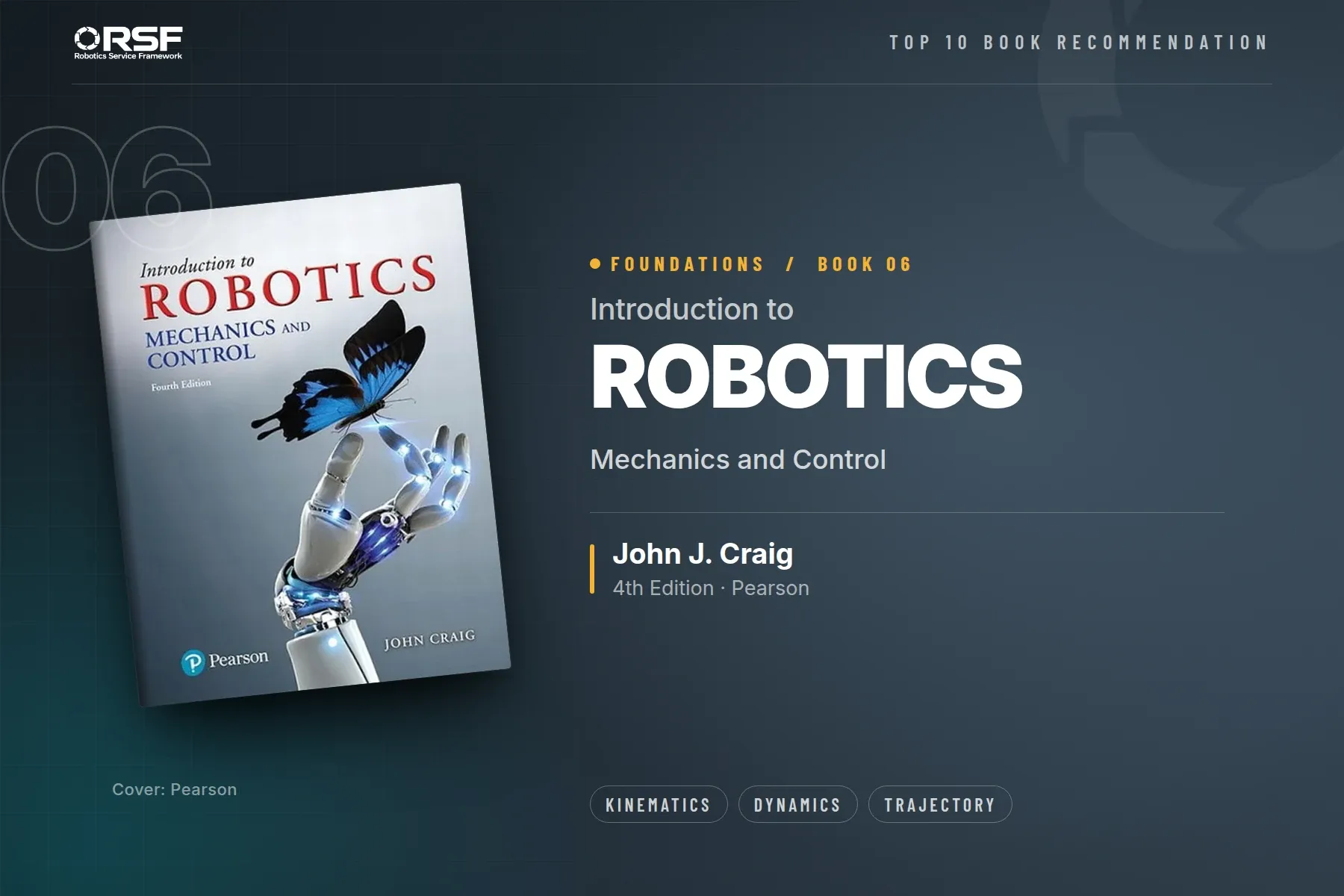
Full title | Introduction to Robotics: Mechanics and Control |
Author | John J. Craig |
Edition | 4th edition, Pearson — verified 2026-07-25; |
Access | Paid; print and eText via Pearson. No legal free edition. |
RSF mapping | Layer 1 (Mechanical Body) · Module 2 |
Difficulty | ★★★☆☆ — linear algebra and trigonometry; the recommended first half is the gentler half |
Official page (Pearson, verified 2026-07-25):
https://www.pearson.com/en-us/subject-catalog/p/Craig-Introduction-to-Robotics-Mechanics-and-Control-4th-Edition/P200000003304/9780133489798
2. Why This Book
Six of the ten universities Robotics Service Framework benchmarked for its curriculum — MIT, TUM, USC, Oxford, Berkeley, Stanford — teach robot kinematics from Craig. No other book on this list matches that adoption. Four decades on, it is still how the field learns to talk about frames, transforms and joints; when a vendor manual mentions D-H parameters or a tool frame, it is speaking Craig’s language.
A service engineer needs that language for a concrete reason. Calibration procedures, teach pendant menus, and error codes about position deviation all assume you know what a coordinate frame is and how one maps to another. You do not have to design a manipulator to service one, but you do have to read documents written by people who did.
So why No. 6 rather than higher? An honest reason: the service value is indirect. A Professional-tier engineer needs roughly the first half of the book, and the dynamics and control chapters serve designers — so on the dimension this list now weights double, service practicality, Craig scores mid-table. Its unmatched adoption keeps it this high. And since open access is tagged rather than scored, the lack of a free edition no longer costs points — though Modern Robotics (No. 8) still covers similar ground for nothing. Ranked by influence alone, it would fight for first place.
3. What’s Inside
Craig builds the book in the order a manipulator problem is actually posed. The opening chapters cover spatial descriptions and transformations: how to describe a rigid body’s position and orientation, how to attach coordinate frames to links, and how to chain transforms so that a point known in the gripper frame can be expressed in the base frame. This is the bedrock; everything later leans on it.
Next comes manipulator kinematics. Forward kinematics uses the Denavit–Hartenberg (D-H) convention — Craig’s own variant of it — to go from joint angles to end-effector pose. Inverse kinematics goes the other way and explains why the answer is sometimes not unique and sometimes does not exist: the origin of workspace limits and singular configurations. The Jacobian chapters then connect joint velocities to end-effector velocities and joint torques to tip forces — the mathematics behind "a small error at one joint becomes a large error at the tool."
The second half moves toward design and control: manipulator dynamics, trajectory generation, mechanical design considerations (stiffness, actuation, transmission choices), then linear and nonlinear control of manipulators and force control for contact tasks. A closing part discusses robot programming languages and off-line programming systems.
Two traits mark the writing. Worked examples run on simple planar arms before anything six-axis, so the geometry stays visible. And the notation is disciplined — every frame, vector and transform is labeled the same way throughout, which is exactly what makes the book teachable and its vocabulary portable to vendor documentation.
4. The RSF Perspective
In the Robotics Service Framework four-layer model, Craig serves Layer 1, the mechanical body, and one module: Module 2. That sounds narrow. It is not, because Module 2’s kinematics sessions speak Craig’s language — and so does the industry.
For Module 2 (Mechanical & Electrical Layer): read the spatial-descriptions chapters first, slowly. The goal is not to compute transforms by hand but to hold the picture: every joint has a frame, every frame has an origin, and the controller’s idea of where the arm is depends on that chain of frames being right. The J3-axis case that runs through the RSF course — a joint reporting position deviation — turns on exactly this. "Zero-point calibration" is a frame-origin question: the encoder’s zero no longer coincides with the origin the kinematic model assumes, so every pose computed downstream inherits the offset. After Craig, you understand why a mastering procedure exists, why it must be redone after replacing a motor or belt, and why this fault shows up as a consistent offset rather than random noise.
Then read the forward and inverse kinematics chapters for vocabulary: D-H parameters, tool frame, base frame, singularities. Teach pendants and calibration sheets assume all of it. When a FANUC or KUKA manual asks you to define a tool frame or warns about a wrist singularity, that is Craig, nearly verbatim. One note on conventions: Craig teaches D-H; Modern Robotics (No. 8) teaches the newer product-of-exponentials formulation. Know both exist — but industry manuals overwhelmingly use D-H, which is a practical argument for Craig despite the older mathematics.
The Jacobian chapters deserve a lighter pass. Keep one idea: joint-space errors map through the Jacobian into task-space errors, and the mapping blows up near singularities. That is the mathematical reason the same J3 deviation can appear as a large tool-tip error in some poses and almost none in others — a genuinely useful fact in Module 5’s layered diagnosis.
What to skip at Professional tier: everything from manipulator dynamics onward — dynamics, trajectory-generation mathematics, linear and nonlinear control, force control. Those chapters are for people who build controllers, not people who keep the machines running; the RSF Professional assessment does not touch them. One last factor, specific to RSF’s audience: the official Chinese translation makes Craig the lowest-language-barrier rigorous kinematics text for Chinese-speaking learners. For a bilingual certification program, that is not a footnote — it is a ranking consideration.
5. Difficulty & Audience
Difficulty: 3 of 5. The mathematics is linear algebra and trigonometry — matrices, rotations, vectors — applied carefully rather than deeply, and the recommended reading stops before the genuinely hard chapters, which is why the rating is three stars and not four. Budget 15–20 hours for the first half: spatial descriptions, forward and inverse kinematics, and a light pass over the Jacobians. Ideal reader: an RSF Professional candidate working through Module 2 who wants the standard account of frames and transforms beneath the RSF textbook, and any service engineer who keeps meeting D-H tables in vendor manuals. Readers more comfortable in Chinese should simply take the official translation. At Specialist tier, the dynamics and control chapters become worth the climb.
6. Companions & Alternatives
Modern Robotics (No. 8, Lynch & Park) is the free, modern-mathematics alternative — the sensible pairing if the Pearson price stings, though it is harder going. The free RSF Module 2 textbook covers exactly what the Professional assessment needs; Craig is the depth behind it, not a prerequisite. Spong, Hutchinson and Vidyasagar’s Robot Modeling and Control is the other classic at this level, preferred at some universities. And a used earlier edition of Craig is a legitimate saving: the kinematics chapters that matter here have been stable across editions.
Mechatronics W. Bolton — RSF Top 10 Robot Education Textbooks · No. 1
ITIL Foundation: ITIL 4 Edition PeopleCert — RSF Top 10 Robot Education Textbooks · No. 2
Industrial Robotics Fundamentals Ross, Fardo & Walach — RSF Top 10 Robot Education Textbooks · No. 4
Robotics, Vision and Control Peter Corke — RSF Top 10 Robot Education Textbooks · No. 5
Introduction to Robotics J. J. Craig — RSF Top 10 Robot Education Textbooks · No. 6
Probabilistic Robotics Thrun, Burgard & Fox — RSF Top 10 Robot Education Textbooks · No. 7
Modern Robotics K. M. Lynch & F. C. Park — RSF Top 10 Robot Education Textbooks · No. 8
A Gentle Introduction to ROS Jason M. O’Kane — RSF Top 10 Robot Education Textbooks · No. 9
Small Unmanned Aircraft: Theory and Practice Beard & McLain — RSF Specialist Shelf · Book S2 of 6
Underactuated Robotics Russ Tedrake — RSF Specialist Shelf · Book S3 of 6
Planning Algorithms Steven M. LaValle — RSF Specialist Shelf · Book S4 of 6









Leave a comment