

1. At a Glance
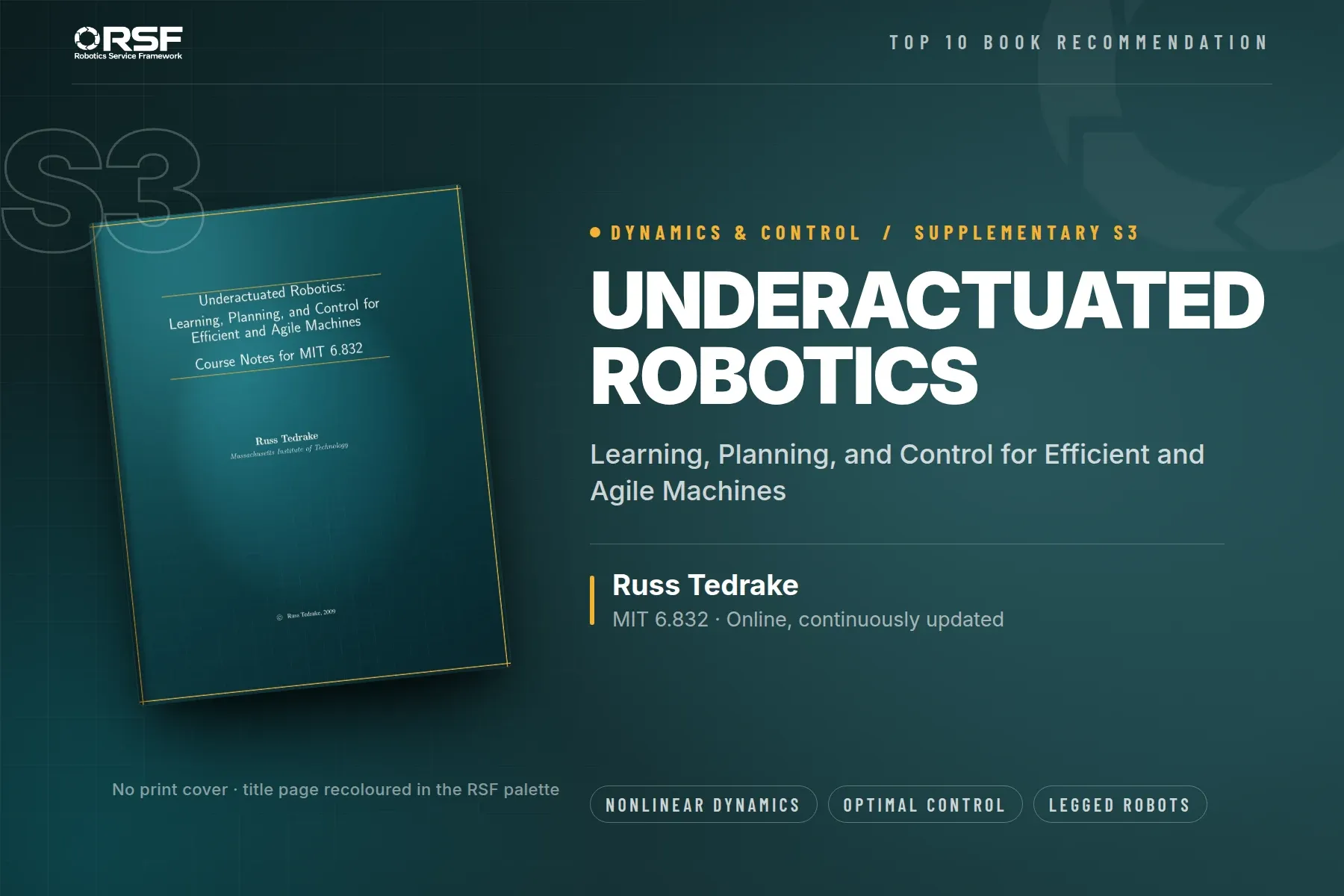
Full title | Underactuated Robotics: Algorithms for Walking, Running, Swimming, Flying, and Manipulation |
Author | Russ Tedrake (MIT) |
Edition | Free online edition, continuously updated, verified 2026-07-25; no fixed print edition |
Access | Free; online HTML text, recorded MIT lecture videos (6.832), and Python/Colab exercises included |
RSF mapping | Layers 1/2/3 (Mechanical Body, Electrical & Control, Software & Middleware) · M7.2 (humanoid) + M7.3 (quadruped/legged) |
Tier & Difficulty | Specialist-tier deep dive · ★★★★☆ — assumes a strong controls background; content stays current since it is continuously updated |
Official page (MIT CSAIL, verified 2026-07-25):
https://underactuated.csail.mit.edu/
2. Why This Book
Legged and humanoid robots fail in a specific way: they fall over, and the reason is control theory, not mechanics. Underactuated Robotics is the textbook-length answer to why a bipedal or quadrupedal system has fewer actuators than degrees of freedom, and what a controller has to do about it. Modern Robotics (No.8) gives an Robotics Service Framework learner the kinematics and dynamics of a rigid-body robot — forward kinematics, Jacobians, screw theory, equations of motion. It stops short of explaining why a two-legged robot cannot simply be commanded into a pose the way a fixed-base arm can. Tedrake’s book picks up exactly there: underactuation, balance, and the control techniques — LQR, feedback linearization, trajectory optimization — that keep a robot with too few actuators upright and moving.
A Professional-tier engineer services a robot as a black box: read the fault code, replace the part. A Specialist-tier engineer diagnosing a humanoid that will not recover from a stumble needs the underlying theory, because the vendor’s technical documentation assumes it. This book is free, continuously updated, and paired with recorded MIT lectures and runnable Python exercises, which makes it the natural on-ramp once a learner commits to the humanoid or legged specialization track.
3. What’s Inside
The book opens with the distinction between fully actuated and underactuated systems, then builds intuition through three running examples used throughout: the simple pendulum, the acrobot (a double pendulum with one actuated joint), and the cart-pole. These low-dimensional systems carry every idea the later chapters generalize, and Tedrake returns to them repeatedly rather than treating them as one-off warm-ups.
From there the book moves into control proper: linear control including the linear-quadratic regulator (LQR), and nonlinear techniques including feedback linearization. A chapter on trajectory optimization covers how to plan a dynamically feasible motion, not just a geometrically valid one — the distinction that matters once a robot has real dynamics to obey rather than a kinematic path to follow. A motion-planning chapter connects this back to the broader planning literature.
The legged-locomotion chapter is the specialization payoff: walking and running models including the spring-loaded inverted pendulum (SLIP), zero-moment point (ZMP) balance criteria, and capture-point analysis for recovering from a push or a stumble. Later chapters extend the same underactuation lens to manipulation and contact dynamics — what happens when a robot’s actuators must act through unilateral, frictional contact with an object or the ground — and to perception for control, connecting sensor data back to the control problem rather than treating perception as a separate chapter.
Because the book lives online and is continuously updated, chapter numbering and exact content shift over time; the topic sequence above has been stable across recent versions. Every chapter includes runnable Python/Colab notebooks, and MIT’s recorded lecture series (6.832) tracks the book closely, so a reader can watch a lecture and run the corresponding notebook.
4. The RSF Perspective
Underactuated Robotics is, in a real sense, the theory of why legged and humanoid robots fall and what a whole-body controller (WBC) does to stop that from happening. M7.2’s humanoid fault list includes “WBC freeze on perception latency spike” and “gait instability / fall non-recovery” — both are exactly the failure modes this book’s balance and control chapters describe from first principles. A WBC freeze is a controller that stopped receiving usable state estimates in time to close its control loop; the book’s treatment of feedback control and the assumptions behind it explains what “in time” means and why a stale estimate is worse than a noisy one. Fall non-recovery is a capture-point problem: the legged-locomotion chapter gives the actual definition of a capture region and why a controller either finds a foot placement inside it or the robot goes down.
M7.3’s quadruped/legged fault case, “dynamic balance calibration loss after joint gearbox wear,” reads differently once a reader has been through the underactuation chapters: gearbox wear changes the effective actuator dynamics the controller was tuned against, which is precisely the mismatch between assumed and actual system dynamics that the LQR and feedback-linearization chapters warn about. The book does not mention gearboxes; it gives the control-theoretic vocabulary that makes the fault legible.
Beyond fault diagnosis, the capture-point and ZMP vocabulary is what lets a Specialist-tier engineer actually read a Boston Dynamics, Unitree, or Agility Robotics technical whitepaper instead of skimming past the control-theory paragraphs. Those documents assume this book, or something like it, as background.
Reading protocol: start with the pendulum, acrobot, and cart-pole chapters — not because they are simple, but because every later chapter reasons in terms of them, and skipping them makes the legged-locomotion chapter opaque. From there go directly to the legged-locomotion chapter; it is the highest-value chapter for M7.2/M7.3 fault work and does not strictly require the trajectory-optimization chapter first. Full LQR derivations, the Lyapunov-stability material, and the trajectory-optimization formalism reward a second pass once a learner has committed to humanoid or legged specialization — they are not needed to get value from the book on a first read.
5. Difficulty & Audience
Difficulty: 4 of 5. The book assumes a working knowledge of linear algebra, ordinary differential equations, and basic feedback control; a reader without that background will struggle with the control chapters even though the pendulum/acrobot intuition-building sections stay accessible. Because it is continuously updated rather than fixed to a print edition, the content stays current with the field — a genuine advantage over a book that goes stale after publication, at the cost of chapter numbers occasionally shifting between visits. Budget 30–40 hours for the reading-protocol chapters above; the full book, including the manipulation and perception-for-control material, is closer to 60–80 hours.
This book is not required at Robotics Service Framework Professional tier — nothing in the Professional curriculum assumes LQR or capture-point analysis. Read it when specializing in humanoid (M7.2) or quadruped/legged (M7.3) service work, not before.
6. Companions & Alternatives
Modern Robotics (No.8) is the prerequisite: read it first for forward/inverse kinematics, Jacobians, and equations of motion, then come to this book for what to do with a system that has fewer actuators than degrees of freedom. For platform-specific detail beyond the theory, Boston Dynamics, Unitree, and Agility Robotics all publish technical whitepapers that assume this book’s vocabulary. The book’s own Python/Colab exercises are the fastest way to turn the LQR and trajectory-optimization chapters from reading into working code, and cost nothing beyond time.
Mechatronics W. Bolton — RSF Top 10 Robot Education Textbooks · No. 1
ITIL Foundation: ITIL 4 Edition PeopleCert — RSF Top 10 Robot Education Textbooks · No. 2
Industrial Robotics Fundamentals Ross, Fardo & Walach — RSF Top 10 Robot Education Textbooks · No. 4
Robotics, Vision and Control Peter Corke — RSF Top 10 Robot Education Textbooks · No. 5
Introduction to Robotics J. J. Craig — RSF Top 10 Robot Education Textbooks · No. 6
Probabilistic Robotics Thrun, Burgard & Fox — RSF Top 10 Robot Education Textbooks · No. 7
Modern Robotics K. M. Lynch & F. C. Park — RSF Top 10 Robot Education Textbooks · No. 8
A Gentle Introduction to ROS Jason M. O’Kane — RSF Top 10 Robot Education Textbooks · No. 9
Small Unmanned Aircraft: Theory and Practice Beard & McLain — RSF Specialist Shelf · Book S2 of 6
Underactuated Robotics Russ Tedrake — RSF Specialist Shelf · Book S3 of 6
Planning Algorithms Steven M. LaValle — RSF Specialist Shelf · Book S4 of 6







Leave a comment