

1. At a Glance
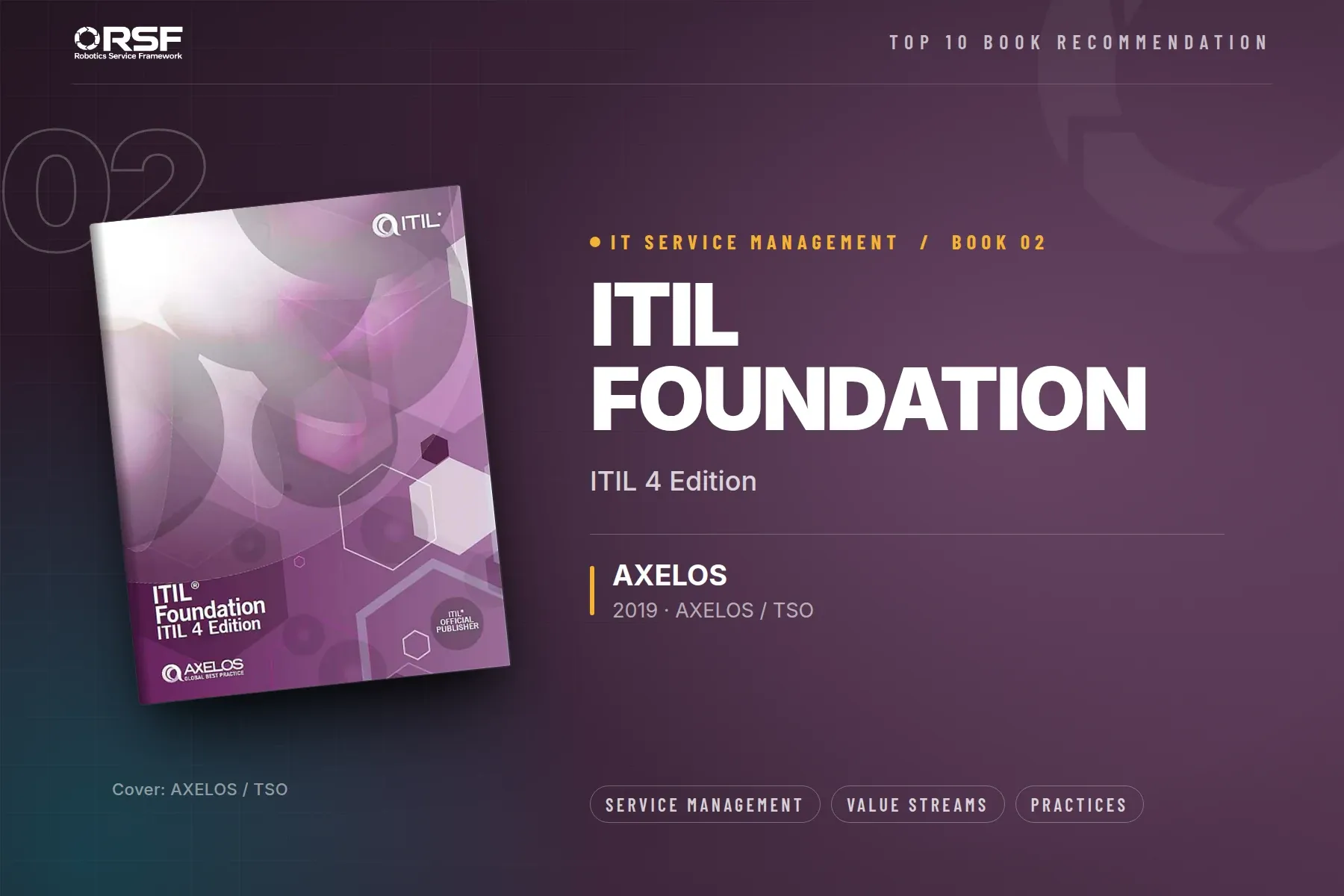
Full title | ITIL Foundation: ITIL 4 Edition — AXELOS/TSO, 2019, ISBN 9780113316076 (current PeopleCert imprint 2022, ISBN 9789925600007); the official Foundation publication, also a certification body of knowledge |
Author | PeopleCert International Ltd — framework owner and examination institute; acquired AXELOS, the original publisher, in 2021 |
Edition | ITIL 4 Edition (2019) — the version this list cites and the most useful to RSF learners; a Version 5 followed in 2026, ITIL 4 remains valid in parallel |
Access | Paid publications and exam via PeopleCert; PeopleCert sells the official eBook inside exam/eLearning bundles, standalone paperback via accredited resellers; syllabus and sample papers free on the official site |
RSF mapping | Service management dimension · Modules 1, 8 |
Difficulty | ★★☆☆☆ — no math; terminology-dense |
Official page (PeopleCert, verified 2026-07-25):
ITIL 4 Foundation: https://www.peoplecert.org/browse-certifications/it-governance-and-service-management/ITIL-1/itil-4-foundation-2565
2. Why This Book
Open any robot service contract and the language is not robotics — it is ITIL®. Response time, resolution time, availability, incident, problem, change window, escalation path: every one of these terms was standardized by the IT service management world, and ITIL is where they are defined. A Professional-tier engineer will spend more career hours living inside an SLA than reading kinematics, yet no engineering textbook explains what an OLA is or when a breach clock starts ticking.
This is the only management item on the list, and the only entry that is not a book in the usual sense: the official Foundation publication does exist — ITIL Foundation: ITIL 4 Edition (AXELOS/TSO, 2019, ISBN 9780113316076; current PeopleCert imprint 2022, ISBN 9789925600007) — but it is a certification body of knowledge sold mainly as exam collateral, bundled with the exam or eLearning rather than shelved as a trade textbook. Editor’s note on versions: ITIL Version 5 was released in 2026, after this list’s research window closed. ITIL 4 remains valid, and it is what every reference in this article means. It rises to second because it is the single best preparation for the service-management side of RSF — SLA, escalation and lifecycle are the actual daily work, and a reader who arrives with this material absorbed will find Modules 1 and 8 familiar ground, even though the book says nothing about robots. It is framework-level knowledge and does not replace vendor training. Whoever writes your service tickets already speaks this language; you should too.
3. What’s Inside
The ITIL 4 Foundation body of knowledge is compact, and it is the slice of ITIL with the most to offer an RSF learner. At its center sits the service value system: a service organization turns demand into value through a repeatable chain of activities, guided by principles rather than rigid procedures. The four dimensions remind you that every service rests on its people and organization, on technology and the information it carries, on suppliers and partners, and on the processes that tie them into value streams — a checklist worth running before blaming any single component.
The seven guiding principles are the most quotable part — “focus on value” and “keep it simple and practical” give the flavour: plain-sense maxims about value, iteration, collaboration, visibility and simplicity. They read like common sense until you watch a service team break all seven in one week.
The working core for RSF learners is the practice catalog. Foundation introduces dozens of practices; five matter here. Incident management: restore service fast, worry about root cause later. Problem management: find the root cause behind repeat incidents. Change enablement: how a modification gets authorized without breaking the system. Service level management: define, negotiate and report against SLAs — including the distinction between an SLA (provider to customer), an OLA (internal team to internal team) and an underpinning contract (with an external supplier). Continual improvement: the loop that turns every ticket into a better process. Around these sits the metrics vocabulary — availability, MTTR, MTBF — that Module 8 turns into calculations. This conceptual core is the durable part: whichever exam version you eventually face, these are the load-bearing ideas.
4. The RSF Perspective
Service management has an industry-standard vocabulary — the concepts standardized across ITIL 4 and ISO/IEC 20000 — and arriving with it already in hand is the biggest head start an RSF learner can give themselves. For Module 1 (Robotics Service Framework Intro): read the service value system and the four dimensions before the first session. M1 examines the robot service lifecycle — install, maintain, upgrade, decommission, replace — alongside the IT service lifecycle this book describes, then spends equal time on where the parallel breaks. Robots are physical: a failed change cannot always be rolled back by restoring a snapshot. Robots are safety-regulated: change enablement must pass through ISO 10218 and lockout/tagout, not just a change board. And robot fleets are multi-vendor in a way most IT estates are not. IT frameworks stop at the server room door; M1 exists to walk these concepts out onto the factory floor.
For Module 8 (SLA & Customer Communication): this is applied service level management, and Foundation’s SLM material is the best preparation available. M8’s centerpiece exercises — reading a real robotics SLA contract, running a breach-clock escalation scenario, computing MTTR and MTBF from a work-order history — go far more smoothly when you can already tell an SLA from an OLA from an underpinning contract. The L1→L2→L3 escalation model M8 teaches will feel immediately familiar to a reader of this book: it parallels incident management’s tiered support structure, and the robotics-specific triggers are the new part. The incident-versus-problem distinction also pays off in Module 5’s diagnostic discipline: the fix that restores service tonight and the analysis that stops the fault recurring are different activities on different clocks.
Now the practical advice, stated plainly: you do not need the paid ITIL certification to pass RSF. The free RSF M1 and M8 textbooks cover all the service-management concepts the 120-question assessment touches. Take ITIL Foundation itself only if you are heading toward IT-adjacent service management roles — service desk lead, service delivery manager — where the certificate opens doors on its own. What to skip at Professional tier: the full practice catalog (Foundation lists over thirty practices; five are the ones an RSF learner will actually meet), value stream mapping detail, and everything about the certification scheme above Foundation.
One more thing ITIL teaches by example: a framework does not replace product training. ITIL never made anyone a Cisco engineer — CCIE does that; ITIL tells the CCIE holder where their work sits inside a service operation. RSF has exactly this relationship to OEM courses. The standard skill stack is RSF plus a vendor certificate, not one or the other.
5. Difficulty & Audience
Difficulty: 2 of 5, with an asterisk. There is no mathematics anywhere; the challenge is terminology density — dozens of defined terms that look like ordinary English but carry precise meanings, and exam questions turn on that precision. Budget 8–10 hours for the concepts that matter most to an RSF learner: the value system, the guiding principles, the five practices above, and SLM in detail. That is far less than a full Foundation exam preparation. Ideal reader: every RSF Professional candidate — Modules 1 and 8 move much faster for those who bring this vocabulary with them — plus working engineers who keep getting copied on SLA disputes and want to know what the contract words mean. If English is your second language, the terminology burden doubles: learn the English terms even when studying in Chinese, because contracts use them untranslated.
6. Companions & Alternatives
The free route first: PeopleCert publishes the ITIL 4 Foundation syllabus and sample papers at no cost, and they are the best concentrated summaries available. ITIL knowledge and know-how are a real asset for understanding Robotics Service Framework; for the assessment itself, the free RSF M1 and M8 textbooks provide all the grounding needed. For the standard behind the framework, an overview of ISO/IEC 20000 — the international service management standard — shows what auditors will one day check your processes against. Buy the paid ITIL publications only with an exam date booked, and choose the version your employer’s contracts cite — today that is usually ITIL 4.
ITIL® is a registered trademark of PeopleCert group. Robotics Service Framework is an independent framework and is not affiliated with, accredited by, or endorsed by PeopleCert. Book titles and publisher names are used for identification only; no endorsement is implied.
Mechatronics W. Bolton — RSF Top 10 Robot Education Textbooks · No. 1
ITIL Foundation: ITIL 4 Edition PeopleCert — RSF Top 10 Robot Education Textbooks · No. 2
Industrial Robotics Fundamentals Ross, Fardo & Walach — RSF Top 10 Robot Education Textbooks · No. 4
Robotics, Vision and Control Peter Corke — RSF Top 10 Robot Education Textbooks · No. 5
Introduction to Robotics J. J. Craig — RSF Top 10 Robot Education Textbooks · No. 6
Probabilistic Robotics Thrun, Burgard & Fox — RSF Top 10 Robot Education Textbooks · No. 7
Modern Robotics K. M. Lynch & F. C. Park — RSF Top 10 Robot Education Textbooks · No. 8
A Gentle Introduction to ROS Jason M. O’Kane — RSF Top 10 Robot Education Textbooks · No. 9
Small Unmanned Aircraft: Theory and Practice Beard & McLain — RSF Specialist Shelf · Book S2 of 6
Underactuated Robotics Russ Tedrake — RSF Specialist Shelf · Book S3 of 6
Planning Algorithms Steven M. LaValle — RSF Specialist Shelf · Book S4 of 6





Leave a comment