

1. At a Glance
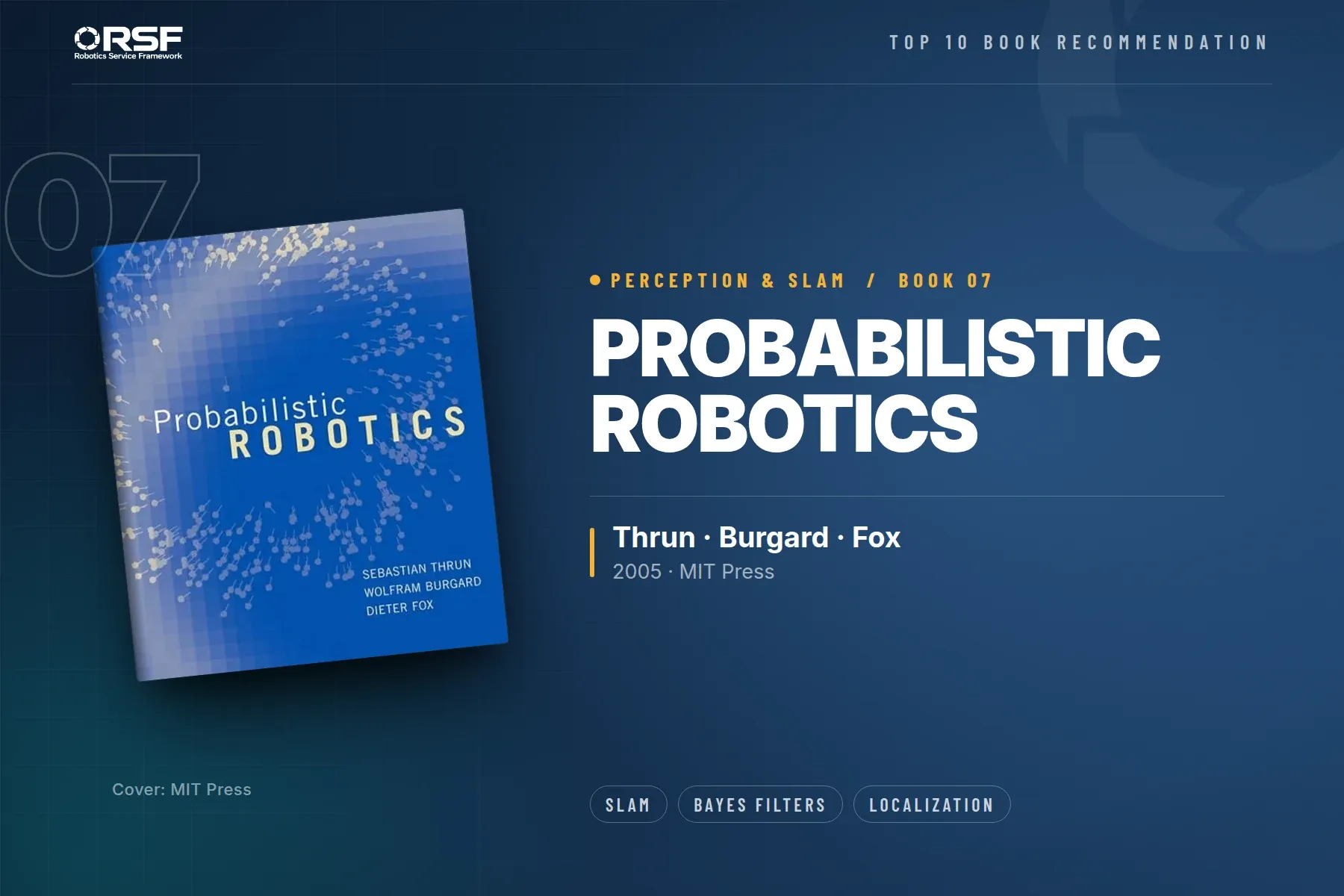
Full title | Probabilistic Robotics |
Author | Sebastian Thrun, Wolfram Burgard, Dieter Fox |
Edition | MIT Press, 2005 — sole edition; two decades on, still the standard text of the field, verified 2026-07-25 |
Access | Paid; print and eBook via MIT Press. No legal free edition. |
RSF mapping | Layer 4 (AI Perception & Decision) · Modules 5, 6 |
Difficulty | ★★★★☆ — hardest book on this list; the reading protocol in Section 4 removes most of the pain |
Official page (MIT Press, verified 2026-07-25):
https://mitpress.mit.edu/9780262201629/probabilistic-robotics/
2. Why This Book
An AMR that has "lost localization" has not broken anything you can touch. The encoders count, the LiDAR returns points, every node is up — and the robot still drives to the wrong shelf. Layer 4 faults do not smell like faults: no burnt part, no error code that names a culprit. Probabilistic Robotics explains what actually failed. A robot never knows where it is. It maintains a belief — a probability distribution over where it might be — and every sensor reading merely updates that belief. When the belief drifts away from reality, the robot behaves confidently and wrongly at the same time. That is the signature of a perception fault, and this book is where the idea comes from.
Thrun, Burgard and Fox wrote the defining text of the probabilistic approach that now runs inside essentially every localization and SLAM stack a service engineer will meet. Stanford, Berkeley, Oxford and USC teach from it. It sits at No. 7 for one reason only: difficulty. This is the hardest book on the list, and a Professional-tier reader must refuse most of its mathematics — the highest-value mindset for Layer 4 diagnosis, capped by the difficulty fit. Read for the mindset instead, and no other book changes how you diagnose perception problems as much. The value is high; the barrier is high; the rank is the difference.
3. What’s Inside
The book builds in four stages. The first constructs the machinery of recursive state estimation: probability basics, then the Bayes filter — the loop in which a robot predicts its new state from motion, then corrects that prediction with a measurement, over and over. Gaussian filters come next, the Kalman filter and its extended variants, which keep the belief as a mean and a covariance. Then nonparametric filters — histogram and particle filters — which keep the belief as a cloud of samples and power the Monte Carlo localization found in real AMR stacks.
The second stage grounds the filters in hardware. Probabilistic motion models describe what wheeled robots actually do when commanded, and why executed motion always differs from commanded motion. Measurement models treat a range finder honestly: a scan is evidence about the world, not truth, and it comes with characteristic failure modes — maximum-range readings, unexpected obstacles, random noise.
The third stage is the payoff. Localization against a known map: Markov localization, EKF localization, Monte Carlo localization, including the kidnapped-robot problem — the formal version of "the robot is lost and does not know it." Then mapping, then full SLAM, where map and pose must be estimated together: EKF-SLAM, FastSLAM with particles, and information-form and graph-style techniques. The final stage treats planning and control under uncertainty, up to POMDPs — how to act when you are not sure where you are.
Chapters open with intuition and figures, state each algorithm in a compact pseudocode table, and only then descend into derivations. That structure is what makes the selective reading in the next section possible.
4. The RSF Perspective
Robotics Service Framework maps this book to Layer 4 and to Modules 5 and 6, and it earns that mapping with a single idea: belief. Once you accept that a robot acts on a belief rather than on the world, the mysterious L4 fault cases in the course become ordinary. The belief diverged from reality; the diagnostic question is which input corrupted it — the motion model, the measurement model, or the map.
For Module 5 (Fault Diagnosis Fundamentals): the Bayes-filter chapters give you the language that layered diagnosis needs at the top layer. A robot that localizes badly with healthy sensors and healthy software is not an L3 problem — no log grep will find it — it is an L4 belief-or-model problem. Knowing the difference is exactly what M5’s decision trees ask of you: which layer owns this symptom?
For Module 6 (Advanced Fault Diagnosis): the AI-layer symptom session is applied Thrun. Work through M7.4’s AMR cases with the three-input question in hand. Localization loss after a warehouse layout change: sensors fine, software fine — the map input is stale, so every scan argues with the belief. Wheel odometry drift on epoxy floors: the motion model’s error grows faster than the filter expects. LiDAR point-cloud degradation: the measurement model is being starved of usable evidence. Even M3’s vision grasping failure reads the same way — the perceived object pose is a belief, and something fed it bad evidence. You will not compute a single filter update on site, but you will stop guessing and start asking for the right evidence: match scores, scan quality, covariance blowing up in the logs.
The reading protocol matters more here than for any other book on the list. Read chapter introductions, the intuition text, and every figure. Treat each pseudocode table as a flowchart: inputs, loop, outputs. Skip every derivation — all of them, without exception. Two stars of the four-star difficulty vanish the moment you stop opening the math. Skip entirely at Professional tier: unscented and information-filter variants, the SLAM internals beyond each chapter’s opening pages, and the POMDP mathematics — take only the idea that planning can hedge against uncertainty. The full text is Specialist-tier material, and it will still be the standard when you get there.
5. Difficulty & Audience
Difficulty: 4 of 5 as printed — graduate-level probability if you read everything. Under the Section 4 protocol it behaves closer to a 2: the intuition text and figures were written to be readable on their own. Budget 12–15 hours: the Bayes-filter introduction, the motion and measurement model chapters at intuition level, the Monte Carlo localization chapter, and the opening pages of the SLAM chapters. Ideal reader: RSF Professional candidates who service AMRs or any robot with a perception stack, especially before Modules 5–6. Read Siegwart (No. 3) first if probability makes you nervous. Specialist-tier engineers targeting the L4 diagnosis track should return and read it properly, mathematics included.
6. Companions & Alternatives
Siegwart’s Introduction to Autonomous Mobile Robots (No. 3 on this list) is the gentler entry — read it first and this book becomes the depth pass on its probabilistic half. Kochenderfer’s Algorithms for Decision Making offers a modern treatment of decision-making under uncertainty with a free official PDF, useful once the belief idea has landed. The free Robotics Service Framework Module 5 and 6 textbooks distill the concepts the Professional assessment actually tests. Buying advice: there is only one edition, and a 2005 text does not go stale — a used copy delivers full value.
Mechatronics W. Bolton — RSF Top 10 Robot Education Textbooks · No. 1
ITIL Foundation: ITIL 4 Edition PeopleCert — RSF Top 10 Robot Education Textbooks · No. 2
Industrial Robotics Fundamentals Ross, Fardo & Walach — RSF Top 10 Robot Education Textbooks · No. 4
Robotics, Vision and Control Peter Corke — RSF Top 10 Robot Education Textbooks · No. 5
Introduction to Robotics J. J. Craig — RSF Top 10 Robot Education Textbooks · No. 6
Probabilistic Robotics Thrun, Burgard & Fox — RSF Top 10 Robot Education Textbooks · No. 7
Modern Robotics K. M. Lynch & F. C. Park — RSF Top 10 Robot Education Textbooks · No. 8
A Gentle Introduction to ROS Jason M. O’Kane — RSF Top 10 Robot Education Textbooks · No. 9
Small Unmanned Aircraft: Theory and Practice Beard & McLain — RSF Specialist Shelf · Book S2 of 6
Underactuated Robotics Russ Tedrake — RSF Specialist Shelf · Book S3 of 6
Planning Algorithms Steven M. LaValle — RSF Specialist Shelf · Book S4 of 6






Leave a comment