Industry Briefing
A single destination for timely, editor-curated robotics news from around the world.

NVIDIA Introduces Jetson Thor: Memory Bandwidth Crucial for Robotic Intelligence
NVIDIA has launched the Jetson Thor product line, emphasizing that memory bandwidth is essential for robotic intelligence rather than just processing power. On July 16, NVIDIA announced two mid-range products, the T3000 and T2000, set to release in Q1 2027. Despite the T3000 having only 72% of the GPU power of the T5000, its memory bandwidth remains intact, allowing it to perform close to the T5000 in multimodal tasks. This focus on memory bandwidth is vital as robots require efficient data transfer for inference tasks. The ability to handle visual, language, tactile, and motion data relies on timely data delivery to processing units. NVIDIA's strategy involves reducing memory capacity while maintaining bandwidth to optimize performance for complex applications, addressing the growing size of model weights and context. Additionally, NVIDIA has reduced power consumption significantly, with the T3000 operating at approximately 65 watts, half that of the T5000, making it suitable for lightweight autonomous devices. The introduction of affordable entry-level boards and memory-optimized AI skills aims to make advanced robotic intelligence more accessible, addressing the challenges posed by rising memory prices in the AI landscape.
Robotics AI Memory Optimization Computational Efficiency
NVIDIA Launches Jetson Thor Modules to Enhance Robotics and Edge AI Applications
NVIDIA has unveiled the T3000 and T2000 modules based on the Thor architecture, designed to meet the growing demand for compact AI supercomputers in robotics and edge AI. These modules enable mass-market deployment of advanced humanoid and robotic systems, with notable adoption from leading companies such as Amazon Robotics and Boston Dynamics. The introduction of the Jetson T3000 and T2000 modules is significant as they provide high-performance AI compute capabilities in a smaller form factor, achieving up to 865 FP4 teraflops for the T3000. This advancement allows developers to optimize their systems while reducing costs, particularly in light of rising memory prices. The T2000 serves as an entry point for a wider range of edge AI applications, further expanding NVIDIA's scalable edge AI platform. Looking ahead, the new Jetson modules are expected to facilitate faster deployment and lower system costs across various industries. Companies like UBTech and Agile Robots have already reported substantial memory savings, indicating a trend towards more efficient development processes in robotics. No further timeline was disclosed at the time of publication.
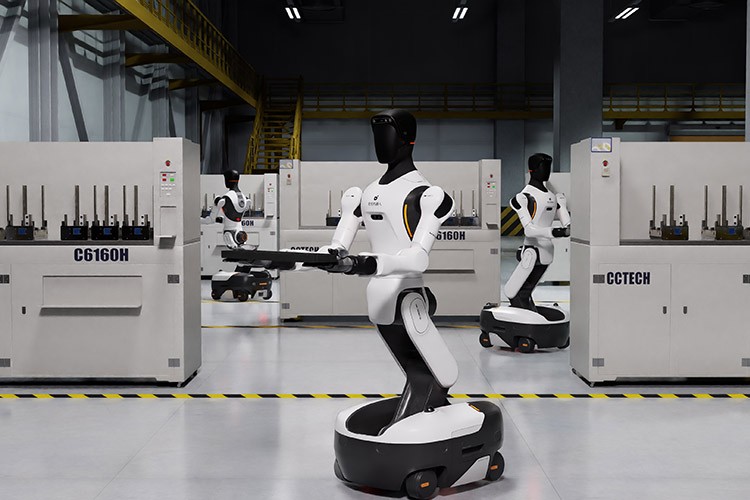
Comprehensive Performance Upgrade: AGIBOT G2 will Fully Integrate NVIDIA Jetson Thor
AGIBOT has unveiled its next-generation robot, the AGIBOT G2, which will feature NVIDIA's Jetson Thor as its core domain controller. This integration represents a significant leap in robotic performance, boasting a 7.5 times increase in AI computing power along with improved real-time processing and task generalization capabilities. The upgrade is designed to position the AGIBOT G2 as a standard in embodied intelligence, responding to the rising demand for intelligent robots across various sectors, including industrial automation and smart logistics.
Robotics Artificial Intelligence Technology Automation Embedded SystemsRobotics needs a service framework.
RSF defines a common language for robot service capability, lifecycle operations, certification pathways, and service-provider networks.
Join the RobotToday community on LinkedIn
Daily robotics news, in-depth analysis, conference highlights, and discussions with professionals worldwide.