

Wang Xingxing Discusses Humanoid Robotics Challenges at WRC Following Yushu Technology's IPO
- Published
- Source
- leaderobot.com
On August 20, Wang Xingxing, founder of Yushu Technology, spoke at the World Robot Conference (WRC) about the challenges facing humanoid robotics. This followed the company's IPO on the STAR Market, where its stock surged 460% on the first day, reaching a market capitalization of 341.8 billion yuan. Despite this success, Wang emphasized the need for improved efficiency and capability in humanoid robots, stating that current models still lag behind human performance.
Wang highlighted the limitations of existing humanoid robots, particularly their need for retraining when faced with new tasks, which hampers efficiency. He pointed out that while robots can perform various tasks, they struggle with precision in the final stages of execution, leading to significant errors. He contrasted the challenges of embodied intelligence with pure language models, noting that physical interactions introduce unique technical difficulties.
Looking ahead, Wang set a benchmark for when general-purpose robots could enter homes, suggesting that a robot should be able to understand and complete 80% of tasks from voice commands in unfamiliar environments. He introduced Yushu's latest technology, the Physical AI Robot Self-Evolution V1.0, which aims to enhance development efficiency and speed through automated processes. No further timeline was disclosed at the time of publication.
Original report
Founder Wang Xingxing Highlights Challenges in Humanoid Robotics at WRC
leaderobot.com · LeaderobotThis briefing is an independently written summary based on publicly available reporting and is provided for industry information and news discovery. The original report and source publication are credited and linked where applicable. RobotToday does not claim ownership of third-party source material.
Rights concerns? Contact [email protected] with the relevant URL and details. We will review the matter and take appropriate action where warranted.
More related news
- 1
- 2
- 3
- 4
- 5
- 6
- 7
- 8
- 9
- 10
- 11
- 12
Related Suppliers

KiQ Robotics
Japan
Japanese maker of 3D-printed lattice-structured flexible robot fingers for multi-variety gripping and workpiece protection.

A&K Robotics
Canada
Vancouver maker of the Cruz self-driving electric mobility pod that transports people through airports, malls and museums.

GMO Humanoid Lab
Japan
Tokyo Physical AI lab opened April 2026 by GMO Internet Group, running whole-body humanoid control research and Japan's Humanoid Hack hackathons.
Mirsee Robotics Inc.
Canada
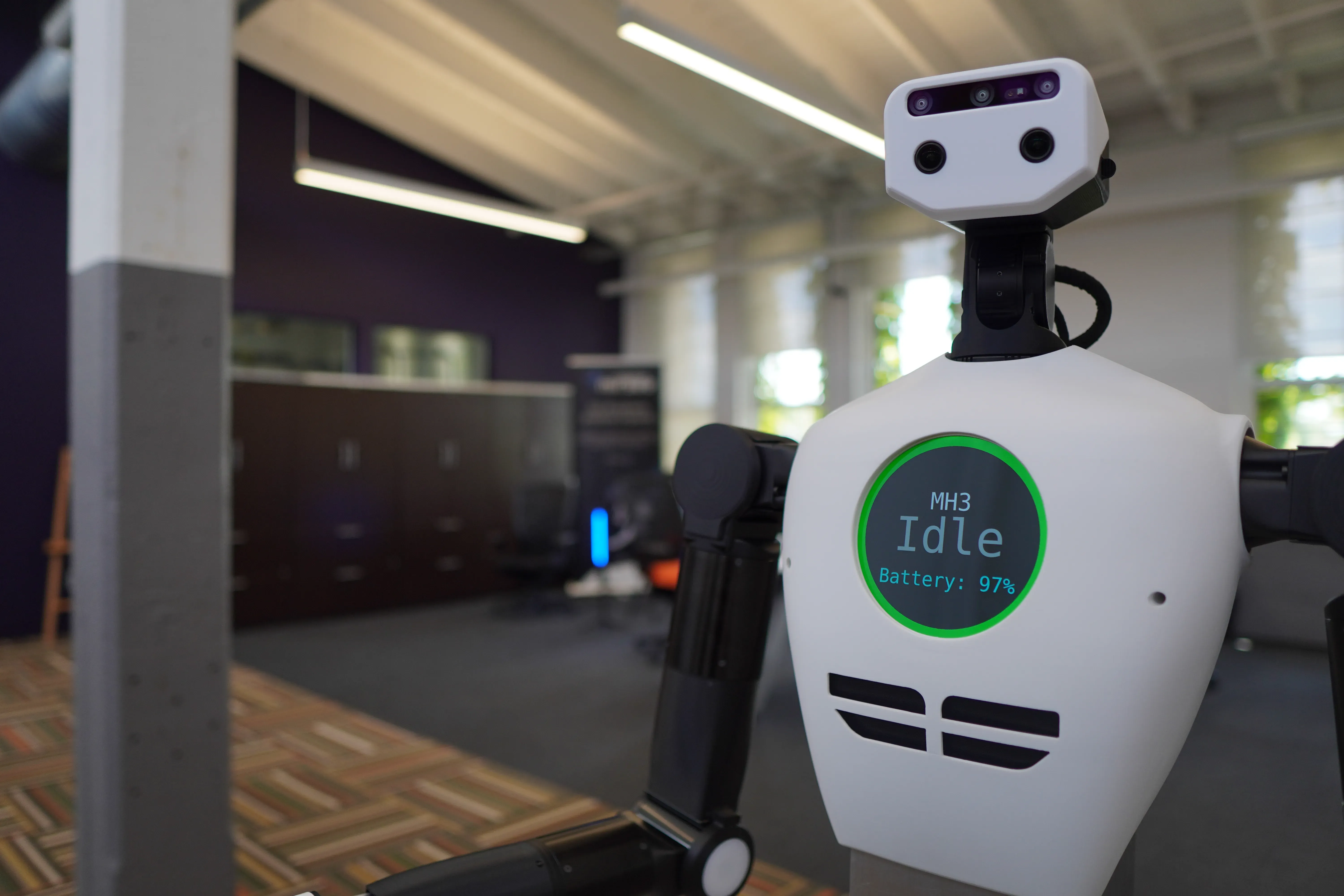
Canadian humanoid robotics company (est. 2017, Cambridge ON); MH3 humanoid with 31 DoF, 30 kg arm strength, 10 h runtime.

Unitree Robotics 宇树科技
China
Chinese robotics manufacturer of quadruped and humanoid robots; held ~70% of global quadruped unit sales in 2024 with Go2, B2, H1, and G1 models.

X Square Robot 自变量机器人
China
Shenzhen embodied-AI company founded December 2023 by Wang Qian; builds Quanta X1 Pro and X2 dual-arm robots on its WALL-A and WALL-B foundation models.
Weilan Tech 南京威兰德智能科技有限公司
China
Chinese robotics company (Nanjing, est. 2019) making the BabyAlpha quadruped companion robot — world's top-selling consumer robot dog, 25,000+ units sold.
RAI Institute
United States
Independent robotics and AI research institute in Cambridge, MA, led by Boston Dynamics founder Marc Raibert.
Walden Robotics
United States
Walden Robotics launched from stealth in July 2026 with a $300M seed co-led by Toyota, deploying general-purpose factory robots at a Toyota plant.
Noble Machines
United States
US developer of general-purpose humanoid robots that learn industrial skills in hours via language, demonstrations, and gestures.
Hubei Optics Valley Dongzhi Embodied Intelligence Technology Co., Ltd. 湖北光谷东智具身智能技术有限公司
China
Wuhan, China embodied-intelligence firm founded 2025, backed by HEC Group, Zhiyuan Robotics, and Peking University; makes Lumen humanoid and service robots.
Insight Intelligence 具识智能
China
Shanghai developer of insightOS, an embodied-AI robot operating system spanning dev, runtime and fleet ops; HIT spin-out with deployments at BYD.
Robotics needs a service framework.
RSF defines a common language for robot service capability, lifecycle operations, certification pathways, and service-provider networks.
Join the RobotToday community on LinkedIn
Daily robotics news, in-depth analysis, conference highlights, and discussions with professionals worldwide.


