


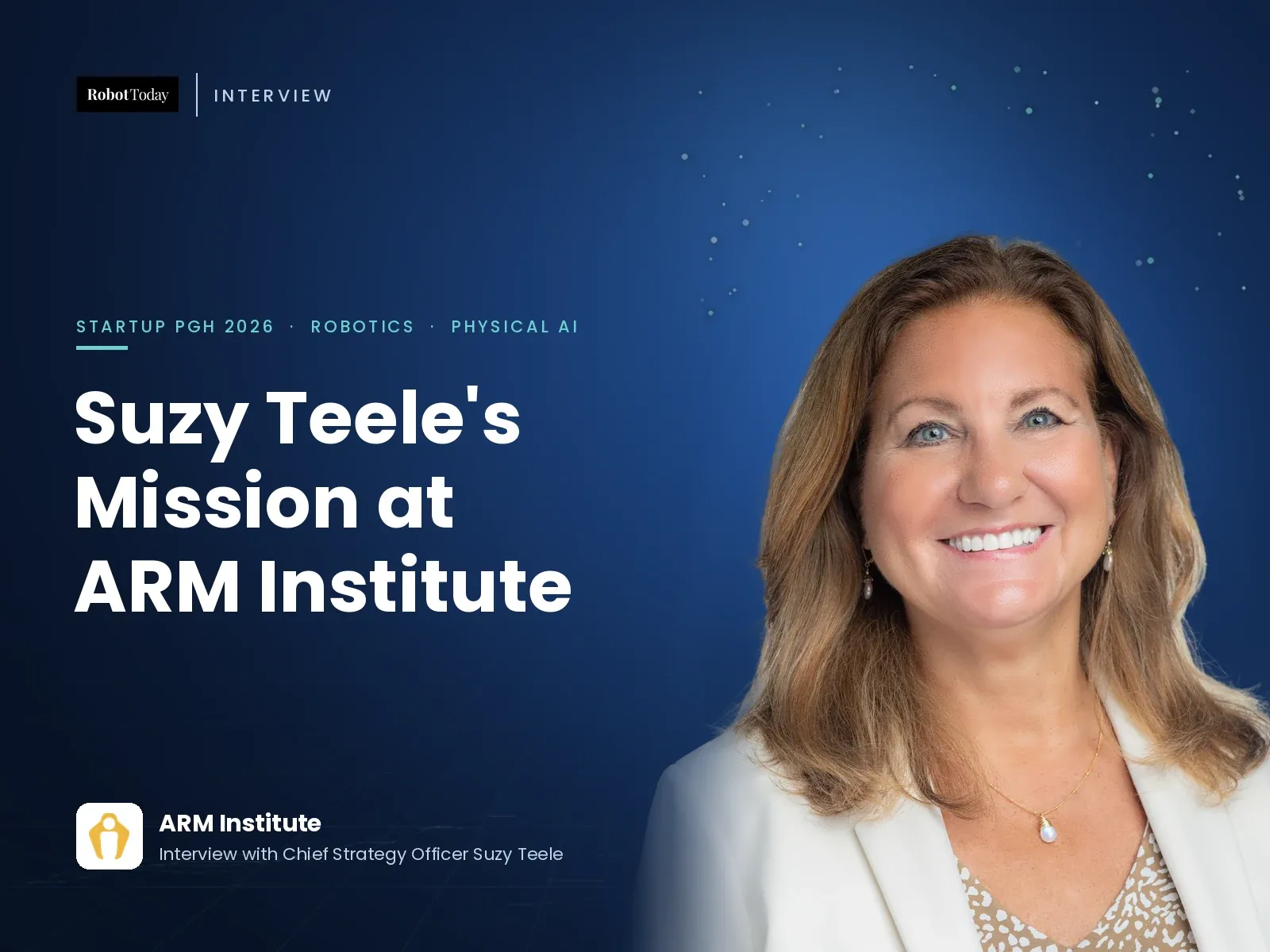
After nearly ten years helping build the Advanced Robotics for Manufacturing (ARM) Institute, Chief Strategy Officer Suzy Teele says the problem is no longer fear of robots. It’s knowing where to start.
In January 2017, a new national institute opened in Pittsburgh with a simple mission: get more robots working in American factories. Suzy Teele joined almost at the start, as the young organization’s chief marketer. The public conversation she walked into was dominated by one fear.
“We’ve gone from ‘robots are stealing my jobs,’ which is what I walked into as the primary marketing person 10 years ago,” she says, to a new question from manufacturers: “I think I have some challenges that robots might solve, but I’m not quite sure how to get started or where to find the information.”
That shift is the story of Teele’s decade at ARM. The institute now counts nearly 500 member organizations and marks its 10th anniversary in January 2027. Alongside the applied research it has funded since the start, its focus has broadened to helping manufacturers, especially small ones, actually put robots and physical AI to work.
RobotToday spoke with Teele on October 2, after a week in Pittsburgh covering IROS 2026 and Pittsburgh Startup Week.
From software executive to founding team
Teele came to robotics from software. She started as a systems engineer, moved into product management, and eventually ran a $250 million software portfolio. She then held General Manager, COO and CMO roles at several international software companies.
ARM offered something different. “I felt like it was a chance for me in my career to finally give back,” she has said, to help revitalize the Pittsburgh region and bring manufacturing back “using technology, not cheap labor.”
As one of ARM’s first two employees, she built the institute’s first marketing assets and set out to define and grow its consortium. She later became Vice President of Strategic Initiatives and Outreach, and in September 2022 was named Chief Strategy Officer. Today she oversees ARM’s strategy, programs, stakeholder relationships and partnerships, and leads its satellite office in Florida’s Tampa Bay region. In January 2025 she was elected to the Robotics Technology Strategy Board of A3, the Association for Advancing Automation.
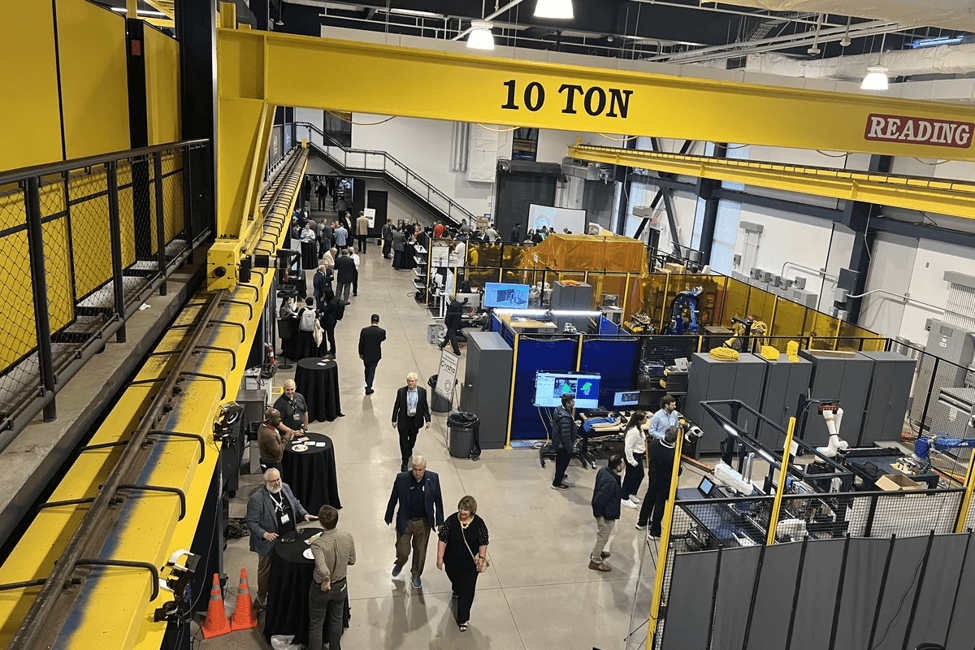
The founding years left small marks too. ARM’s headquarters sits in Mill 19, a former steel mill in Pittsburgh’s Hazelwood neighborhood, which it shares with Carnegie Mellon University’s Manufacturing Futures Institute. The space’s gold and black, Pittsburgh’s colors, were a founding-team choice. “I was part of that decision,” Teele says.
Over nearly a decade, she has watched ARM grow its consortium, launch a national workforce platform and open a hands-on robotics hub for local manufacturers. Below, in her own words, is how ARM has changed and where she sees it going.
The number one reason isn’t cost and isn’t workforce. It’s that they don’t know what to automate.
— Suzy Teele, Chief Strategy Officer, ARM Institute
In her own words
RobotToday: What is the ARM Institute, and where does it sit between industry, academia and government?
Suzy Teele: Under the Obama administration, there was a decision to create a series of public-private partnerships focused on advanced manufacturing, modeled on what’s happening in other parts of the world. The Fraunhofer Institutes in Germany were a good model. Congress provided funding, and an office was created, the AMNPO, run out of NIST in the Department of Commerce. Even though this started in 2012, we didn’t get our start until 2017. We just announced our 18th institute, FutureTEX, which will focus on advanced fabrics and is based in North Carolina.
We’re all nonprofits, and we all run consortiums. The goal is to look collectively at the challenges preventing manufacturers from adopting advanced technologies, and find ways to solve them. Our overall mission is to grow U.S. manufacturing: not to bring everything back, but to bring enough back to protect us from a national security perspective.
We were founded in January 2017 to focus on robotics, and we’ve expanded that to robotics and physical AI. We now have a consortium of about 500 organizations, which is literally thousands of experts. Our mission is to invest in projects, technology and workforce solutions that help more manufacturers, particularly small and medium-sized manufacturers, adopt robotics.
We’re primarily funded by the Department of Defense. Lately we’ve done a lot of work to help modernize the government’s own military manufacturing facilities. Some of them are very old and are using some of the same processes since World War II.
RobotToday: You joined at the very beginning. What is the biggest change between ARM in 2017 and today?
Teele: Back when we started, the biggest reason companies wouldn’t adopt robots was that they were inflexible and hard to program. Over 90% of U.S. manufacturers are small and medium-sized, and a good portion are contract manufacturers. Their work is very different from a Ford or a GM producing 10,000 of one car. If your work is predictable every day, a robot is great. But smaller manufacturers need to easily reprogram that robot as they move from contract to contract, and that has been a huge barrier. They also don’t have the floor space for big rooms of caged robots.
What the world always desires is a drop-in app. We’re not there with robots, but we’ve gotten much closer over the past 10 years, and it has to keep getting better. Stats we saw from ITIF show only about 8% of small manufacturers in the United States are using robots. Their work changes daily or hourly, and they can’t find or afford the $150,000 to $200,000 person to reprogram the robot.
Physical AI is going to be a huge boon here. Imagine a robot that knows we’re switching from job A to job B, loads the right program and stops job A, without any human intervention. That’s what small manufacturers need.
We have to capture Bob’s knowledge before he retires.
— Suzy Teele, Chief Strategy Officer, ARM Institute
RobotToday: Where do you see ARM over the next five to ten years?
Teele: When we started, we were doing more project research around technology readiness level (TRL) three or four. That means it has just come out of a university like CMU, Stanford or MIT, and it’s still being determined whether it’s viable for manufacturing. Now we see more TRL six through eight work, which means the industry is maturing. The advances in grippers alone are amazing. Ten years ago, there wasn’t anything that could grab a piece of fabric. Now we’ve got robot hands that can grab all kinds of things.
So a big focus for us today is transition: how do we get these technologies into use by manufacturers, or by the Defense Department? That means helping researchers who have turned their work into early-stage companies find customers and use cases. It’s a much stronger part of our mission now than it was 10 years ago, and it gives our members a viable path to introduce their technologies to potential customers.
RobotToday: How does physical AI fit into that transition?
Teele: The average age of a manufacturing employee is higher than in just about any other U.S. industry, so retirements are a bigger challenge. In finance, almost everything a retiring employee knows is already in data. That’s not true in manufacturing. A McKinsey study found that the shop floor has some of the lowest AI usage, because the data on how that 60-year-old machine operates isn’t easily available.
We have to capture Bob’s knowledge before he retires: that machine A operates this way and machine B that way, even though they do the same job and are 20 years apart in age; that machine A needs maintenance more often; that machine B is finicky with a certain raw material. As we get better at capturing that knowledge and building it into robots, it will be a huge advantage, especially for smaller manufacturers struggling to implement robots.
RobotToday: After a decade, why are so few small manufacturers using robots?
Teele: It makes me really sad that after 10 years only 8% of small manufacturers are using robots, so we spend a lot of time thinking about why. Based on what we’ve learned, the number one reason isn’t cost and isn’t workforce. It’s that they don’t know what to automate. They don’t know where to start.
Today, their only recourse is to go to a systems integrator or directly to a robot maker, and their primary motivation is to sell a piece of equipment. They’ll be helpful, but they’re not selling consulting services. We see a lot of instances where people have a robot sitting in the corner.
So for the past four years, with a grant from the EDA at the Department of Commerce, we’ve done automation assessments and de-risking. We built a prototyping center in Pittsburgh called the Robotics Manufacturing Hub. At no cost to them, we went out to small and medium-sized manufacturers in southwestern Pennsylvania, looked at their environment and identified what could or couldn’t be automated. Sometimes they wanted a robot to do something and we told them the robot couldn’t do that. We’re a nonprofit, an honest broker. If they decided to move forward, we helped put together a bill of materials and introduced them to an equipment supplier or systems integrator. The integrators loved it, because we’d done the heavy lift on problem identification and we referred work to them. The grant unfortunately ends this year, but it’s a model we hope to help spread across the United States.
As a consortium, when a manufacturer has a problem we don’t have an answer to, we can go to our members and ask, “Company X is struggling with this. Can you help?” Academia, robotics suppliers, early-stage companies, community colleges and trade schools, and manufacturers are all part of it. Being that connector is really critical.
RobotToday: Where is the education gap in the robotics workforce?
Teele: We don’t think there is a gap in training. There was a lack of knowledge about the skills and competencies needed to work with robotics in manufacturing: the technicians and operators on the factory floor who run and maintain the robots.
About six years ago we launched a digital platform, RoboticsCareer.org. It catalogs over 18,000 training programs across the United States, from micro-credentials to PhDs. Anyone can learn what jobs are available working with robots in manufacturing, what they pay, and which skills they need. We built a competency framework and career pathway for robotics careers in manufacturing and matched all 18,000 programs against it. About four years ago we added jobs, and we average about 15,000 listings. This summer we added a new framework and pathway for people working with physical AI on the factory floor, which takes more programming and data skills.
There’s no lack of training programs out there. It’s the lack of knowledge of what you need to work with robots in manufacturing that we’re trying to solve.
ARM at ten
As ARM approaches its 10th anniversary, Teele’s measure of success is no longer how many people stop fearing robots. It’s how many small factories actually use them. The tools she points to are practical: an honest broker that tells manufacturers what not to buy, a national map of the skills robot jobs require, and physical AI that can capture a retiring worker’s knowledge before it walks out the door.
She sees ARM’s role in the same terms she uses for her own: connecting academia, suppliers, startups, schools and manufacturers so that more of America’s small manufacturers can finally put robots to work.





Leave a comment