

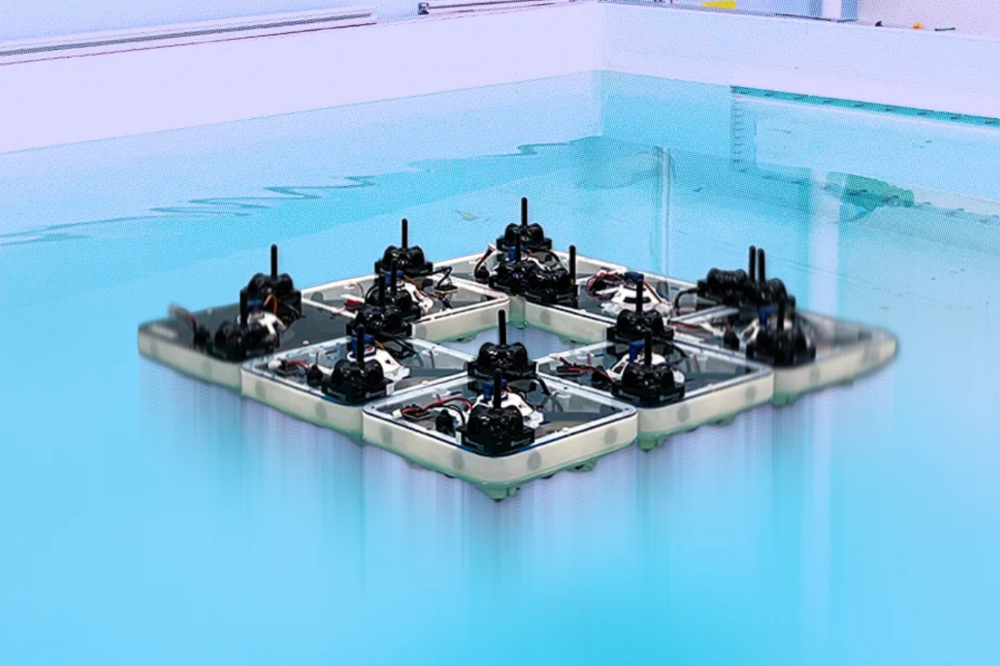
A group of palm-sized square robots autonomously converge, lock together, and form a temporary floating bridge within minutes. This innovative achievement comes from MIT's Computer Science and Artificial Intelligence Laboratory (CSAIL) and was recently published in Nature Communications. Inspired by fire ants, these robots utilize decentralized control, allowing them to coordinate movements without a central command, enhancing their scalability.
Each FloatForm robot measures 21 centimeters on each side and is equipped with propellers, sensors, and magnetic locks. The robots can synchronize their movements by exchanging positions with neighbors, making the planning complexity dependent on local interactions rather than the total number of robots. Simulations indicate that the framework can smoothly scale up to 64 units, showcasing significant potential for various applications.
The team has successfully tested the robots in controlled environments, achieving a 90% success rate with four robots and 70% with eight in completing tasks autonomously. Future developments will focus on integrating GPS or visual navigation and mechanical locking for real-world applications, including floating markets and emergency bridges in urban areas with waterways. No further timeline was disclosed at the time of publication.
Editor's Note
The development of decentralized robotic systems like MIT's FloatForm represents a significant advancement in the field of autonomous robotics. This technology could revolutionize how temporary structures are deployed in urban environments, enhancing efficiency and reducing the need for traditional construction methods. As cities increasingly seek innovative solutions for infrastructure challenges, the implications of such technologies could be profound.



























Leave a comment