

Generalist's GEN-1 Model Expands Support for Diverse Robot End Effectors
- Published
- Source
- RoboticsBusinessReview.com
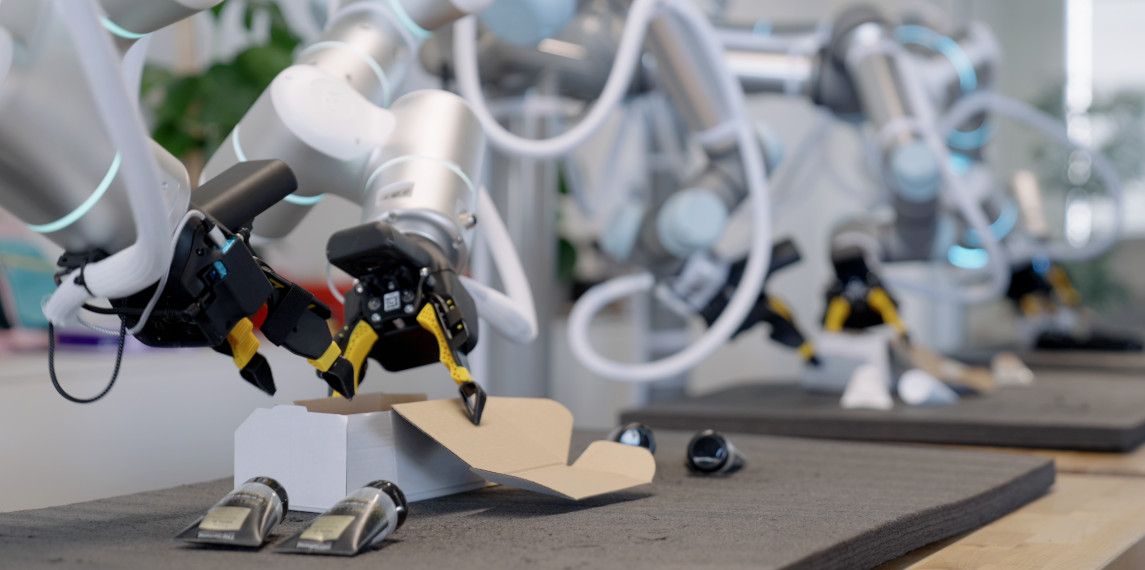
Generalist has announced that its GEN-1 foundation model now supports a wide array of robot end effectors, ranging from five-fingered hands to specialized tools. This advancement showcases the model's ability to learn sensorimotor policies that can adapt across various physical interactions, demonstrating the versatility of a single AI model in robotics.
The significance of this development lies in GEN-1's extensive pretraining on a diverse dataset, which includes over half a million hours of real interaction data with approximately 9,000 variations of end effectors. This training enables the model to understand complex physical interactions, such as geometry, contact, and dynamics, allowing it to apply learned knowledge across different tools and tasks effectively.
Looking ahead, Generalist is actively studying how each new end effector influences the pretrained model and is expanding its dataset to include more variations. The company is also exploring the implications of switching end effectors mid-task, which could enhance the model's adaptability and reasoning capabilities in real-world applications. No further timeline was disclosed at the time of publication.
Original report
Generalist’s GEN-1 foundation model now supports a range of robot end effectors
RoboticsBusinessReview.com · The Robot Report StaffThis briefing is an independently written summary based on publicly available reporting and is provided for industry information and news discovery. The original report and source publication are credited and linked where applicable. RobotToday does not claim ownership of third-party source material.
Rights concerns? Contact [email protected] with the relevant URL and details. We will review the matter and take appropriate action where warranted.
More related news
- 1
-
2
ROBOTTODAY Weekly October 19 – 23, 2026 RobotToday · 2 days ago
- 3
- 4
- 5
- 6
- 7
- 8
- 9
- 10
- 11
- 12
Related Suppliers
Generalist AI
United States
Frontier AI research company building embodied foundation models for general-purpose robots, with GEN-1 achieving 99% task success rates.
Poke & Wiggle
Germany
Munich robot-evaluation firm running a Franka FR3 Duo farm at the Deutsches Museum; its PAW-GEN-10 benchmark logged 3,600 real rollouts per policy.

AL.Robot Co., Ltd.
Korea, Republic of (South)
South Korean force/torque sensor maker est. 2017; TSR-J Series holds TÜV SÜD functional safety cert for cobots and humanoid robots.

Suzhou Hangkai Microelectronics Technology Co., Ltd. 苏州航凯微电子技术有限公司
China
Chinese MEMS sensor developer making multi-axis force, tactile and acceleration sensors and tactile end-effectors for humanoid and general robots.
Physical Intelligence
United States
San Francisco AI robotics company founded 2024; its pi0 vision-language-action models direct many robot types, backed by billions in venture funding.

Astribot (Stardust Intelligence) 星尘智能
China
Shenzhen, China humanoid-robot maker founded late 2022; its dual-arm S1 platform reaches over 10 meters per second with 0.1 mm repeatability.

Learning Robots
France
Learning Robots is a Paris-Saclay CNRS spin-off making AlphAI, an educational robot and software for teaching artificial intelligence.
Positronic Robotics
Romania
Robotics startup building an open-source Python stack and AI control systems to turn commercial robots into autonomous cleaners.

Void Robotics
United States
Marathon, Florida startup offering sub-$10K autonomous material transport robots at $1/hr; Voidwalking platform moves 50 lbs of goods using GPS navigation.
Autonomique
Canada
Builds physical-AI software for industrial robots, enabling autonomous contact-rich assembly and dexterous manipulation on production floors.

AidALL Inc.
Korea, Republic of (South)
South Korean startup developing Bedivere, an autonomous guide robot for the visually impaired using proprietary neuromorphic on-device AI architecture.

ReHaptix
Switzerland
ETH Zurich spin-off (2013, Bremgarten CHE); tablet app clinically validates upper-limb motor assessment for remote stroke and MS rehabilitation.
Robotics needs a service framework.
RSF defines a common language for robot service capability, lifecycle operations, certification pathways, and service-provider networks.
Join the RobotToday community on LinkedIn
Daily robotics news, in-depth analysis, conference highlights, and discussions with professionals worldwide.


