


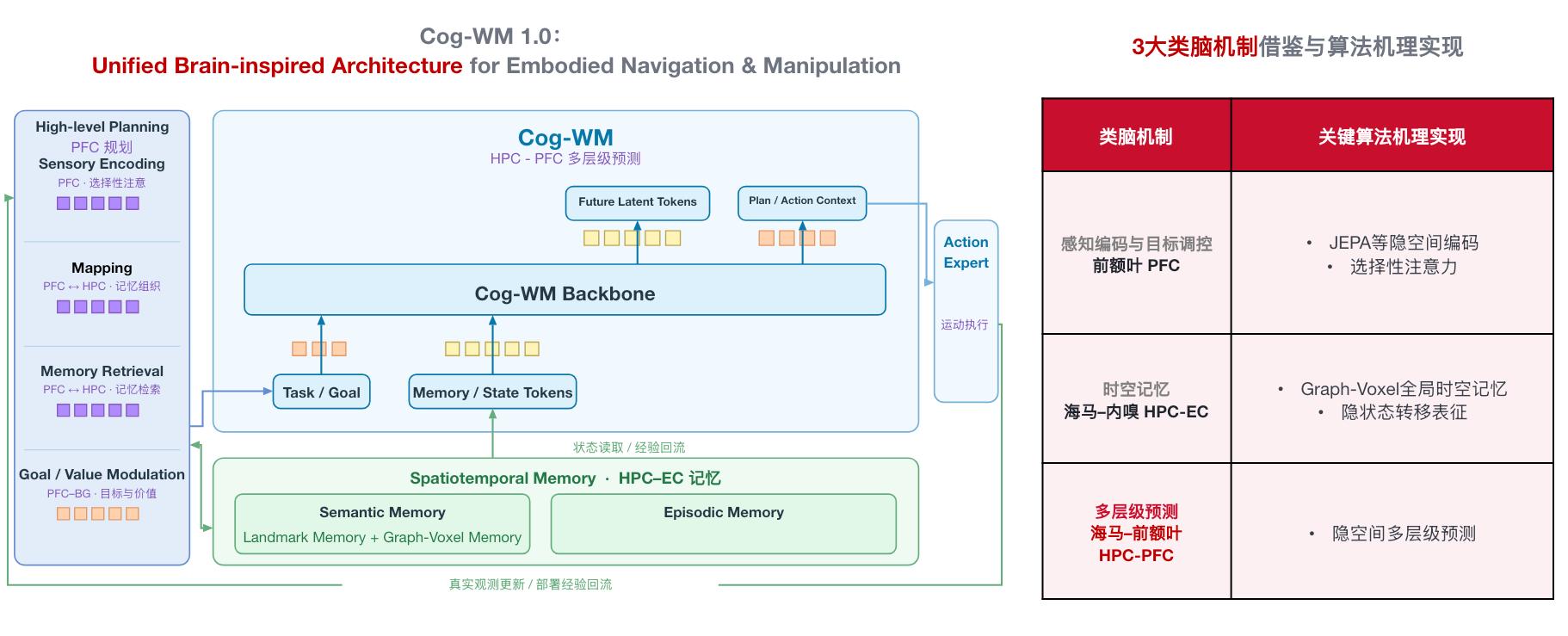
On September 14, the first forum on brain-like embodied intelligence unveiled Cog-WM 1.0, a cognitive world model developed by Brain Rock. This model addresses challenges faced by robots in unfamiliar environments, such as maintaining spatial memory and predicting actions after losing sight of targets. The forum attracted top experts and capital interest, aiming to position Shanghai as a global hub for brain-like intelligence innovation.
The significance of Cog-WM 1.0 lies in its potential to shift the competition in embodied intelligence from data quantity to the quality of internal world representation. The model integrates navigation and manipulation tasks, demonstrating improvements over existing state-of-the-art methods. This advancement suggests a new direction for embodied intelligence, focusing on cognitive maps and global memory spaces rather than solely on data-driven approaches.
Looking ahead, the development of Cog-WM 1.0 could redefine how robots interact with their environments, emphasizing the importance of memory and prediction. The founder of Brain Rock, Dr. Zhu Senhua, highlighted the structural challenges in the field, suggesting that breakthroughs in embodied intelligence will require innovative approaches beyond mere data scaling. No further timeline was disclosed at the time of publication.
Editor's Note
The launch of Cog-WM 1.0 represents a significant advancement in the field of embodied intelligence, highlighting a shift towards cognitive modeling. This could influence how robots are designed to navigate and interact with complex environments, potentially impacting supply chains and manufacturing processes. As the industry evolves, understanding the implications of cognitive models will be crucial for decision-makers and investors alike.




























Leave a comment