

Ant Group's Chief Scientist Discusses Building Robots' Vision from the Ground Up
- Published
- Source
- leaderobot.com
Ant Group's subsidiary, Ant Lingbo, has made a bold decision to abandon existing digital pre-trained models and build a native visual foundation for robots from scratch. Chief Scientist Shen Yujun emphasizes that while traditional visual models focus on image quality and scene recognition, robots require an understanding of how to interact with objects in real-time, necessitating a complete overhaul of training methods.
This approach is significant as it addresses the limitations of existing models that cannot process real-world scenarios effectively. The second-generation model has seen a substantial increase in pre-training data from 20,000 hours to 60,000 hours, expanding robot configurations and improving efficiency in training. The new model is built on three technological pillars, including a mixture of experts architecture and a causal unidirectional attention mechanism, which have been developed to meet the demands of the physical world.
Looking ahead, Ant Lingbo aims to gather millions of hours of native pre-training data to enhance its models. Shen believes that China will surpass the U.S. in data scale due to its robust hardware supply chain and increased production of robots. No further timeline was disclosed at the time of publication.
Original report
Ant Group's Chief Scientist on Building Robots' Vision from Scratch
leaderobot.com · LeaderobotThis briefing is an independently written summary based on publicly available reporting and is provided for industry information and news discovery. The original report and source publication are credited and linked where applicable. RobotToday does not claim ownership of third-party source material.
Rights concerns? Contact [email protected] with the relevant URL and details. We will review the matter and take appropriate action where warranted.
More related news
- 1
- 2
- 3
- 4
- 5
- 6
- 7
- 8
-
9
A3 Business Forum 2027 | Jan 18–20, Orlando RobotToday · 4 days ago
- 10
- 11
- 12
Related Suppliers

Visionary Technologies
United States
Holland, Michigan machine vision integrator founded 2003 as Vis-Tech, LLC; builds Cognex and Keyence inspection and guidance systems.
Ensenso
Germany
IDS Imaging brand of stereo-vision 3D cameras for robot guidance, bin picking and industrial automation.
Karelics
Finland
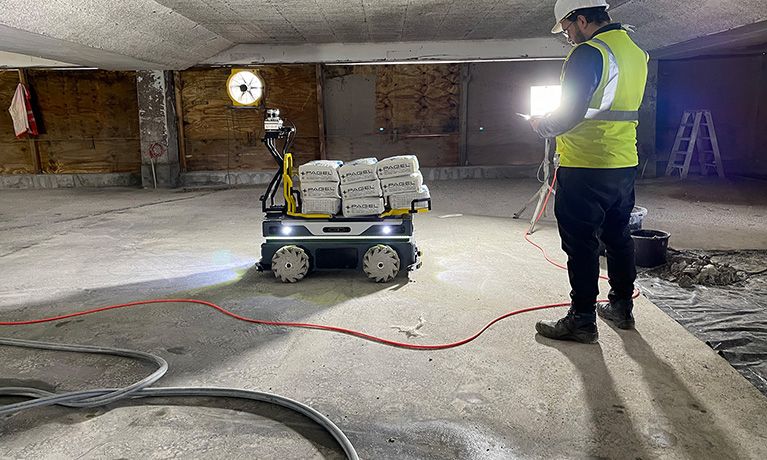
Finnish robotics software company providing ROS 2-based autonomy stack (Karelics Brain) and cloud fleet management for construction-site robots.
Intermodalics
Belgium
Belgian robotics software firm specializing in ROS-native navigation, SLAM, 2D/3D AI vision, and perception for autonomous systems.
ModelBest 面壁智能
China
ModelBest is a Beijing AI company whose MiniCPM edge-side language models run on-device in Samsung Galaxy AI and automotive cockpit systems.
Gideon Brothers
Croatia/Hrvatska
Croatian robotics company developing AI and 3D vision-powered heavy-duty autonomous mobile robots for warehouse and logistics operations.

HYPRLABS Inc.
United States
San Francisco AI robotics company founded 2020; HYPRDRIVE no-priors run-time learning autonomy stack enabling navigation without pre-mapped environments.
Synthium
United States
Synthium is a Singapore-based, Antler-backed startup that crowdsources gamified simulations to generate training data for humanoid robot AI models.
OpenAI
United States
US AI research lab and product company founded 2015; develops GPT, DALL-E, and robotics/embodied AI foundation models targeting physical-world AGI.

Niantic Spatial
United States
Builds real-world foundation models and a Visual Positioning System that give robots and AI centimeter-accurate localization and 3D understanding, including.

Shanghai Artificial Intelligence Laboratory 上海人工智能实验室
China
Shanghai-based national AI research institute founded 2020; develops the InternLM model family and the Intern-Robotics embodied-AI engine.

Liquid AI
United States
MIT-spinout building device-native foundation models (LFMs) that run on-device across phones, cars, robots and edge hardware.
Robotics needs a service framework.
RSF defines a common language for robot service capability, lifecycle operations, certification pathways, and service-provider networks.
Join the RobotToday community on LinkedIn
Daily robotics news, in-depth analysis, conference highlights, and discussions with professionals worldwide.


