Education & Research Research Institute Software & Algorithm Provider
University of Illinois Researchers Challenge Traditional Views on Brain Decision Making
Original from ScienceDaily.com: Scientists discovered the brain doesn't make decisions the way we thought

University of Illinois Researchers Challenge Traditional Views on Brain Decision Making

Researchers at the University of Illinois Urbana Champaign have revealed new insights into brain decision-making processes, suggesting that these processes begin earlier than previously thought. This research, led by Professor Yurii Vlasov, indicates that early sensory brain regions play a crucial role in decision-making, contradicting the long-held belief that decisions are made only after information passes through a strict hierarchy of brain regions.

The implications of this study are significant for both neuroscience and artificial intelligence. By understanding that decision-making involves interconnected feedback loops rather than a linear progression, researchers can design AI systems that mimic this biological architecture. This could lead to the development of AI that is not only more capable but also more energy-efficient, addressing current limitations in AI technology.

Moving forward, the research team aims to further explore how biological intelligence, refined through evolution, can inform AI development. No further timeline was disclosed at the time of publication.

Editor's Note

This groundbreaking research highlights the need for a paradigm shift in how we understand brain function and its implications for AI. As industries increasingly rely on AI technologies, insights from biological intelligence could lead to more efficient and effective systems, enhancing decision-making capabilities across various applications.
RobotToday Initiative

Robotics needs a service framework.

RSF defines a common language for robot service capability, lifecycle operations, certification pathways, and service-provider networks.

Share

Related Articles/News

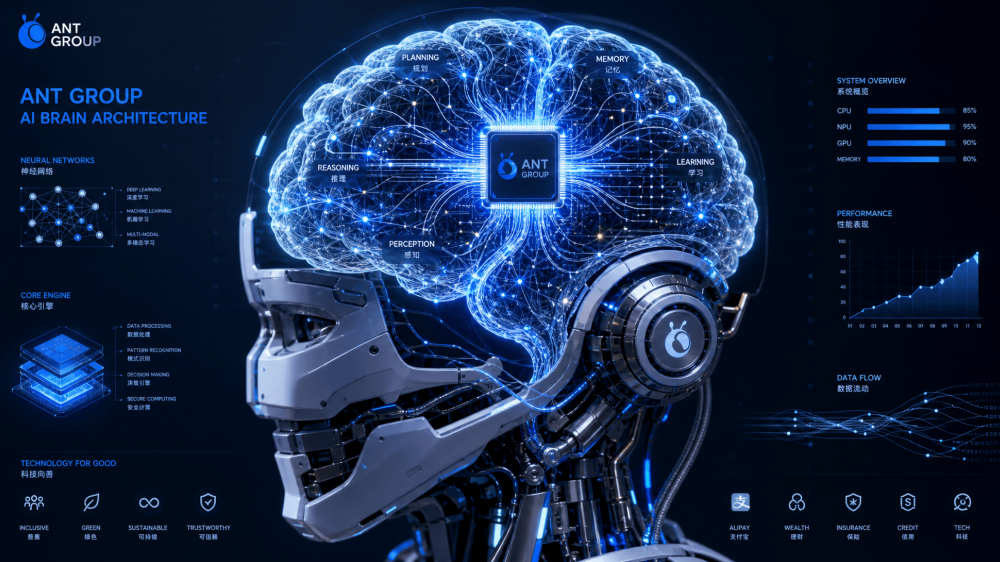
Ant Group's Robotics Subsidiary Introduces Innovative Robot Brain Technology

Ant Group's Robotics Subsidiary Introduces Innovative Robot Brain Technology

Ant Group's robotics subsidiary, Robbyant, has adopted a unique approach by prioritizing the development of a robot brain over hardware design. This strategy leverages the AI infrastructure behind Alipay, which processes billions of payment transactions daily, to enhance robots' ability to perceive their environment and make autonomous decisions. The intr...

Robotics AI Machine Learning
Xspark AI Raises Nearly $15 Million to Advance Physical AI Technology Development

Xspark AI Raises Nearly $15 Million to Advance Physical AI Technology Development

Xspark AI has successfully completed its first round of angel financing, securing nearly 100 million yuan (approximately $15 million). This funding round was led by Dinghui VGC, Chuxin Capital, and the SEE Fund, with participation from several financial investment institutions. The capital will primarily be allocated towards core technology research and d...

Physical AI Robotics Funding
ROBOTTODAY Weekly July 6 – 10, 2026

ROBOTTODAY Weekly July 6 – 10, 2026

This week in robotics: AI² Robotics raises $735M for wheeled humanoids, Unitree G1 performs first live surgery, Dexmal launches DexOS platform, Agility Robotics announces SPAC, and Ondas acquires DZYNE for $875.8M. July 6–10, 2026.

RobotToday Weekly
Physical AI Landscape: From Digital Intelligence to the Embodied Physical World

Physical AI Landscape: From Digital Intelligence to the Embodied Physical World

A comprehensive industry analysis of Physical AI — covering Embodied AI, Field AI, Factory AI, VLM, World Model, VLA, and the VLA vs WAM architecture debate. Includes 20+ companies, 28 references, and the RobotToday Physical AI Landscape diagram. July 2026.

Artificial Intelligence
Xspark AI Raises Nearly 100 Million Yuan to Enhance Physical AI Capabilities

Xspark AI Raises Nearly 100 Million Yuan to Enhance Physical AI Capabilities

Xspark AI, a company focused on reliable physical intelligence, has successfully completed its first angel funding round, securing nearly 100 million yuan. The funding was led by Dinghui VGC, Chuxin Capital, and SEE Fund, with participation from various financial and industrial investors. The capital will primarily support core technology development and ...

Physical AI Robotics Technology Development
LingBot-VLA 2.0: Open-Source Universal Brain for Robots

LingBot-VLA 2.0: Open-Source Universal Brain for Robots

Robbyant open-sources LingBot-VLA 2.0, a vision-language-action model trained on 60,000 hours of data for cross-morphology, whole-body robot control.

Artificial Intelligence
SpaceX's $1.75 Trillion Valuation Driven by Starmind's Future Potential

SpaceX's $1.75 Trillion Valuation Driven by Starmind's Future Potential

Starmind is a pivotal element in SpaceX's estimated $1.75 trillion IPO valuation, despite currently generating no confirmed revenue. The stock price reflects optimistic projections regarding AI infrastructure growth, which Starmind has yet to substantiate. As of early July 2026, SpaceX's stock has decreased from its 52-week high of $225.64 to around $150,...

Revolutionizing Robotics with Artificial Tendons: A New Era of Embodied Intelligence

Revolutionizing Robotics with Artificial Tendons: A New Era of Embodied Intelligence

Suzhou Zhixingjian Robot Technology Co., Ltd. has unveiled a groundbreaking development in robotics with its creation of artificial tendons designed to replace conventional motor systems. This innovative technology, which mimics biological tendons, significantly improves the weight, precision, and energy efficiency of robotic hands. By integrating these b...

Artificial Tendons Robotics Embodied Intelligence
2026H2 Robotics Events Briefing: Tailored Recommendations for Robotics Readers

2026H2 Robotics Events Briefing: Tailored Recommendations for Robotics Readers

Discover the ultimate directory of global robotics events in 2026. Tailored briefings for engineers, investors, and founders on humanoid robots, AI, and industrial automation by RobotToday.

Events Market and Business News
CORA 2026 | Conference on Robots and Automation

CORA 2026 | Conference on Robots and Automation

Explore CORA 2026, an international conference examining the economic, business, and policy impact of robotics, automation, and artificial intelligence in Kiel, Germany.

Events
European Robotics Forum (ERF) 2027 | Europe's Leading Robotics & AI Conference

European Robotics Forum (ERF) 2027 | Europe's Leading Robotics & AI Conference

Join the European Robotics Forum (ERF) 2027 in Birmingham, bringing together Europe's robotics, AI, automation, research, industry, startups, investors, and policymakers to shape the future of robotics.

Events
ROBOTTODAY Weekly June 30 – July 4, 2026

ROBOTTODAY Weekly June 30 – July 4, 2026

Unitree wins CSRC approval for China’s first humanoid IPO, Korea unveils ₩312T AI investment, RoboCup 2026 opens in Incheon, and Paris launches Europe’s inaugural Physical AI summit.

RobotToday Weekly

Related Suppliers

MAUM.AI Inc.

MAUM.AI (South Korea) develops Physical AI foundation modules for embodied systems. Key tech: MAIED (edge robotic brain, multi-chip VLA support), BODA (vision), SUDA (language), WoRV (motion), MAAL (action/LLM). Products include JINDO BOT (autonomous quadruped security robot), Mate Box (retrofit brain for Unitree quadrupeds/humanoids), on-premise LLMs. Focus: autonomous decision-making, task automation in security, industrial, and service applications.

Brain Corp

ShelfOptix™ is a fully managed service utilizing robotic automation for shelf intelligence, enabling real-time inventory tracking and analytics. Integrated with the BrainOS® platform, it leverages AI for precise inventory management and operational efficiency. The solution encompasses autonomous cleaning and remote site management, facilitating enhanced operational oversight and improved environmental hygiene in retail environments.

Scripps Research Inst.

Independent US biomedical research institution conducting basic science research in chemistry, biology, and neuroscience. Website content was unavailable at time of scrape; not a robotics or automation supplier but has research programs involving lab automation.

Education & Research Healthcare & Senior Care Research Institute

Bielefeld University Neuroinformatics Group (DE)

Research group at Bielefeld University focused on neuroinformatics and cognitive systems. Conducts interdisciplinary research in computational neuroscience, machine learning, and autonomous systems relevant to robotics and AI.

Education & Research Healthcare & Senior Care Human-Machine Interaction

Abaka AI

Abaka AI offers a robust data platform that supports the entire AI data lifecycle, including data collection, annotation, and processing. It provides pre-curated multimodal datasets for various applications such as LLM training, speech recognition, and image generation. The platform ensures compliance with GDPR/CCPA and features automated annotation capabilities, enhancing efficiency and accuracy in data handling for AI development.

reNAND.ai

The product offers proprietary datasets for autonomous driving, robotics, and natural language processing (NLP), comprising billions of annotated data points. It features image and LiDAR detection capabilities, along with pre-trained models for various applications. The platform supports modular AI development, encompassing data management, model training, and evaluation, while ensuring high-quality annotations through a global expert workforce and rigorous quality control processes.

Opteran

Opteran's neuromorphic software emulates biological intelligence, enabling autonomous machines to navigate unstructured environments without GPS. Utilizing a foundation model based on neuroscience, it achieves robust localization and adaptability in dynamic conditions. The system operates efficiently on edge devices, minimizing data reliance and eliminating the need for extensive training or centralized AI infrastructure, thus enhancing operational autonomy in real-time applications.

Voaige (Voaige Inc.)

Voaige develops cognitive inference systems aimed at achieving general intelligence through a modular architecture. Each capability builds on prior advancements, optimizing design constraints and objectives. The approach draws insights from biological intelligence, emphasizing systems-level understanding while acknowledging biological limitations. Early incorporation of diverse constraints enhances adaptability, facilitating the integration of additional goals without compromising system efficacy.

Stanford Artificial Intelligence Lab

Stanford AI Laboratory (SAIL), founded 1963 — one of the world's leading AI research centers. Research spans machine learning, computer vision, NLP, robotics, and autonomous systems; home to foundational AI and robotics research including work by Sebastian Thrun and Fei-Fei Li.

Education & Research Research Institute Software & Algorithm Provider

Think Artificial

Think Artificial develops AI software solutions and machine learning applications for automation and intelligent systems. The company focuses on applied artificial intelligence, including computer vision and natural language processing for business and industrial use cases.

Software & Algorithm Provider Control & Software Systems Human-Machine Interaction

Innatera Nanosystems BV

Innatera's Spiking Neural Processor (SNP) utilizes a proprietary analog-mixed signal architecture to emulate brain-like processing for sensory data. Leveraging Spiking Neural Networks (SNNs), it achieves ultra-low power consumption (<1mW) and minimal latency, enabling real-time pattern recognition and complex signal processing. The technology is designed for power-constrained environments, facilitating efficient cognitive performance in various applications.

Waabi (Waabi Innovation Inc.)

Waabi's Physical AI Platform integrates advanced AI and neural simulation to facilitate autonomous transportation across diverse environments. Utilizing a unified, verifiable AI model, it supports both autonomous trucks and robotaxis, enhancing scalability and safety. The platform's capabilities include highway and surface street navigation, enabling a Direct to Customer trucking model while adhering to rigorous safety standards through simulation and validation processes.