

Skylark Labs Applies CFAM Learning to Humanoid Explosive-Hazard Search
- Published
- Source
- BreakingDefense
Skylark Labs is applying its CFAM learning approach to humanoid search for explosive hazards, according to the source article. The article reports that CFAM delivered about 30% higher task success than a standard model in a real-world robot test. It does not disclose the test date, location, robot model, or the specific explosive-hazard search demonstration details.
The reported result points to task success as a measure for evaluating learning approaches in real-world robot tests. For organizations assessing humanoid systems for hazardous search tasks, the comparison offers a performance signal, but the article provides no test methodology, sample size, or further metrics. The result is attributed to the source article and should not be read as evidence of operational deployment or field readiness.
Skylark Labs’ next disclosed milestone is not specified. The article does not state when the CFAM approach will be tested in explosive-hazard search, what hazards or environments will be covered, or whether the demonstration involved a completed search. No further timeline was disclosed at the time of publication.
Original report
Skylark Labs demonstrates humanoid search for explosive hazards
BreakingDefense · Peter CallaghanThis briefing is an independently written summary based on publicly available reporting and is provided for industry information and news discovery. The original report and source publication are credited and linked where applicable. RobotToday does not claim ownership of third-party source material.
Rights concerns? Contact [email protected] with the relevant URL and details. We will review the matter and take appropriate action where warranted.
More related news
- 1
-
2
RobotToday Weekly November 16–20, 2026 RobotToday · 20 hours ago
- 3
- 4
- 5
-
6
RobotToday Weekly November 9–13, 2026 RobotToday · 1 week ago
- 7
- 8
- 9
- 10
- 11
- 12
Related Suppliers

Scentience
United States
US startup designing neuromorphic olfactory sensors, edge AI models, and developer APIs to give robots a sense of smell for navigation, security, and.
SafeWorld
United States
Oakland, California startup whose browser-based simulator stress-tests robots around people; raised a USD 12.2M seed in October 2026.
Lucky Robots
United States
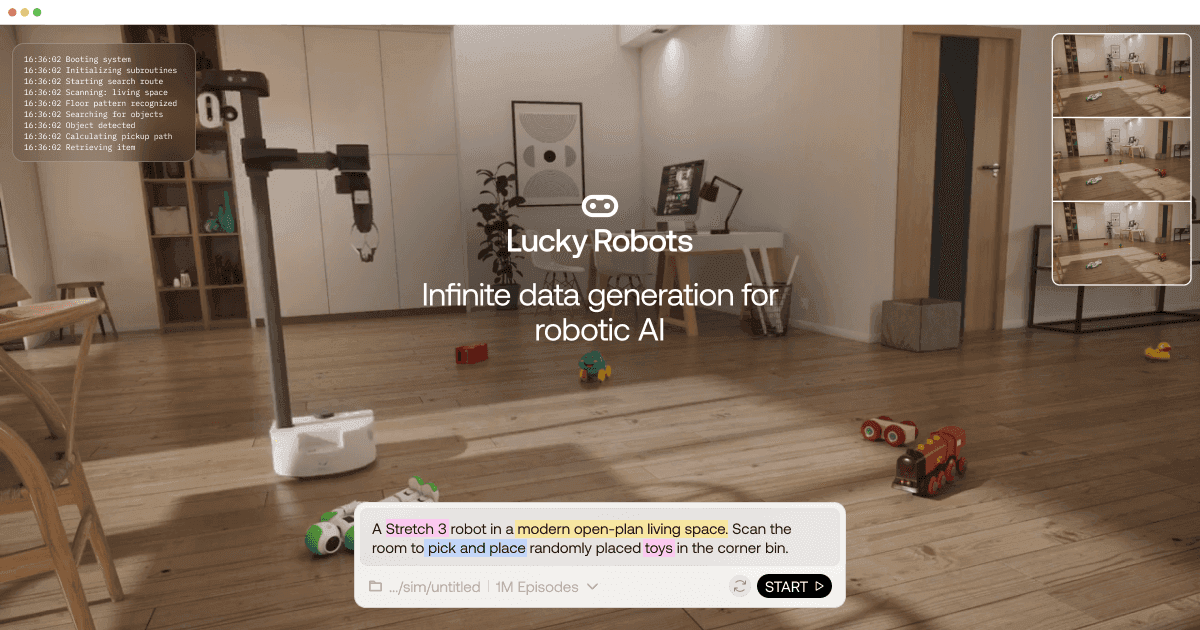
Austin TX startup founded 2024 providing a synthetic-data simulation platform that lets software engineers train and test robot AI without physical hardware.

Config
United States
Builds data infrastructure and foundation models for general-purpose bimanual robotic manipulation.

Avatar Robotics
United States
San Francisco robotics startup founded 2025, deploying human-supervised robot fleets for warehouse sorting, inventory, picking, and tote handling in logistics.

Minus Zero
India
Indian full-stack ADAS startup (est. 2021, Bengaluru); Nature-Inspired AI for autonomous driving without LiDAR or HD maps.

Minerva Humanoids
United States
San Francisco startup founded 2025 by MIT, Tesla Optimus and Boston Dynamics alumni; builds the teleoperated humanoid Roger for oil, gas and EOD work.

Valkim Technologies
United States
San Antonio-based company developing intrinsically safe, pneumatic inspection robots for hazardous confined spaces and explosive environments.
Robotics needs a service framework.
RSF defines a common language for robot service capability, lifecycle operations, certification pathways, and service-provider networks.
Join the RobotToday community on LinkedIn
Daily robotics news, in-depth analysis, conference highlights, and discussions with professionals worldwide.