
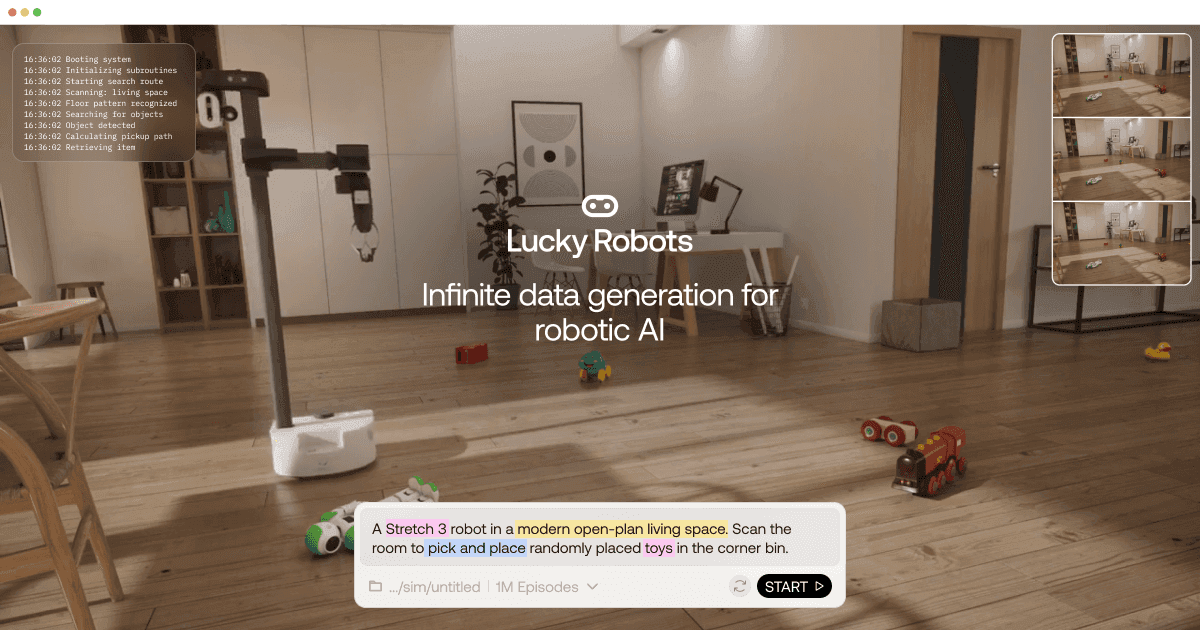
The Infinite Data Generation platform utilizes advanced simulation techniques to create hyper-realistic environments for robotic AI training. By generating millions of randomized, labeled episodes, it enhances machine learning efficiency, reducing training time by up to 90%. This approach eliminates hardware constraints and accelerates the development of autonomous systems in diverse scenarios, ensuring robust performance across various tasks.
RSF defines a common language for robot service capability, lifecycle operations, certification pathways, and service-provider networks.
Ukraine’s ‘Sub Sea Baby’ autonomous torpedo struck a Russian Kilo-class submarine inside Novorossiysk harbour in December 2025 — the first confirmed underwater drone attack on a submarine in history. The U.S. Navy is requesting $5.3 billion for unmanned maritime systems in FY2026, a 70 percent year-on-year increase. Saronic Technologies went from prototype to $392 million production contract in under 12 months. And DARPA’s Manta Ray XL-UUV completed full-scale sea trials. This article maps the maritime autonomous systems revolution — from Ukraine’s improvised Black Sea fleet to the Pentagon’s hybrid manned–unmanned force of the 2030s, and from Saronic’s Franklin, Louisiana shipyard to Boeing’s 85-tonne robot submarine.
ByThomas Siew Apr 20, 2026How the cost equation of modern warfare has inverted: a $500 AI-guided drone now rivals a $2 million precision missile in tactical effect. Part One of the Future Warfare Series examines the unit economics, supply chain realities, and venture capital forces reshaping defence procurement — from Ukraine's 1.7 million FPV drones to Anduril's $30 billion factory-as-weapon bet.
ByThomas Siew Mar 11, 2026China’s humanoid robotics boom has over 300 startups—but with high costs and uncertain markets, only a few may survive, absorb huge losses, and reach IPO-ready scale.
ByKelly Stone Dec 22, 2025
Leave a comment



