

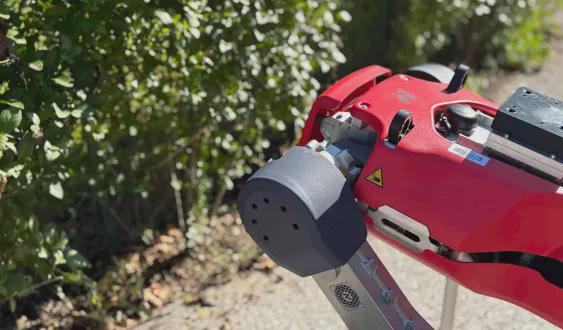
A collaborative team from Johannes Kepler University Linz, Free University of Bozen-Bolzano, University of Trento, and University of Sussex has developed a method for robot dogs to mimic insect movements to enhance their visual perception. By performing rhythmic lateral movements, akin to the 'peering' behavior observed in insects like locusts, these robots can effectively see through obstructions such as foliage and debris.
This innovation is significant as it addresses a common challenge faced by exploration robots in environments cluttered with obstacles that hinder visual sensors. The research establishes a connection between the peering motion and synthetic aperture sensing, allowing the robots to create a virtual aperture that enhances background signals while blurring out obstructions.
Future developments to watch include the potential applications of this technology in various environments, including forests and disaster sites. The research indicates that the synthetic aperture technique is most effective at around 50% obstruction density, suggesting a promising avenue for improving robotic vision in complex terrains. No further timeline was disclosed at the time of publication.
Editor's Note
The integration of biological principles into robotic design highlights a growing trend in the industry where nature-inspired solutions are being leveraged to overcome technical limitations. This approach not only enhances the capabilities of robots in challenging environments but also opens new avenues for research and development in robotic perception technologies.































Leave a comment