

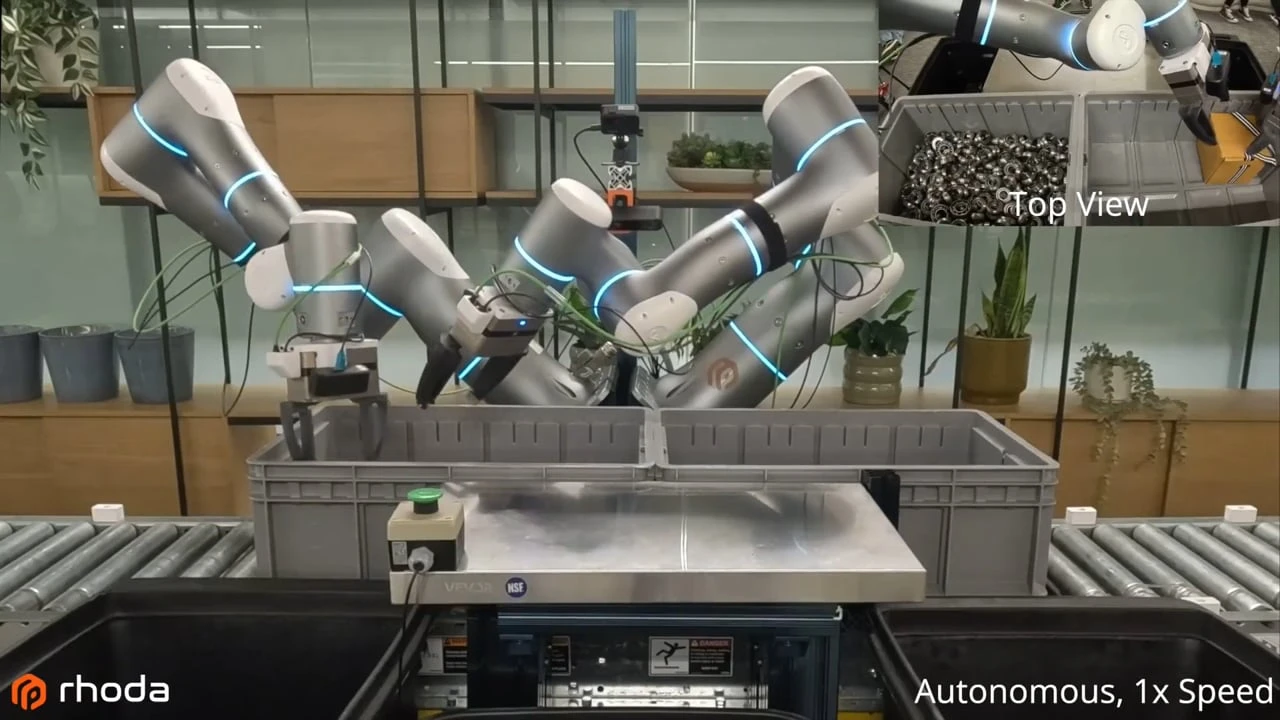
Rhoda AI has reported enhancements in industrial manipulation capabilities through scaled web-video pretraining, as detailed in a study released on September 10. The research tested various model sizes, achieving completion rates of 3.7%, 65.0%, 75.3%, and 84.7% in under 100 seconds for tasks like unpacking bearings and sorting waste, with the largest model scoring 94 out of 111.
This study is significant as it explores a fundamental aspect of physical AI, demonstrating that larger models, while requiring more computational resources, can lead to improved performance. A separate fixed-size experiment indicated that increasing pretraining compute raised performance from 57.8% to 75.3%, suggesting that the amount of pretraining data and compute plays a crucial role in task execution efficiency.
Looking ahead, Rhoda's approach, which utilizes the Direct Video-Action architecture, emphasizes the importance of causal video modeling in robot training. The company’s ongoing evaluations and adaptations of its models will be critical to understanding the future applications of video pretraining in robotics. No further timeline was disclosed at the time of publication.
Editor's Note
Rhoda AI's advancements in web-video pretraining highlight a growing trend in robotics where leveraging vast amounts of data can enhance machine learning capabilities. This approach not only improves task performance but also raises questions about the efficiency of training methodologies in industrial applications. As companies continue to explore AI-driven solutions, the implications for manufacturing and automation will be significant.




























Leave a comment