

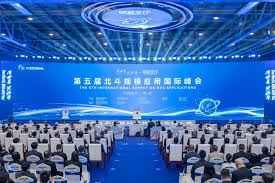
During the fifth Beidou Scale Application International Summit held on September 15-16, Qianxun Position CEO Chen Jinpei emphasized the shift from quantity to quality in Beidou applications. He stated that the next phase involves leveraging valuable spatial data generated through Beidou's spatial intelligence to enhance various scenarios, integrating this data with AI technologies.
Chen highlighted the evolution of machines from simple manual control to advanced physical AI capable of interacting with the physical world. He proposed building a comprehensive infrastructure based on Beidou satellites, which would provide centimeter-level positioning, millimeter-level perception, and nanosecond-level timing. This infrastructure, termed the third network of physical AI, is essential for stable robot operation in real environments.
At the summit, Qianxun Position launched the SpatiXBot, an embodied spatial intelligence platform designed for applications in inspection, security, and emergency rescue. With over 10,000 GNSS stations globally, Qianxun's services support approximately 70 million smartphones and over 500,000 smart vehicles, indicating significant deployment in the robotics sector. The success of the third network will depend on the penetration and depth of spatial services in robotics, with 80,000 terminals marking a promising starting point.
Editor's Note
The robotics industry is witnessing a pivotal shift towards integrating spatial intelligence with AI technologies. As companies like Qianxun Position focus on enhancing the quality of spatial data, the implications for sectors such as smart manufacturing and autonomous driving are profound. The development of robust infrastructure to support these advancements will be crucial for the future of robotics and automation.






















Leave a comment