

Import AI 447: The AGI economy; testing AIs with generated games; and agent ecologies
- Published
- Source
- Substack.com
A recent exploration into the concept of superintelligence arcologies has sparked interest among futurists and urban planners. This innovative idea envisions self-sustaining, high-density urban environments that integrate advanced artificial intelligence to enhance living conditions and resource management. The discussion gained momentum in October 2023, as experts gathered at a technology conference to examine the potential benefits and challenges of such developments.
Proponents argue that superintelligence arcologies could address pressing global issues, including climate change, urban overcrowding, and resource scarcity. By leveraging AI, these structures could optimize energy use, waste management, and transportation systems, creating a more sustainable urban ecosystem. The integration of smart technology would allow for real-time data analysis, enabling residents to make informed decisions about their environment.
Critics, however, caution against the risks associated with relying heavily on AI for urban living. Concerns about privacy, security, and the potential for systemic failures in such complex systems were highlighted during the discussions. The feasibility of constructing these arcologies also raises questions about economic viability and societal acceptance.
As the conversation continues, researchers and developers are exploring various models and designs for superintelligence arcologies, aiming to create prototypes that could be tested in real-world scenarios. The outcome of these efforts could significantly shape the future of urban living, potentially transforming cities into interconnected, intelligent habitats that prioritize sustainability and quality of life.
Original report
Import AI 447: The AGI economy; testing AIs with generated games; and agent ecologies
Substack.com · Jack ClarkThis briefing is an independently written summary based on publicly available reporting and is provided for industry information and news discovery. The original report and source publication are credited and linked where applicable. RobotToday does not claim ownership of third-party source material.
Rights concerns? Contact [email protected] with the relevant URL and details. We will review the matter and take appropriate action where warranted.
More related news
- 1
- 2
- 3
- 4
- 5
- 6
- 7
- 8
- 9
- 10
- 11
- 12
Related Suppliers

BioRobotics Laboratory, Korea University of Technology and Education
Korea, Republic of (South)
South Korean university research laboratory focusing on haptics, exoskeletons, rehabilitation robotics, and autonomous ground vehicles.

McMaster Manufacturing Research Institute
Canada
Hamilton, Ontario applied manufacturing research center at McMaster University; runs a 21,000 sq ft facility with seven research labs.

Robotics Education & Competition Foundation
United States
The REC Foundation is a US nonprofit that runs VEX-based robotics and drone competitions reaching 1.1 million students across 70 countries.

ADEK Industrial Computers
United States
US-based industrial PC manufacturer building custom rugged rack-mount, panel, and embedded computers for robotics, SCADA, and HMI applications since 1993.

Aichi Robot Industrial Promotion Council
Japan
Japanese industry council promoting robotics development and diffusion in Aichi Prefecture, one of Japan's largest robot manufacturing hubs.

Arctek Robótica Industrial
Brazil
Brazilian industrial robotics system integrator in Curitiba, Parana, specializing in robotic welding, automated handling, palletizing, and custom automation.
E-COBOT
France
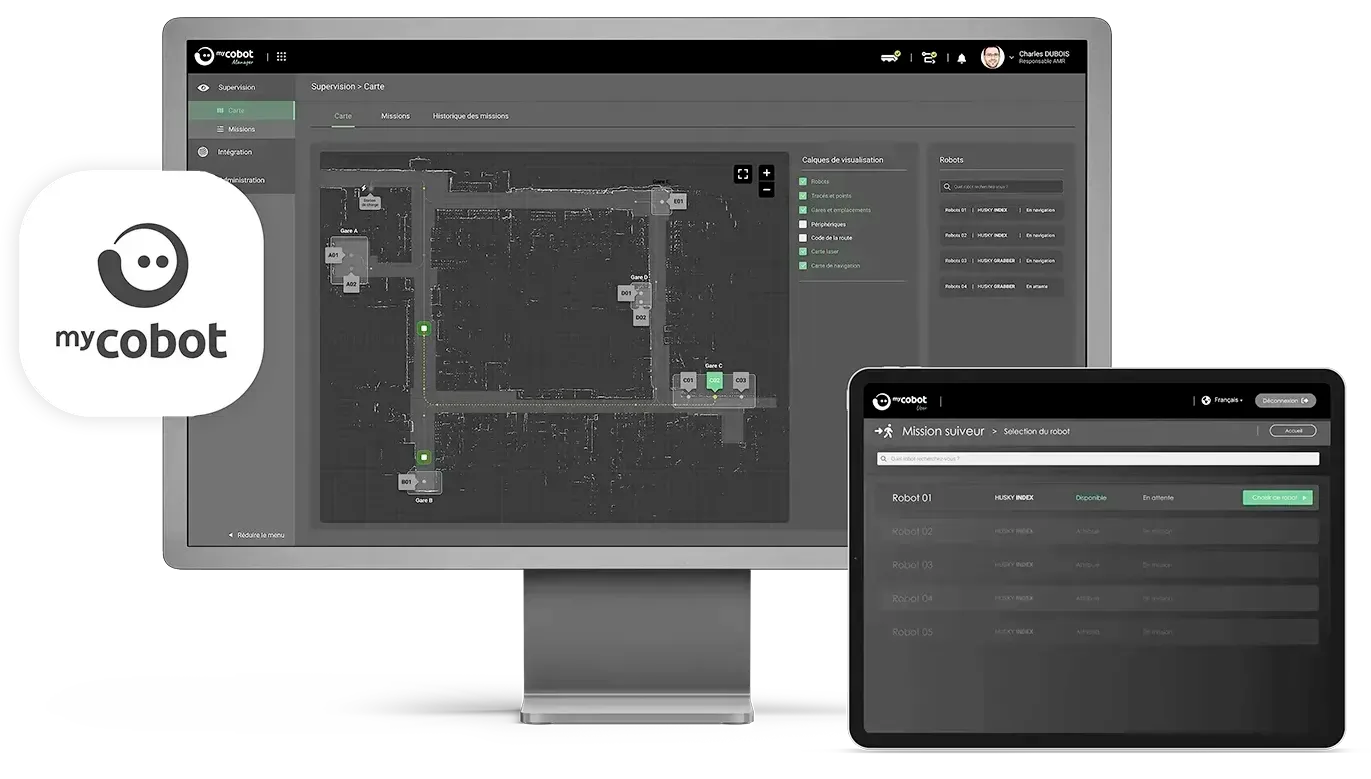
French AMR manufacturer and system integrator offering the HUSKY robot range and MyCobot fleet management software.
EasyMile
France
Toulouse, France autonomous-vehicle software company founded 2014; EZTow and EZDolly systems automate industrial tow tractors and cargo movers at airports.

Filics
Germany
Munich-based robotics startup making ultra-flat omnidirectional AMRs that drive under Euro pallets for space-efficient intralogistics.

Datanomix
United States
No-Operator-Input production monitoring software that turns CNC machine data into real-time visibility and prescriptive coaching for manufacturers.
Datatang 数据堂(北京)科技股份有限公司
China
Beijing AI training-data supplier founded 2010 and quoted on NEEQ; its Nexdata arm sells egocentric, teleoperation and hand-pose datasets for robot learning.
Anyscale
United States
Anyscale is a San Francisco AI infrastructure firm behind Ray, the open-source engine for large-scale model training; Nscale agreed to buy it for $1.65B.
Robotics needs a service framework.
RSF defines a common language for robot service capability, lifecycle operations, certification pathways, and service-provider networks.
Join the RobotToday community on LinkedIn
Daily robotics news, in-depth analysis, conference highlights, and discussions with professionals worldwide.


