

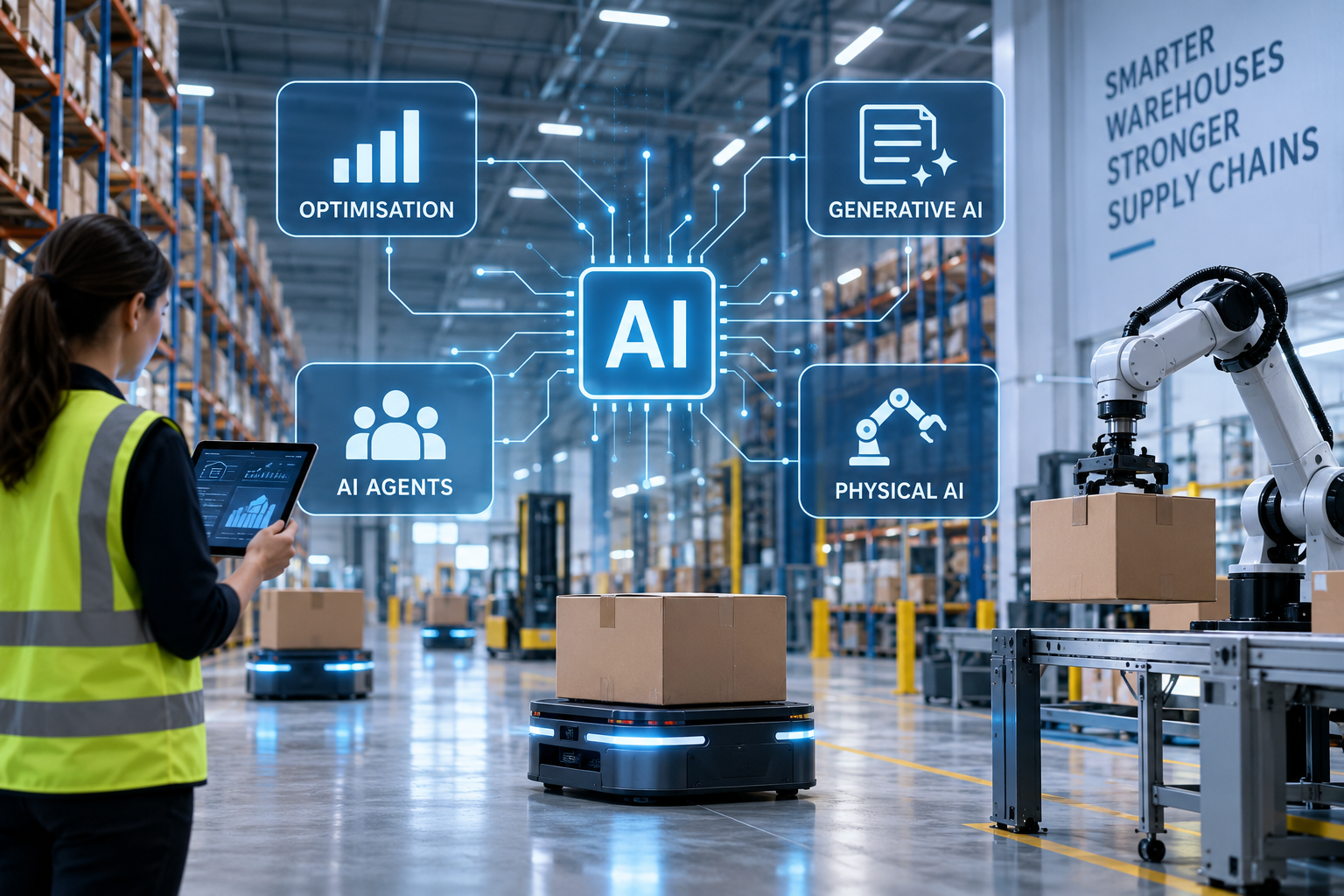
Gartner has identified four significant AI trends that are reshaping warehouse operations as of September 17, 2026. These trends emerge from three driving forces: ongoing labor constraints, evolving capital models for automation, and the growing maturity of AI technologies. The trends range from enhanced optimization techniques to the deployment of physical AI agents capable of executing warehouse tasks.
The first trend focuses on the evolution of traditional AI-based optimization, which now utilizes real-time data and advanced algorithms for applications like demand forecasting and inventory management. The second trend highlights operational-driven generative AI, which transforms unstructured data into actionable insights, enhancing decision-making processes within warehouses.
The third trend introduces suggestive and semiautonomous agents that facilitate greater automation while keeping humans involved in decision-making. Lastly, the fourth trend integrates AI with robotics and sensing technologies, enabling physical AI agents to perform tasks such as picking and packing. Gartner advises supply chain leaders to adopt a pragmatic approach, starting with established applications before exploring more advanced AI solutions.
Editor's Note
The integration of AI in warehouse operations is becoming increasingly critical as companies face labor shortages and seek to enhance efficiency. The trends identified by Gartner reflect a shift towards more sophisticated AI applications that not only optimize existing processes but also introduce new capabilities. As these technologies mature, organizations must balance automation with human oversight to ensure effective implementation.



























Leave a comment